Showing posts with label heroes. Show all posts

Friday, April 27, 2012

Defending Sir Percy

The Scarlet Pimpernel did not take it upon himself to punish the guilty; his care was solely of the helpless and of the innocent. For this aim he risked his life every time that he set foot on French soil, for it he sacrificed his fortune, and even his personal happiness, and to it he devoted his entire existence. [...] The Scarlet Pimpernel was a personality of whom an entire nation might be justly proud.
~El Dorado by Baroness Orczy

Being the unashamed word geek that I am, I find puns hilarious (even those that cause everyone around me to groan and roll their eyes) and take great delight in oxymorons.  If you don't know what an oxymoron is, let me enlighten you: it's a phrase that contradicts itself, like "jumbo shrimp", "chilled hot chocolate," "boring Jane Austen" or "defending Sir Percy".

Because, you know, Sir Percy doesn't need anyone to defend him.  Seriously.  If there's going to be any defending going on here, Percy's the one who does the defending.  Are we clear on this?

All that said, it has come to the attention of one Miss Amy Dashwood that Sir Percy Blakeney, Baronet, has been getting a bad rap lately.  There seem to be two kinds of people in this world: those who appreciate the Scarlet Pimpernel (spoiler alert: Percy is the Scarlet Pimpernel. All my apologies in advance) and those who don't know what they're missing.  The ones who appreciate Percy as he is meant to be appreciated go by many names, but my favorite term is one coined by the staunchest of them all: the Leaguettes.   The Leaguettes (female members of the League of the Scarlet Pimpernel) are faithful fans of the books, the movie, and the man himself (and his lovely wife, but unfortunately she gets forgotten occasionally, especially when we're being jealous of her. Ahem).  Then there is the other camp, the people who think Sir Percy is nice enough and even heroic, but nothing to write home about.  They seem to be laboring under the mistaken delusion that Percy is humorous and even gallant, but unrealistic.  (Technically there's a third group: those who know nothing about The Scarlet Pimpernel [TSP], but we can only hope that they will come out from under their rocks as soon as possible.)


In case you couldn't tell, I'm a Leaguette.  Anne-girl has declared today the Official Percy Day of Hero Week, and so I'm going to take this opportunity to refute the unfounded accusations against poor misunderstood Sir Percy.  (Disclaimer: I'm a huge TSP fan, but I'm not the Fan to End All Fans and therefore am not the ultimate authority on His Awesomeness.  If you want to read an explanation of Percy's greatness by the Greatest Fan herself, go here.)

First of all, I'd like to combat the theory that Percy is a goofball.  Ladies, puh-leeze.  Look, he's a hero in disguise.  And in this case, Mr. Darcy's famous quote about disguise of every kind being his abhorrence doesn't fit, because Percy's disguises have a heroic reason behind them.  He's putting his life on the line for the sake of helpless innocents.  For those of you who don't know, Percy's story takes place during the French Revolution, when Robespierre's Reign of Terror was sending hundreds of people to the guillotine every day.  Sir Percy Blakeney, Baronet, and his band of nineteen brave men pledged themselves to rescue as many French aristocrats as they could, working under the mysterious name of the Scarlet Pimpernel.  Since Percy would be immediately arrested if the French authorities knew who the Scarlet Pimpernel really was, it was necessary for his "public personality" to be as far removed from his real identity as possible, so that no one would ever know that the brainless fop was truly the bravest of heroes.  


Percy is a consummate actor, and his foppish (I do like that word, it's such fun), dandified alter ego succeeded in fooling nearly everyone.  Obviously, it's fooled some of you too.  A dear friend who shall remain anonymous to protect her identity (heehee, shall I refer to her as Madame Pimpernel?) said that she felt his funny way of acting annoys her too much.  "Okay, so, in the movie it's funny... but first time is funny, second time is silly, and third time is a spanking, y'know? He seems to act that way much more than he really needs to."  Now, I'm of the firm opinion that everyone is entitled to her own opinion (just as long as it's the same as mine--- KIDDING, I'm KIDDING) but I have to respectfully disagree with Madame here.  Since I would never be able to say it half so well in my own phraseology, I'll just give you a few words from the man himself.
If we are to succeed, we must maintain our anonymity, mask our identities, even if it means suffering the mockery of others. Being taken for fools, fops, nitwits, even cowards. (from the 1982 movie)

I'm trying my hardest not to just quote Alexandra for this entire post :D but I can't resist it here.  In her recent guest post on Scribblings, she said:
It takes a lot of guts to sacrifice your reputation when with one flick of the eyeglass you could declare that you are The Scarlet Pimpernel and instantly have a nation falling at your feet. A Real Hero doesn’t do his good deeds to get a pat on the back. He often works behind the scenes so as to not get credit. Because credit isn’t the point for him. It’s doing what is right.   
Are you convinced yet? In this day and age, a man's reputation is not what it once was.  Years ago, a man's honor and good name were his most precious possessions.  As Shakespeare famously said, "Who steals my purse steals trash... but he who filches from me my good name robs me of that which not enriches him and makes me poor indeed."  (Be proud of me, Anne-girl-- I wrote that entire quote from memory.)  Sir Percy, like any other respectable gentleman, puts great stock in his honor... yet he's willing to give it up for the sake of something far more important.  If others want to think that he truly is an idiot, he's willing to let that slide because there's something so much greater at stake.

If you still aren't convinced, then listen very closely to what I'm about to say:

Go read El Dorado.

It's unquestionably the best TSP novel ever written, and I firmly believe that I didn't know how much of a hero Sir Percy was until I read that book.  (At the risk of my life at the hands of the other Leaguettes, I should mention here that I heartily disliked Sir Percy at the beginning of the first book.  *ducks broadswords*  Needless to say, I'd changed my tune by the end, once I'd realized that the idiocy was only a mask.)

Brief El Dorado synopsis: Percy and his men are on a mission to rescue the young Dauphin of France, but a series of insanely stupid acts of disobedience on the part of Marguerite's unworthy brother Armand (pardon me while I do a Mr. Knightley-esque ERRRRMMM!) land Percy in prison, captured by his archenemy Citizen Chauvelin.  Chauvelin is seriously one of the worst villains in literature, and I guess you could say that he gets his finest hour in El Dorado. Percy is in his hands, and Chauvelin literally stops at nothing--not even torture--to get Percy to give up the Dauphin.  I could go into a long discourse about the merits of this wonderful book, but I'll save that for an e-mail to Ally and instead just provide you with one of the most beautiful passages in the novel.  Marguerite has just come to  visit Percy in prison (he's being starved to death and deprived of sleep, peoples) and begged him to do what Chauvelin asks, but he refuses.
She understood that long ago he had mapped out the course of his life, and now that that course happened to lead up a Calvary of humiliation and of suffering he was not likely to turn back, even though, on the summit, death already was waiting and beckoning with no uncertain hand; not until he could murmur, in the wake of the great and divine sacrifice itself, the sublime words: "It is accomplished."
Kleenex, please.  Also smelling salts, if you happen to have any handy.  (Why does no one carry smelling salts anymore?  Let's bring back smelling salts!)


Naturally, it all turns out okay in the end (oops, I just spoiled THAT for you) but trust me, this is a book you should not miss.  (Yes, Melody, I'm talking to you.)

One last point before I wrap this up: Percy and Marguerite's relationship at first struck me as being sappy and overdone.  You must remember that I was only twelve when I read TSP, and so excuses must be made.  By the time I saw the movie, however (at sixteen) I was completely won over.  See, the true romance in the Blakeneys' relationship doesn't really come into effect until after the honeymoon.  And for a girl who always wanted to know what came after the happily ever after, that's the best part of the love story.  I firmly believe that Marguerite and Percy were in love when they got married-- but not completely, not yet.  Soon after the wedding, they both began to have (not unfounded) doubts about the other that led to a huge rift in their marriage.  It wasn't until they'd been through various fiery trials that showed each of them just how worthy the other was that they really and truly realized their love for each other.

In my humble opinion, that is.


I should like to also take this time, while I still have your attention (you are paying attention, right? Right?  Hey! Wake up!) to point out some other important elements of Sir Percy's character; namely, his fashion sense (for though clothes are not really his only waking thought, he does know how to dress and who doesn't appreciate that?), his gift for poetry (if a rhyme rhymes, it makes a poem, if you follow me), his inexhaustible wit (sink me, your tailors have betrayed you), his ultimate adherence to fair play (m'dear chap, never would have dreamt of depriving you of your moment of pleasure) and last but not least, his monocle-eyeglass-thingie.

Sink me, if I haven't come to the end.  Are you convinced yet?  If not... *tosses copy of El Dorado* Yours, I believe.

PS: For more about Sir Percy, check out The Day Dream, a blog devoted to this hero and his stories.

Thursday, April 26, 2012

Defending Mr. Darcy

I've decided that instead of writing an ongoing series for my top ten literary/period drama heroes the way I did for my top ten heroines (eep, I need to actually finish that thing), I'm just going to write hero posts when I feel like it.  I've also decided that the posts are probably all going to follow the same general format: that of "defending such-and-such".  Because a lot of my favorite heroes get a bad rap, and I want to set about correcting that.  I am only one, but I am one, and though I cannot convince everyone, I may be able to convince someone.

Since this week happens to be Hero Week, it seems a perfect time to write my post in defense of *drumroll please*...


...Mr. Fitzwilliam Darcy.  Hero of Pride and Prejudice, owner of that gorgeous estate known as Pemberley, brother to Georgiana, nephew to Lady Catherine, enemy to George Wickham (boooo), husband to Elizabeth Bennet, Prince-Charming-alternate to many, yawn-inducer to others.

"Something I've noticed about [Mr. Darcy]," my dear friend Melody said recently, "is that you either 'get it' or you don't."  There are, in my humble opinion, three kinds of people where Mr. Darcy is concerned.  There are the staunch Mr. Darcy fans (of which I am one-- but not of the most rabid sort), there are those who honestly don't care about Jane Austen (they don't know what they're missing) and finally there is the apathetic, eh-Mr.-Darcy's-kinda-boring-but-I-don't-hate-him crowd.  (And if you're a member of the crowd that only likes Pride and Prejudice because of Colin Firth in a wet shirt, please take your business elsewhere.  Not to be rude, but... um... that's not what this is about.)  I congratulate the first group on their excellent taste, pity the second group and am aiming this post right at the third group.  Listen up, Third Group.

In the course of my extensive blog reading (I have to improve my mind, you know), I have come across several major misconceptions concerning one Fitzwilliam Darcy, and with your kind permission (or without it) I will now refute each one to the best of my ability in my best higgledy-piggledy fashion (i.e., with neither rhyme nor reason, and in no real order whatsoever).

First of all, Mr. Darcy is not some idle rich guy who does nothing but sit around in his fancy house and go swimming in his fancy lake and give orders to the servants and go to balls to glare at people.  He's one of the most responsible gentleman to be found in literature.  He's not the type to twiddle his thumbs and let everyone else do what needs to be done, nor is he afraid to do unpleasant business.  He obeys his father's posthumous instructions pertaining to Mr. Wickham, even though he can't stand the sight of Not-Gorgeous George.  And when Wickham the Wicked tries to elope with his little sister Georgiana, he steps in and takes things in hand... and then does the same thing all over again for Elizabeth's wayward sister Lydia, putting his own reputation on the line for the sake of the woman he loves.

Second, Mr. Darcy is not incapable of smiling.  Now, I am as much of a fan of the A&E Pride and Prejudice miniseries as anyone (P&P95Forever!) but though that adaptation was practically perfect in every way, Colin Firth's portrayal of Mr. Darcy was lacking in just one teeny respect: his smile.  In the book, Mr. Darcy smiles.  Repeatedly.  See chapter eleven:
"And your defect is a propensity to hate everybody," [said Elizabeth.]
"And yours," he replied, with a smile, "is wilfully to misunderstand them." 
Colin Firth doesn't smile until the end-- that's the movie's fault. The book has no such defect.

That reminds me of another misconception.  It seems to me that there is a wild idea flying around the blogosphere, something about a fellow by the name of Matthew Macfadyen?  Has anybody heard of this?  He's an extremely talented actor and did a fabulous portrayal of Arthur Clennam in Little Dorrit, but he is not Mr. Darcy.  If you want to see an accurate representation of the character Jane Austen created (not the character created by Focus Features), bearing in mind that no actor can do a perfectly perfect job of interpreting such an iconic character, then by all means watch P&P 1995.  I'm no drooling Colin Firth fan, but I do think he does a fantastic job.


Moving on to the all-important sense of humor.  Sadly, Mr. Darcy does not possess as much of this quality as some other Jane Austen heroes (think Henry Tilney or Mr. Knightley) but he does have a sense of humor.  Really.  You just have to look for it.  He's not, perhaps, as hilarious as Mr. Tilney, but he has a dry wit that jumps off the page at you at the most unexpected moments.  "A lady's imagination is very rapid; it jumps from admiration to love, from love to matrimony in a moment."  (True? True.)  Mr. Darcy also knows how to put Miss Bingley in her place (with all of us cheering him on, naturally.  Boo to Caroline Binglebop.)  "Yes, but that was only when I first knew her, for it is many months since I have considered her as one of the handsomest women of my acquaintance."  And really, nothing can match the amazing-ness of his "WHAT?!" in P&P95.  'Nuff said.


I also really love Darcy's interaction with his sister Georgiana.  Their relationship inspired two principal characters in the novel I'm writing right now, but of course that's not the only reason I like them.  It's evident that Georgiana adores her big brother-- and she has good reason.  He may be cold and unfriendly to people he has never met before (after all, he has not that talent of conversing easily with strangers) but with his sister, he's gentle, caring, affectionate and generous.  


I abhor awkward moments in real life, but I get a fiendish delight out of awkward moments in books or movies (the poor characters in my novel... how they do suffer...).  I'm not always a fan of superfluous movie scenes (generally being the first one to squawk, "THAT WASN'T IN THE BOOK!") but I have to applaud Andrew Davies for his wonderful addition to Elizabeth's Pemberley visit, commonly known as The Famous Lake Scene.  I'm not talking about the swimming sequence here--don't quite understand all the hype about that--but instead I'm referring to Darcy and Elizabeth's unexpected meeting after Darcy's impromptu bath.  (My comments are italicized, in brackets.)


"Mr. Darcy!"
"Miss Bennet! Uh..." [My brother loves to quote those lines]
"I did not expect to see you, sir. We understood all the family were from home, or we should never have presumed..."
"Er, I returned a day early. Excuse me; your parents are in good health?"
"Er, yes. They are very well. I thank you, sir."
"I'm, um, glad to hear it... how long have you been in this part of the country?"

"But two days, sir."
"And where are you staying?"
"At the inn at Lambton."
"Ohyesocourse. [This is spoken as one word, haha.] Um, well, I've just arrived myself. [You said that before...] Um... and your parents are in good health? And... and ALL your sisters?" [You said THAT before too...]


This is the part of the movie where you really begin to like Mr. Darcy, I think. You can't help liking someone you feel sorry for, and I definitely feel sorry for him in that scene.  (I feel sorry for Lizzy, too, but I liked her from the beginning.)


Lest you begin to think that this guy is some angelic being who never does anything wrong, let me enlighten you.  Mr. Darcy is proud.  (See title of novel.)  He's arrogant.  He's prejudiced (see title again) against people he believes are beneath him.  He's also socially awkward and often misunderstood, but let's not make him out to be some poor pitiful version of Bashful.  Mr. Darcy has issues. He's not perfect.  But in all honesty, who wants a perfect hero?  Not this far-from-perfect girl, that's for sure.  


What I really love about Mr. Darcy is his character transformation.  The theme song from Beauty and the Beast comes to mind when I think of his relationship with Elizabeth.  "Bittersweet and strange, finding you can change, learning you were wrong..."  Mr. Darcy may have begun as a selfish being who rudely snubbed young women without dancing partners (she is tolerable, I suppose...) but he changes drastically... and we get to know him a little better.


Now, for all those of you who say that Darcy's first proposal was unromantic-- well, I agree with you.  "In vain I have struggled, it will not do, my feelings will not be repressed, you must allow me to tell you how ardently I admire and love you" sounds quite nice, but not when it's followed up by, "In declaring myself thus, I am fully aware that I will be going expressly against the wishes of my family, my friends, and, I hardly need add, my own better judgment."  Um, yes.  That's the way to any girl's heart: tell her that you know you're making a mistake by proposing to her.  Indubitably.


But for all those of you who say that the second proposal was also unromantic... well, there I have to disagree.  Strongly.  "Such I was, from eight to eight and twenty; and such I might still have been but for you, dearest, loveliest Elizabeth! What do I not owe you! … You showed me how insufficient were all my pretensions to please a woman worthy of being pleased."

Perhaps I've convinced you by now, perhaps I haven't.  In the end, it really doesn't matter to me, because writing this post has served its purpose for me-- reminding me all over again how much I like and admire Mr. Darcy, and that Pride and Prejudice is the best book ever.


Oh, and also?  His name is not Fitzwilliam.  Okay, the book might say his name is Fitzwilliam, but we do not call him that.  Nor do we call him Fitzy or Will.  The name is Darcy, gals.  With or without the Mr., whatever floats your boat, but not Fitzwilliam.  Actually, now that I think about it, I have a better idea-- who's in favor of changing his name to Cordelius? It's so much more romantical, you know.

Monday, April 23, 2012

In Which I Offend Everybody

Ahem.  I do like attention-grabbing titles.

This post might be more aptly named "All About My Two Favorite Heroes And Why They Are Equal In My Book", but I prefer to startle y'all, and besides, I probably WILL offend pretty much everybody in this post.  And do you know what?  I'm okay with that.   Are you ready?  Here comes The Big Statement.

Mr. George Knightley (from Emma by Jane Austen) and Sir Percy Blakeney (from The Scarlet Pimpernel by Baroness Orczy) are my two favorite literary heroes, and I don't prefer one above the other.

Now, I can just see the Janeites rising up in wrath over my saying that some guy from the French Revolution is just as good as any character created by the beloved Miss Austen.  I can also imagine the Leaguettes sharpening their guillotines and preparing to come at me for saying that anyone at all is a match for the Scarlet Pimpernel. I, however, consider myself to be both a Leaguette AND a Janeite, and I consider Sir Percy and Mr. Knightley to be equal.  They share the top spot on my list of favorite heroes, okay?  They're both quite wonderful, and neither is better than the other.

(By the by, however, I do think that overall, Jane Austen trumps Baroness Orczy-- and I'm not going to defend that position right now because I already did in the 70+ comment war over at Miss Georgiana Darcy's blog.)

One thing more.  I suggest you get this piano tuned.  When I sit down to an instrument, I like to have it in tune.  (Whoops, I think I quote Mary Poppins a little too much...)  What I meant to say was that currently Mr. Knightley and Sir Percy are sharing the top spot in my list of heroes because I really don't have one specific number one hero yet.  Because I haven't met him yet, you see.  Someday, when I get married, my husband will zoom right to the top spot.  I'll let you know when that happens. (This idea may or may not have been stolen from a blogging friend. :P)

I hope that made some semblance of sense.  A line from Anne of Avonlea (the book) that seems to be rather unfortunately appropriate is niggling at the back of my mind right now, however.
Gilbert, having tried to please both sides, succeeded, as is usual and eminently right, in pleasing neither. (ch. 4, "Different Opinions")
Moving on.

My dear sister Anne-girl is currently hosting Hero Week over at her lovely blog, and today the challenge is to list your top ten literary heroes.  I'm happy to oblige, but first I had to get that Big Statement out in the open.  Just so y'all know where I'm coming from, you know.


Hero Week
She hasn't made one for Mr. Knightley... sigh.  Actually, she didn't make any JA buttons.  Bah, humbug.
Without further ado, my top ten literary heroes, in some sort of order-- and if you are the kind of person who keeps tabs, you might notice that I have in actual fact listed eleven heroes, since I have two in the number one spot.  But hey, who's counting (except you)?  And please, as you read this list, keep in mind that I had a terrifically hard time assigning spots for heroes 2-9.  Terrifically.  I like them all so very much, it was quite difficult to say "this guy is better than this guy" and "well, I like him, but I like him even more".   

1
Sir Percy Blakeney and Mr. George Knightley (please, no comments about which goes first, 'kay? Blogger won't let me put their pictures side-by-side, and Blakeney comes first alphabetically).

Anthony Andrews as the One and Only Scarlet Pimpernel.  The End.
"Ceased? I shall love her 'til the day I die.  That is the tragedy."
~Sir Percy Blakeney, The Scarlet Pimpernel (1982)

Sir Percy is the epitome of the Self-Sacrificing Hero.  He's brave, he's loyal, he's compassionate, he's funny, he's romantic and he's willing to fight for the right without question or pause, to march into hell for a heavenly cause.  In short (hmm, echoes of Mr. Micawber) he goes into the fire to make impossible dreams possible.  Also, he wears capes.  And eyeglass-thingies.  Sink me.

Jonny Lee Miller as Mr. Knightley in Emma 2009.  (In this case I will acknowledge other versions.)
"I cannot make speeches, Emma.  If I loved you less, I might be able to talk about it more."
~Mr. Knightley, Emma (chapter 49)

Mr. Knightley is the kind of man I want to marry someday.  He's caring, kind, morally strong, responsible, intelligent, witty and just plain nice.  (Uh-oh, Henry Tilney's going to get me for that one...)  He never sacrifices truth on the altar of politeness, but at the same time he's thoughtful of the feelings of others.  He's also the perfect gentleman--a Knightley in Shining Armor.  (And for the record, folks: it's KnightlEy, with an E, not Knightly.  Just think of Anne Shirley, okay?)

(I may be going into greater detail about why these two are my favorites later in the week, so stay tuned.)

2
Mr. Fitzwilliam Darcy

Colin Firth as Mr. Darcy in Pride and Prejudice 1995
"In vain I have struggled; it will not do.  My feelings cannot be repressed.  You must allow me to tell me how ardently I admire and... love you."
~Mr. Darcy, Pride and Prejudice (1995)

Mr. Darcy, in my opinion, is thoroughly misunderstood.  (And yes, I realize that I sound like a snobby Janeite, but the truth of the mattuh is that I am, in general, a bit of a snob where my beloved JA is concerned.  Soary.) Some people think he's boring and has few (or zero) hero qualities.  I strongly disagree.  Some people think he's amazing simply because he's portrayed by Colin Firth.  I strongly disagree.  Look here, Mr. Darcy is great because he is a sympathetic character created by Jane Austen, who has issues at the beginning of the story but overcomes them in a truly admirable way.  And all those of you who say he doesn't smile?  Read the book.  Please, please, please.

3
Gilbert Blythe

Jonathan Crombie as Gilbert in Anne of Green Gables (1985)
"There would never be anybody for me but you."
~Gilbert Blythe, Anne of Green Gables: The Sequel (1987)

Gilbert's so wonderfully down-to-earth, as my dear friend Rachel put it.  He might not be the first one to pop into your mind when you think of a dragon-slayer, but he's an absolutely wonderful guy.  Read this post (in which I went into much more detail) if you don't believe me.

4
Colonel Christopher Brandon

Alan Rickman as Colonel Brandon in Sense and Sensibility 1995
"Give me an occupation, Miss Dashwood, or I shall run mad."
~Colonel Brandon, Sense and Sensibility (1995)

Colonel Brandon was never christened Christopher by Jane Austen---presumably, if he was indeed christened Christopher, his parents did it.  Obviously.  Um, anyways, what I mean is that Jane Austen never mentions the Colonel's first name in S&S.  That's a liberty taken by the filmmakers, and I'm okay with that.  The name seems to fit him.  Colonel Brandon is one of my mom's favorite Austen heroes, and he's well-deserving of the title.  He might not be the charismatic, sweep-you-off-your-feet type, but whoever said that was what made a hero?  The Colonel is wise, caring, romantic (yes he is) and full of true character and integrity.

5
John Chivery
Russell Tovey as John Chivery in Little Dorrit (2008)
"All that time I was breaking my heart over her, she was breaking hers over you."
~John Chivery, Little Dorrit (2008)

John Chivery's story makes me cry every time I see the movie (much more so than in the book) and since I take a morbid delight in crying over stories, I really like John.  That is not, of course, the only reason.  There are others: for instance, John SPOILER ALERT completely sacrifices his own feelings so that the woman he loves can be happy with the man she loves.  Who is not him.  That was grammatically incorrect, but I'm too tired to fix it.  END OF SPOILER.  John may be a bit melodramatic at times, but in the end he displays tremendous selflessness.  Also, whenever he says, "It's you, Amy," in an adorable British accent, I melt a little bit because I am Very Silly Indeed.  (Because, you know, it's my name... anyways.  Moving on.)

6
Edward Ferrars
Hugh Grant as Edward Ferrars in S&S 1995

"My heart is... and always will be... yours."
~Edward Ferrars, Sense and Sensibility (1995)

Edward is one of the most honorable literary men I have ever read about, and though I'm afraid he sometimes gets a bad rap, I am staunchly Team Edward.  (Edward FERRARS, people.  Ferrars.)  I elaborated on this topic here.
7
Arthur Clennam
Matthew Macfadyen as Arthur Clennam in Little Dorrit (2008)
"What a blind idiot you must have thought me."
~Arthur Clennam, Little Dorrit (2008)

Arthur, my sister and I have agreed, is the ultimate Mr. Nice Guy of period drama.  He would, I believe, do anything for anybody, no matter how little they deserved it.  He always thinks of others before himself, and though he might not always be the most perceptive person ("I don't know why I'm telling you all this, Amy!") he makes up for it with his heart of gold.  Besides all the wonderful things he does for the ungrateful Dorrit family, just think how he stood up as best man in Pet's wedding, even though Pet, the girl he thought he loved, was marrying a guy he detested.  Well, "a guy he detested" is a relative term-- I'm not sure Arthur could really truly detest anyone.
8
Jean Valjean

Colm Wilkinson, who IS Jean Valjean
"If I die... let ME die... let him live... bring him home."
~Jean Valjean, Les Miserables (the musical) 

Jean Valjean's story is one of the most powerful I've ever read, and it is The Best Ever to be portrayed on stage.  "I will brook no argument."  Forgiveness and self-sacrifice are the themes of Valjean's life, and he displays them over and over and over again.  He reveals his true identity when another man is falsely accused in his place... he bears no grudge against the policeman who chased him down and hated him for years... he puts his own life in danger to protect the boy who loves his daughter... he eventually allows his daughter to leave him and be married, even though it breaks his heart.  (Tissues, anyone?)

9
Henry Tilney


"And this is a very nice day, and a very nice walk, and you are two very nice young ladies.  Oh! it is a very nice word indeed.  It does for every thing."
~Henry Tilney, Northanger Abbey (ch. 14)

Henry is hilariously witty-- definitely the funniest hero Miss Austen ever created, and therefore has to rank on my top ten list.  Naturally.  He also may or may not have been part of the inspiration for the hero in the novel I'm currently scribbling.  Henry is humorous, definitely, but he is also responsible, moral, fair and an excellent judge of muslin.  And, following Mr. Darcy's advice, he improves his mind with extensive reading--his hair standing on end the whole time, mind you.

10
Atticus Finch
Gregory Peck as Atticus Finch in To Kill a Mockingbird (1962)
"I wanted you to see what real courage is, instead of getting the idea that courage is a man with a gun in his hand. It's when you know you're licked before you begin, but you begin anyway and see it through no matter what."
~Atticus Finch, To Kill a Mockingbird

I discovered Harper Lee's classic novel To Kill a Mockingbird last summer, and though I've only read it once so far, I intend to read over again many, many times.  Atticus Finch exemplifies moral courage to me, and his integrity, sense of justice and willingness to fight for the right left me awed at the end of the book.  I realize that this character is a bit different from the other Classic Literature Club members ranking on my list, but I simply couldn't leave him out of the top ten.

And of course, I can't close this post without giving honorable mention to such literary greats as Roger Hamley, Johnny Tremain, Enjolras Whodoesn'thavealastname, Tommy Beresford, John Jarndyce, Nicholas Nickleby, Reginald Jeeves... shall I go on?  No, I'll spare you.   But now it's your turn-- head over to my sister's blog and leave her a link with your list of favorite heroes!

Note:  Please give due appreciation to the pictures in this post-- you have no idea how long it took me to get them all properly dragged into their proper places.  Blogger, I have decided, just plain hates me.

Thursday, March 15, 2012

Anne of Green Gables Week: Defending Gilbert Blythe


Several months ago, during Sense and Sensibility week, I wrote a post defending Edward Ferrars.  Poor Edward has, in my experience, frequently suffered under the libelous label of "boring" in Austenite circles.  So I wrote a post defending him and pointing out all his good points and what I like about him, and I was Most Pleasantly Surprised to find that many of you are Ferrars Fans too.

Well, now I am going to write a post defending Gilbert Blythe.  My reasons are threefold.  Reason 1) Gilbert might not be labeled "boring" as poor Edward has been, but he is, sadly, often overlooked when we talk about our favorite literary heroes.  Jane Austen's heroes are overshadowing him too much.  (No offense to Austen or anything, and all that.)  Reason 2) It's Anne of Green Gables Week, and since I already posted about Anne, it makes perfect sense to write about Gilbert too.  Reason 3) Because "my reasons are threefold" sounds better than "my reasons are twofold".  I don't actually have a third reason.

I like to start my character posts by listing all the reasons why I like and dislike the character at hand, so that's what I'll do now.  The reasons I dislike Gilbert are as follows:

.....

Hang on.  I'm sure I can think of something.

*twenty-eight minutes later* Well, to be perfectly frank (and yes, Melody, I'm aware that my name is not Frank), Gilbert is rather rude when we first meet him.  *ducks rotten vegetables*  No, really, he is.  Y'all know what happens in the famous carrot-and-slate scene, so I won't rehash it for you.  But I will say that pulling a girl's hair and insulting her in a shout-whisper is NOT the way to her heart.  "I only said that because... well, because I wanted to meet you so much."  And then he was rude again at the Christmas ball.  Which is excusable, because after all he had apologized--multiple times--and Anne continued to be Hard-Hearted and Unforgiving.

Now that we've covered Gilbert's character flaws, let's get down to the good stuff--why he is just as much of a hero as any man created by Jane Austen.  Or Dickens.  Or Elizabeth Gaskell.  Or... dare I say it?... Baroness Orczy.

*hastily moves past what might be a dangerous subject*


Marilla Cuthbert, who is well-beloved by yours truly for frequently saying exactly the right thing, does an amazing job of summing up Gilbert's character to poor blind-as-a-bat Anne.  "Anne, you have tricked something out of that imagination of yours that you call romance. Have you forgotten how [Gilbert] gave up the Avonlea school for you so that you could stay here with me? He picked you up every day in his carriage so that you could study your courses together. Don't toss it away for some ridiculous ideal that doesn't exist."

Gilbert isn't particularly dashing.  He isn't thrillingly romantic-- in fact, he makes fun of Anne's sappy romanticism.  He doesn't buckle swashes.    He doesn't write swoon-inducing poetry or sit around mooning all the time.  (Whether he lets a girl get a word in edgewise is another matter entirely.)  He's a farmer who wears ugly overalls and teaches an unruly classroom of eight grades so that he can save to go to medical school.  He is also caring, compassionate, gentle, pleasant, funny, patient and super-duper loyal.

So why, then, do we so often gloss over him or forget him in the wake of such literary greats as Mr. Darcy, Sir Percy Blakeney or Mr. Knightley?  "Poor Gilbert," a very dear friend of mine once lamented. "He always seems to be replaced by some Jane Austen hero or other in our hearts as we get older."  Well, it's quite true-- but why?  Maybe it's because Gil himself is so unpretentious and down-to-earth.  "Wilt thou give up thy garter, oh fairest of the fair? Anne, nobody talks that way!"  If Anne--or anyone--asked him what he would think of being referred to as a hero, he would probably find it hilarious.


By the way, I happen to find Gilbert hilarious.  I appreciate a hero with a good sense of humor (something Mr. Darcy sadly lacks until near the end of the book). "Well, well, well. The elegant and illustrious Miss Shirley. Relaxed while seeking out ideas for her next Rollings Reliable writing assignment, I presume."  And of course no one can forget the classic Pitching and Mooning scene.  "And just look at that sap Percival who sits around mooning all the time... in real life, she'd have pitched him."  (This quote isn't complete without the little smirk that accompanies it.)

Silliness aside, the thing I admire most about Gilbert is his unfailing loyalty. And his patience.  Which are pretty much the same thing because they go hand-in-hand.  This sounds sappy and sentimental (though not quite as bad as wilt-thou-give-up-thy-garter) but I absolutely love how Gilbert loved Anne for so long before she realized it.  (And before she deserved it.)  "This is true  love.  Do you think this happens every day?"

She ignored him (even when he rescued her from death by drowning), was rude to him, finally forgave him but then insisted on being just friends and finally turned down his proposal... and yet he didn't let any of that get in the way.  He still stuck by her and stood up for her and never let her down.  "Well, I won't change... that's the least I can promise you."


Speaking of turning down proposals... look, peoples, I love Anne and all that, but I'm seriously quite willing to push her off Moody Spurgeon's kitchen roof when she tells Gil she won't marry him in The Sequel.  That scene is heartrending.  Now, granted, she tries to do it as gently as possible (and in all honesty, you wouldn't have wanted her to say yes to someone she didn't love--er, didn't realize she loved--would you?) but that doesn't change the fact that she broke his heart.  "Anne, I've loved you as long as I can remember. I need you. Please say yes..."

And out come the Kleenex. :)

Anne.  Seriously.  Get a grip, girl.


I should take this opportunity, while we're on the subject, to point out a very serious and grave error on the part of the Anne filmmakers.  In The Sequel, they changed the story around so that Gilbert proposed to Christine Stuart after Anne turned him down.  (insert facepalm) No, Sullivan Films.  No, no, no.  That never happened in the books, not even a hint of it.  Yes, Gilbert took Christine to a party or two (maybe to make Anne jealous, maybe not) but there was never any kind of romantic interest between them-- at least not on his part.  (Christine's reappearance in Anne of Ingleside leads me to believe there might have been a little on her side, but that's another story for another time.) "There would never be anyone for me but you."

Gilbert never proposed to Christine, anyway.  He waited for Anne... and waited... and waited...
And then, finally, he did the only thing he could think of: contracted typhoid and almost died.  To get her attention, you know. ;)

It worked.  Quite nicely, in fact. Anne came to her senses and realized that her "romantic ideal" had been pulling her out of mud puddles, crashing his bicycle into the creek and rescuing her from watery graves all along.  Right under her very nose.

"It'll be three years before I finish medical school," he tells her on the bridge at the end.  "Even then there won't be any diamond sunbursts or marble halls."
"I don't want diamond sunbursts, or marble halls," says Anne (while I grope for another tissue). "I just want... you."


What is a hero, anyway? A hero is a man who is compassionate, caring and kind.  A hero is unselfish and thinks of others before himself (sometimes going as far as giving up his life).  A hero is real and down-to-earth without being boring.  A hero is wonderful, and that's what Gilbert is.

And it sure took the illustrious Miss Shirley long enough to realize it.

Wednesday, December 14, 2011

Hero? or villain?


"Warthog!"

That's the word my sister Anne spits out every time John Willoughby, Esquire, shows his face on the screen during Sense and Sensibility.  Maybe it's not the most mature way of describing his character, but it does seem to fit.  Charisma, gallantry and good looks are all very well, but when a person is so despicable, those little insignificant details are trodden underfoot.

My sister and I have very strong opinions about Jane Austen's villains.  No, actually we have just one opinion.  We hate them.  Henry Crawford, John Willoughby, George Wickham, William Elliot, Philip Elton and John Thorpe are all universally disliked around here.

Unlike Queen Victoria, we are much amused by the fact that Jane Austen apparently did not like gentlemen whose names began with W (Captain Wentworth excepted).  Willoughby, Wickham, William Elliot... we sometimes consider starting a fan web site called www.janeaustenvillains.com.

You are supposed to be laughing now.

Oh, very well, have it your own way.  The imaginary web site is not the point of my post.  Rather, I wish to talk about John Willoughby and Tom Lefroy.  Specifically, I wish to tell you that I believe John Willoughby's character to be modeled after Tom Lefroy.

Now before you rise up in wrath and throw your Becoming Jane DVDs at me, let me say that I have duly read Miss Laurie's post on Tom Lefroy with great interest, and I have nothing against Tom Lefroy.  I do not mean to slight his character in this post, nor to slight Miss Austen's (or imply that she was bitter).  I am simply Making a Well-Informed Observation.

Jane Austen, as I mentioned in a previous post, was an excellent--nay, amazing--writer who drew from her own experiences, from real life, to write her novels.  Is it, therefore, "incontheivable" that she would base one of her villains on someone in real life?  Think for a moment, if you will, on the parallels between the two.

From what little we know of Jane's brief acquaintance with Tom Lefroy, we see that he was in the Steventon area visiting a wealthy Aunt.  Point number one.  I call to your attention Willoughby's rich relation Mrs. Smith, owner of Allenham.

Second point: we see Tom Lefroy as a mysterious, rather dashing personage, with whom Jane might just have fallen in love.  If she did indeed develop romantic feelings for him, it happened over a very short period of time.  Do recall Marianne's almost instantaneous affection for Willoughby when he rescued her after the ankle incident.

Third point: scandalous behavior on the part of both couples.  Marianne and Willoughby raced around on horseback, coolly toured Allenham despite the lady of the house's absence and danced with no one but each other at gatherings.  Jane and Tom danced and sat exclusively together, perhaps shocking their friends with their literary conversations about the "horrid" novel Tom Jones.

Fourth point: both young men had to suddenly go away, Willoughby to London and Tom... well, I'm not sure where Tom went, but presumably back to college.  Marianne was left heartbroken, while the more self-controlled Jane wrote lightly and brightly to her sister Cassandra of Tom's departure.  

Marianne, we remember, was quite sure that Willoughby would propose to her before he went away.  Jane wrote to Cassandra that she didn't care a sixpence for Tom Lefroy, but that if he proposed to her she would accept, if he were to get rid of his ugly white morning coat.  (Jeeves, anyone?)

Then came the time of wondering: would she ever hear from him again?  Marianne wrote effusive "notes" as she visited Mrs Jennings in London; Jane, it appears, laughed the whole thing off and started to write Pride and Prejudice.  We know that Cassandra Austen burnt many of Jane's more personal letters after Jane's death--could there have been something in those letters to divulge her real feelings? Speculation, speculation.

But then the sad part.  Willoughby, the rogue, married Miss Grey for her 20,000 pounds, while Tom was wed to a woman named Mary Paul (whose family situation I know nothing of).  I don't know if Tom married for money, but from what I've read of him it seems unlikely.  Willoughby, of course... well, we know his back story.

Here lies the biggest difference, however.  Marianne mourned, wept and refused even olives in her distress.  Jane, I think, let the whole matter drop, reconciled herself to spinsterhood and went on to write the best British literature of the nineteenth century.  Marianne ended up happy with Colonel Brandon... maybe because Jane wanted a fairy-tale ending, and knew that the only way she would get it was vicariously.

Did Jane Austen really think of Tom Lefroy as a villain?  I doubt it.  Does his behavior to her parallel that of Willoughby to Marianne (to a certain extent?) I think so.  Was Willoughby based on Tom?  Who knows?

But hey, if there were no speculation, we should be restricted only to "clouding the issue with facts."

Monday, December 12, 2011

Happy Birthday, Jane Austen!

Yet Another Period Drama Blog


And... Jane Austen's weeklong birthday party begins!

Let's begin with a little confetti, some virtual cake and ice cream, and a tribute to my most favoritest author ever. (Okay, so she's not my only most favoritest author, but she's one of them.)

Jane Austen's stories have, as the cheesy saying goes, stood the test of time.  Two hundred years have passed since her first publication (Sense and Sensibility was first printed in autumn of 1811), and she is now one of the most popular authors in the history of western civilization.

But why? What is it about this quiet woman's writing that has touched so many people?  Why is she still so wildly popular?  Why have her books been standard fare in English literature classrooms, the subject of innumerable films, the tie that binds us Janeites together?  (Stupid spell-check wouldn't accept "Janeites".  I remedied this by adding it to the dictionary immediately.)

I'm no scholar.  I'm not an expert.  I'm not Dr. Dashwood, Professor of Jane Austen's Literature and Highly Knowledgeable About Everything.  I'm just a high school student who respects, admires and aspires to be like  the Austen writer.  So take what I say with a grain of salt, and if you disagree with me, that's what my comment box is for.

Jane Austen's books were written in a contemporary setting.  Her stories take place at the end of the Georgian and beginning of the Regency eras.  Etiquette, clothing, food, transportation and language have all changed drastically since Miss Austen's era, but her works are still relevant to us in the 21st century... and this is why.  I believe that Jane Austen has remained relevant to us today because she wrote about people.

Politics change.  Lifestyles change.  Language changes.  Fashions change.  But people do not change.  Human nature has remained exactly the same as it was in Jane Austen's time (in fact, it's remained the same since Adam and Eve!) and the way people interact with each other will never change.

The first Austen book I ever read was Pride and Prejudice, when I was fourteen.  Summer 2009 was a busy and somewhat stressful season for me, yet I always felt relaxed when I curled up in a chair with P&P. I was captivated from the first page, laughing at Mr. Bennet's sparring with his wife and liking Elizabeth immediately.   I'm a very fast reader, but I stretched out P&P as long as I could. When I finally finished it, I didn't want it to end.  Something in me had connected with the characters in a way that doesn't happen often.  There are few books that touch me the way Pride and Prejudice did (among them are Anne of Green Gables, Johnny Tremain, Little Dorrit, if you're curious).  When I finished the book, my mom and I watched the 1995 A&E miniseries together, and I fell in love with the story all over again.

That was the beginning.  Over my ninth grade year, I devoured Sense and Sensibility and Emma, then read Mansfield Park and Persuasion in summer 2010.  On the ride home from our family vacation in May of this year, I laughed myself silly over Northanger Abbey. I was hooked.  The language was different from what I was accustomed to speaking, the manners and customs a bit unfamiliar.  But the people, the characters--they leapt off the page.

Elizabeth Bennet inspired and amused me.  Elinor Dashwood was a kindred spirit.  Marianne gave me opportunity to laugh and to cry.  Catherine Morland made me giggle and Anne Elliot made me think.  Fanny Price set an example for me, while Emma Woodhouse made me groan and shake my head--but I loved her anyway.  I choked with laughter over Mr. Collins and Mrs. Jennings, shook my fist at Mrs. Norris, huffed in exasperation at Sir Walter Elliot, shot imaginary arrows at Willoughby and Henry Crawford, adored Colonel Brandon and fell in love with Mr. Darcy and Mr. Knightley.  (See Abby's post for more on the subject.)

Jane Austen's characters aren't just words on a page, you see.  They are people--they are friends.

I'm forever grateful to the modest, unpretentious lady who didn't see fit to acknowledge herself as author in the first editions of her works.  She gave me a collection of volumes that are displayed with pride on my bookshelf.  She opened my eyes (albeit indirectly) to the world of period drama.  She inspired me to write.

She gave me the beginnings of yet another period drama blog... and with it, a multitude of new friends.  Without Jane Austen, I never would have cyber-met any of you.

Thank you, Jane Austen.  Happy birthday.

Saturday, November 12, 2011

Defending Edward Ferrars

Miss Georgiana Darcy


"Edward Ferrars was not recommended to their good opinion by any peculiar graces of person or address. He was not handsome, and his manners required intimacy to make them pleasing. He was too diffident to do justice to himself; but when his natural shyness was overcome, his behavior gave every indication of an open, affectionate heart."
~Sense and Sensibility, chapter 3

Though he's not at the top of my Favorite Jane Austen Heroes list, I believe that Edward Ferrars is a greatly under-appreciated character. I think it's a real shame that many people find him boring and bland. Nothing could be farther from the truth. Edward is a wonderful person with character, integrity, kindness, a sense of humor, blah blah blah, and, yes, a great deal of awkwardness. But he's not inanimate, nor is he "un-heroic". I realize that many people do believe that he's boring, and I do hope I won't offend anyone by contradicting them in this post. I respect all your opinions, but I'm going to freely state my own. Besides, if no one ever wrote anything controversial, we'd never have anything interesting to talk about, would we? Blog posts would be dull and predictable, and the comments would consist merely of "How true!" and "Yes, I agree entirely!" and we blogging ladies would kill each other with boredom.


Ahem. Back to my point.

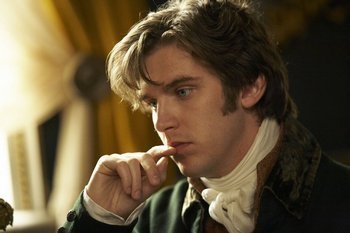
Jane Austen describes Edward better than I ever could--see the quote at the top of this post. Edward Ferrars is not the kind of guy who leaps off the page. He's quiet. He's not strikingly handsome. (No, I am NOT going to digress into a litany about the respective appearances of Hugh Grant and Dan Stevens. Sorreeee.)

But Edward, though his manners "require intimacy to make them pleasing" is a kind and tenderhearted person. He thinks primarily of making other people happy, and isn't focused on impressing those around him. The more I think about it, the more I realize that Edward honestly doesn't care what people think of him. I like this little thing he says in the '95 movie: "All I want, all I've ever wanted, is the quiet of a private life, but my mother wants me distinguished." Edward doesn't care about pomp and splendor. He's not a knight on a white horse. (I didn't say anything about a black horse, though...)

Edward's rapport with Margaret Dashwood exemplifies this. Okay, so he and Margaret didn't have much interaction in the book, but the movies really do a good job of showing their relationship. Think about it--most young men from Respectable Families in those days didn't go around playing pirates with little girls. It simply wasn't Proper. Edward, however, is more interested in making Margaret happy than in being Proper and Stuffy and sitting on an Uncomfortable Chair in a dark and gloomy Parlor.

Plus, Edward is FUNNY. Yes, he is. Maybe he's not laugh-out-loud hilarious like Henry Tilney, but he does have a sense of humor. When he and Margaret are discussing what the Dashwoods would do if they had "a fortune a-piece", he suggests that Marianne would buy up every copy of her favorite books "to prevent their falling into unworthy hands; and she would have every book that tells her how to admire an old twisted tree. Should not you, Marianne? Forgive me, if I am very saucy." (ch. 17)

(Love this scene. Just sayin'.)

But when I say Edward isn't interested in being Proper, I'm referring to endless rules and regulations about Polite Society. I'm not talking about good manners, character and integrity. Because Edward has all those, without a doubt. Now, when he was younger he might not have had much sense. I don't dispute that. I mean, seriously, who falls in love with a moron like Lucy Steele? There are a thousand reasons: he was young, she was pretty, her uncle encouraged the match, he didn't want to marry some other goofy girl his mother was trying to force him on, etc. etc. etc. (Et cetera, according to a friend of mine, stands for End of Thinking Capacity. This struck me as being highly amusing, and though it has nothing to do with this post, I thought I'd stick it in there.)

Anyway, though we don't know why Edward proposed to Lucy Steele in the first place, we do know that he is much too honorable to break off the engagement. He made a promise, he's going to stick to it. I admire that. Too many romance stories involve someone promising to marry someone else, then meeting their soulmate and snapping off the engagement without another thought. Look, that may sound romantic, but it's not. Think about it. How do you know that the said person isn't going to break off THIS engagement?

Hmmm, I seem to be going off on a lot of irrelevant tangerines tangents today. My apologies.

Let me also add something here on that topic. I've heard it said that Edward had no business "leading Elinor on" when he was engaged to Lucy, and that he should have told Elinor exactly what was up with him and Miss Stingy Steele. I don't agree. Edward promised Lucy that their engagement would be kept secret, and he kept his word. Lucy didn't keep hers, but what else would you expect from a girl like her? (Oh, and Edward did not lead Elinor on, for the record. It wasn't his fault that Marianne and Mrs. Dashwood read too much into his friendship with her.)

Well, Edward might be much too honorable to break off his engagement with Lucy, but we have to be glad that Lucy wasn't that honorable. "I'll marry Edward! He'll have lots of money when his mother dies. Oops! His mother found out that he's going to marry me. I need to get some duct tape for my sister Nancy's mouth... Where was I? Oh, yes, Edward isn't rich anymore. Ooh, but his younger brother IS... Hi Robert! Want to dance?"

So we can all give Lucy a round of applause. (Why? Because now the E's can get together, that's why!) Whether or not you are armed with rotten tomatoes as you "applaud" Lucy is your business and I will not be held liable.

And so Mr. F and Elinor were married. And Edward's mother's sister came to live with them soon after, and was known as Mr. F's Aunt. Okay, not really, but I had to stick that in.

And they lived happily ever after.