Showing posts with label NaNoWriMo. Show all posts
Thursday, November 1, 2012
So long! Farewell!
November is upon us, and with it comes NaNoWriMo for some and Half NaNo for others. What, you've never heard of Half NaNo? That's because I made it up. Head on over to my writing blog, The Quest for Stories, to read about it!
Due to Half NaNo and general busyness, Yet Another Period Drama Blog is going to be severely neglected during the month of November. There may be a few posts here and there, but I can't promise anything. However, I shall still be here to moderate comments and read your posts, and if you care to pop over to The Quest for Stories, I'll likely be there from time to time.
I also guest posted over at Anne-girl's blog during her Writers' Conference last week (see here and here) and at Melody's blog earlier this week for no reason in particular. Just for fun. I'll be stopping at Elizabeth Rose's blog (Literary Lane) later this month, too. See you there-- and get writing!
Saturday, March 24, 2012
Beautiful People: Rodney and Elizabeth
It's been quite a while since I posted anything about my NaNoWriMo story (possibly owing to the fact that NaNoWriMO was four months ago), but I've been wanting to do a Beautiful People thingy with one of my characters for quite some time. The only problem was, I couldn't decide which character to do, but this month's questionnaire solved everything. March's Beautiful People is on relationships, and you can fill it out for any two of your characters that have a special kind of relationship (romantic, familial, friendship, whatever).
Elizabeth Sophia Markette and Rodney Edgerton Burke are the male and female protagonists of Only a Novel, and naturally they end up together at the end. (There, I just spoiled it for you. Abject apologies. :P) I could go on and on and on, but I'll just answer the questionnaire for now and then if you're confused you can leave a comment and I'll do my best to clear things up.
I do, however, wish to take a teeny moment and squeal with delight over the fact that I have found Elizabeth! There are few moments more glorious than that one where you know you are staring straight into the face of your character. Now at last I can actually look at her and picture her saying the things I want her to say, etc. etc. etc.
Here she is, folks-- Miss Elizabeth Markette, in the
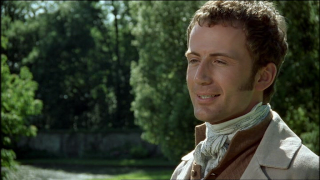
And to make things fair and even, here's Rodney, too. Who you may already know as Roger Hamley from Wives and Daughters. Rodney's actually a cross between Roger Hamley and Henry Tilney from Northanger Abbey, but this picture best fits my mental image of him.
Without further ado, the Questions.
1. Do they believe in anything that most people think is impossible?
Hmm... well, Rodney is an incurable optimist. Elizabeth is more cautious and not too quick to believe in anything just at first (except for storybook endings, haha). But as for believing in the impossible... not particularly.
2. Are they strong, or the "damsel/knight in distress" sort?
Ha. HAHAHAHAHA. Sorry. I'm just getting too much amusement out of picturing Elizabeth as a damsel in distress and Rodney being Knightley and rescuing her... I think even Elizabeth would find that far-fetched. And as for the idea of Rodney being a knight in distress... HA.
They found Mercy in tears—Mercy who supposedly never cried. Something cold and hard and terrifying settled in Elizabeth’s stomach.
“Mercy… what’s wrong?”
She didn’t appear ill or injured. It wasn’t Rodney, of course—it couldn’t be, because nothing bad ever happened to Rodney. Ever.
3. Do they have a special place? (e.g. a corner in his/her bedroom, under a tree...)
The place where they spend the most time together would definitely be the Crimps' stable. Rodney works there, taking care of the horses and cleaning the stalls and whatnot, and Elizabeth brings the children she teaches (Jonathan and Isabelle Crimp) out to see the horses every so often. Increasingly more often as the story goes on. Heehee.
4. What occupation do they have, or plan on having?
Rodney is a carriage driver, gardener, groom, parrot catcher and man-of-all-work for Mr. and Mrs. Crimp. (I think Mr. Crimp has a first name, but I can't remember what it is. Dear, dear.) Elizabeth is the governess for Mr. and Mrs. Crimp's two older children. (The Crimps also have a two-year-old named Maria but she's of little importance.)
5. Describe their current place of residence.
Rodney lives with his little sister in a tiny apartment above the stable.
The apartment above the stables bordered on sparse. One room served as a sort of dining kitchen, and two doors opened off it into what Elizabeth presumed were bedrooms. “I cook our meals in here,” Mercy explained, “on Evangeline, and—”
“Evangeline?” It was rude to interrupt, but curiosity often overpowered manners.
“Oh, that is what we call our lumpy old stove. She is anything but sweet and dainty as the name might suggest, so one day Rodney was in a perverse mood and dubbed her Evangeline after Longfellow’s heroine, and the name stuck.”
(I'm not especially fond of this part because I think it sounds forced, but I haven't had time to revise it because I promised myself I would kill my inner editor and JUST WRITE the rest of the story before I started revising. :P But I included that excerpt anyway because it's the only thing I have describing where Rodney lives. I'm not big on description, in case you couldn't tell.)
Elizabeth has a small, whitewashed bedroom in the servants' quarters of the Crimp home. The room is uncarpeted and there are no pictures on the walls, but that's her own fault because she hasn't bothered to put any up.
Elizabeth put down her pen and stared moodily at the wall. Heroines in novels always gazed wistfully out of the window, but the tiny table in her tiny bedroom faced the wall, not the window.
6. Explain their last crisis. How had they changed when they came out of it?
Heehee. Well... for starters I suppose I should say that Only a Novel isn't a crisis-y kind of story. It's about normal people, in a normal setting, who do normal, everyday things. Because that's the kind of story I like to read, y'all, and so that's the kind of story I write.
But anyway, even though there are no death-defying rescues or heart-stopping disasters in my novel, there are quite a few crises in the form of Uncomfortable Moments. Because, y'know, Uncomfortable Moments can seem like crises at the time. And believe me, Elizabeth and Rodney (well, Elizabeth anyway) have (has) quite a few of those. (This may or may not be because I get an evil delight out of putting my poor characters into cringe-inducing situations. Muwahahahaha.)
To actually answer the question that's been posed, the last crisis Elizabeth and Rodney went through would probably be the ultra-awkward afternoon when Elizabeth ran smack into her friend Lavinia at Kensington Gardens. Ran smack into her quite literally, I might add. Elizabeth had taken Jonathan and Isabelle to the Gardens as per Mrs. Crimp's orders, and Rodney came along. To drive the carriage, you know. Anyway, the kids brought a kite with them, and... here. It's easier to just throw in an excerpt than to recap it all. :)
“I want to fly the kite,” Isabelle piped up.
“It’s mine,” said Jonathan, “and I will get the first turn.” He glanced back at Elizabeth. “Just let me run ahead a tiny bit, Miss Markette.”
“As long as you stay within my sight,” Elizabeth conceded.
“No, you come with us,” Jonathan urged. “Cassandra and Maria [the baby and her nursemaid, reverse respectively] can poke along here as slowly as they want. You come with us, and you can toss up for me.”
“Toss up?” Elizabeth had never tossed up a kite before. Grandfather had always done it for her when they went out together, and after Grandfather’s death she had been too old to fly kites.
“I’ll do it,” Rodney offered, appearing rather disconcertingly at Elizabeth’s elbow. “No one is going to steal the brougham, and I’d be far more interested in helping with a kite than watching Virgil and Opus bite grass and chew it at each other all morning.”
Elizabeth had almost forgotten about Rodney. It would indeed be rather dull for him to stay with the horses all day while she and the children roamed the gardens. She was not entirely sure about the propriety of flying kites with a stable hand in public, but a cursory look around her convinced her that no one would be witnessing the unladylike deed.
So they fly the kite and have a great deal of fun, but then Jonathan and Isabelle start fighting, which turns into a Heart-Stopping Chase Scene (okay, so maybe it isn't heart-stopping, but it IS a chase) which turns into Elizabeth's tearing after them to tell them to stop running (haha). And she ends up practically knocking down her friend Lavinia Solange Vivian Bancroft, who just happened to be out walking with her Auntie. (This is getting long-- I'd better wrap it up.)
At any rate, Elizabeth is much mortified, and Lavinia is even more mortified at the idea of her particular friend racing around in a public place in the company of a stable hand. So naturally she is quite cool and frosty to poor Elizabeth. Rodney, of course, is completely unfazed and seems to think the whole thing rather funny, but Elizabeth wants nothing more than to go home and thunk her head against the wall. In frustration, you know. What comes of all this is, actually, a bit of a light-bulb moment for Elizabeth. It's the beginning of the end of her uppity-ness (a big problem at the beginning of the story) because it begins to show her that Lavinia's attitude towards people-of-the-working-class is silly and snobby, and that she (Elizabeth) has been behaving in the exact same way without realizing it.
Long answer, there.
Oh, and as for Rodney-- for him it just provided some amusement. And a chance to show Miss Bancroft that stable hands are gentlemen, too, because of course he was unflinchingly polite and didn't laugh until it was all over.
7. If they could drive any kind of car they wanted, what would it be?At any rate, Elizabeth is much mortified, and Lavinia is even more mortified at the idea of her particular friend racing around in a public place in the company of a stable hand. So naturally she is quite cool and frosty to poor Elizabeth. Rodney, of course, is completely unfazed and seems to think the whole thing rather funny, but Elizabeth wants nothing more than to go home and thunk her head against the wall. In frustration, you know. What comes of all this is, actually, a bit of a light-bulb moment for Elizabeth. It's the beginning of the end of her uppity-ness (a big problem at the beginning of the story) because it begins to show her that Lavinia's attitude towards people-of-the-working-class is silly and snobby, and that she (Elizabeth) has been behaving in the exact same way without realizing it.
Long answer, there.
Oh, and as for Rodney-- for him it just provided some amusement. And a chance to show Miss Bancroft that stable hands are gentlemen, too, because of course he was unflinchingly polite and didn't laugh until it was all over.
There were no such things as cars in 1881 or 1882, so... next, please.
8. How do they deal with change?
They're both pretty good with change. Elizabeth, at the beginning of the story, is faced with the loss of her grandmother (her guardian) and utter financial ruin. She takes the whole thing in stride and sets out to earn her own living. With a few romantic notions, of course, that get a bit ka-squooshed as time goes on. It's a learning experience. :)
Rodney lost both his parents when he was still a teenager, as well as his family's estate, and like Elizabeth he didn't let it get him down. He simply went looking for work and did his best with what he had and didn't waste time feeling sorry for himself. (Did I mention I liked this guy?)
9. If they had to amputate one body part, which one would they choose?
To quote Anne-girl, "Gross!" Um, probably a foot? Neither of them would take kindly to giving up their hands.
10. What would their favorite be at the local coffee shop?
Rodney takes his coffee black, with sugar (yes, there's a little of me in him) and Elizabeth would probably take hers black without sugar. They're not the creamer type.
The questions about their relationship.
1. How did they meet?
They met when Elizabeth first came to work for the Crimps-- she was out taking a stroll around the garden and tripped over the gardener. The rest, as they say, is history. :D
She was just beginning to calm down again when she found herself stumbling over a person kneeling at the edge of one of the flowerbeds. The person, oddly enough, seemed to be talking to the flowerbed.
It was a young man, dressed in rough outdoor clothes: obviously the gardener. He jumped up immediately to apologize. “I’m so sorry, I had no idea anyone was out here,” he said. In his left hand he held a trowel and in the right, a large garden toad.
Elizabeth was not afraid of most wild creatures, but the sight of the toad so startled her that she nearly screamed. Of course she did not do such an indecorous thing, but she came very close. “Er, no, I beg your pardon,” she said, swallowing twice. “I wasn’t looking where I was going.” Her eyes were glued to the toad, which blinked at her quite sleepily and rearranged himself more comfortably in the young man’s hand.
“Allow me to introduce my friend,” said the young man with a courtly bow, removing his hat. “This is the Toad Who Inhabits The Back Garden. I haven’t actually named him yet, but if you have a suggestion I’d be most eager to hear it.”
2. How do these two deal with conflict?
With each other, or conflict in general? Elizabeth doesn't like confrontation and will most likely back out of an argument if things get heated. Rodney doesn't go looking for a fight, but he will stick to his guns and not back down when something important is at stake. "I will never sacrifice truth on the altar of politeness. But I will also do my best to be civil at all times."
3. Do they have a special song, phrase, item, or place?
Well, they don't, but I as their author do... the song "I See The Light" usually comes to mind when I'm writing about their relationship. Just... because. :)
4. What kind of things do they like to do together?
Talk about books. Talk about life in general. Laugh.
5. Describe their relationship as a whole in 3 words or less.
Took long enough!
(That's a slightly paraphrased quote from Rodney's sister Mercy, by the way. :D)
And to cap it all off, I present you with a picture of the lovely couple. I amaze myself with my amazing Photoshopping skills at times. Quite lovely, no? (It's okay. You can say no. I won't die of anguish. Well, I might, but I won't tell you and so you won't feel bad.)
Thursday, February 2, 2012
February Snippets of Story
I encourage you all to join in Katie's Snippets of Story event at Whisperings of the Pen! If you'd like to find out more about it, go here. I don't know if I'll participate in this every month, but I thought I'd give it try, at least for the first time. Looks like fun!
(By the way, most of these snippets are coming from my NaNoWriMo story, Only A Novel, which was formerly titled What Would Elizabeth Bennet Do?)
There is something about snow that makes everyone discard his or her dignity and just enjoy the moment. Elizabeth knew perfectly well that it was not proper for a governess to be running around the garden with her charges, (hadn’t she gotten in some trouble for running a couple of months ago?) chasing snowflakes and shrieking with laughter, but for the time being she did not care. Not the least, tiniest bit.
~Only A Novel
She had only just crossed the threshold into the dining room when a hoarse, harsh cry split the air and Mr. Crimp’s dreadful, rusty red parrot came diving at her head.
Elizabeth screamed. She hated to scream, and did it only under the most trying circumstances. This, she felt later, was a circumstance deserving of a good healthy shriek. She was not alone in her screaming; Isabelle was treating the company to a demonstration of her lungpower, and Mrs. Crimp was making unearthly squeaking noises as the parrot dove around the room.
Elizabeth, her heart pounding nearly in her throat (something she had always read of in novels, but had never before thought to be physiologically possible) covered her head with both her hands and shrank back against the doorframe in a very cowardly manner. She later made excuses for herself (to herself), saying that if the bird had managed to entangle itself in her hair, she would have laid down on the floor and died.
Which would not have been a dignified thing to do.
~Only A Novel
Elizabeth searched under her table, under her bed, under her pillow, under her lamp, behind her ear and finally under Lavinia’s letter until she found her pen. It had been under Lavinia’s letter. Naturally, whenever she lost something she always found it in the last place she had looked.
Well, of course the last place she had looked had been the place she had found it, for after she found it she need not look for it any more.
Though geometry had been one of her best subjects, logic had never been her strong point, and she returned to her page with her head in a bit of a muddle.
~Only A Novel
They pulled to a stop at an intersection. Elizabeth pulled her head back into the brougham and straightened her hat. Wisps were already escaping from her French twist, and she had been so proud of it only an hour ago. It was no light feat to do one’s own hair so prettily without even Jenny’s help. But the wind rushing past the window had no regard for her hard work and, indeed, seemed to scorn it.
~Only A Novel
“LaVEENia, darling,” squealed the tallest of the group, a sallow-faced young woman attired in an unflattering shade of gold. “How lovely to see you, you look simply lovely, darling, and who is this lovely little friend of yours, how lovely to meet you, you sweet thing!”
Elizabeth, who did not particularly relish being dubbed a sweet thing, politely took the young lady’s hand and shot Lavinia a beseeching look.
~Only A Novel
“And may I introduce,” said Lavinia quickly, “Miss Vivian Applethwaite, Miss Annette Pickering—my dear friend Miss Elizabeth Markette.”
“Delighted,” said Miss Applethwaite.
“Charmed,” said Miss Pickering.
Elizabeth sought for a synonym. “Enraptured,” she said solemnly, shaking hands all around.
~Only A Novel
With great effort, Miss Ballantyne managed to squeeze out two or three tears. Usually the tears were quite effective, but today her friends--and even her sister--seemed made of stone. She offered another injured sniff. In honor of the day, she was wearing her best black bombazine, the one trimmed with delicate fluting all around the waist and hem... so tasteful and so appropriate to the memory of poor dear Humphrey. And yet no one had complimented her on it, nor even seemed to notice how well the fine black material set off her complexion. She had always looked well in black.
~Untitled Story for Rachel's Contest
Miss Waxington drank tea and coffee—in the same cup—every morning for breakfast, and the other teachers were so polite that they never said anything about it to her. The students were not so polite, but they were so in awe of their teachers that they never said anything to Miss Waxington either.
~It's Thursday Again
In the mathematics classroom, Miss Box rapped firmly on the table. “Young ladies, may I introduce to your our newest pupil,” she said.
“Good morning Miss Box,” droned the students. Then they realized that she had not said “Good morning, class,” and they looked at each other sheepishly.
~It's Thursday Again
“Of all the dreadful, rude, insufferable creatures I have ever met in all my life, Annette Pickering is the worst. Don’t try to think of anything nice to say about her, Elizabeth, you’ll only hurt your brain.” If Lavinia could be said to plop, she would have plopped onto her chaise longue. “I didn’t want to say anything in front of Mother, of course. Thank you for not saying anything when I lied through my teeth at dinner and told Mother we had a perfectly lovely tea. I can always count on you, Lizzie.”
~Only A Novel
(By the way, most of these snippets are coming from my NaNoWriMo story, Only A Novel, which was formerly titled What Would Elizabeth Bennet Do?)
There is something about snow that makes everyone discard his or her dignity and just enjoy the moment. Elizabeth knew perfectly well that it was not proper for a governess to be running around the garden with her charges, (hadn’t she gotten in some trouble for running a couple of months ago?) chasing snowflakes and shrieking with laughter, but for the time being she did not care. Not the least, tiniest bit.
~Only A Novel
She had only just crossed the threshold into the dining room when a hoarse, harsh cry split the air and Mr. Crimp’s dreadful, rusty red parrot came diving at her head.
Elizabeth screamed. She hated to scream, and did it only under the most trying circumstances. This, she felt later, was a circumstance deserving of a good healthy shriek. She was not alone in her screaming; Isabelle was treating the company to a demonstration of her lungpower, and Mrs. Crimp was making unearthly squeaking noises as the parrot dove around the room.
Elizabeth, her heart pounding nearly in her throat (something she had always read of in novels, but had never before thought to be physiologically possible) covered her head with both her hands and shrank back against the doorframe in a very cowardly manner. She later made excuses for herself (to herself), saying that if the bird had managed to entangle itself in her hair, she would have laid down on the floor and died.
Which would not have been a dignified thing to do.
~Only A Novel
Elizabeth searched under her table, under her bed, under her pillow, under her lamp, behind her ear and finally under Lavinia’s letter until she found her pen. It had been under Lavinia’s letter. Naturally, whenever she lost something she always found it in the last place she had looked.
Well, of course the last place she had looked had been the place she had found it, for after she found it she need not look for it any more.
Though geometry had been one of her best subjects, logic had never been her strong point, and she returned to her page with her head in a bit of a muddle.
~Only A Novel
They pulled to a stop at an intersection. Elizabeth pulled her head back into the brougham and straightened her hat. Wisps were already escaping from her French twist, and she had been so proud of it only an hour ago. It was no light feat to do one’s own hair so prettily without even Jenny’s help. But the wind rushing past the window had no regard for her hard work and, indeed, seemed to scorn it.
~Only A Novel
“LaVEENia, darling,” squealed the tallest of the group, a sallow-faced young woman attired in an unflattering shade of gold. “How lovely to see you, you look simply lovely, darling, and who is this lovely little friend of yours, how lovely to meet you, you sweet thing!”
Elizabeth, who did not particularly relish being dubbed a sweet thing, politely took the young lady’s hand and shot Lavinia a beseeching look.
~Only A Novel
“And may I introduce,” said Lavinia quickly, “Miss Vivian Applethwaite, Miss Annette Pickering—my dear friend Miss Elizabeth Markette.”
“Delighted,” said Miss Applethwaite.
“Charmed,” said Miss Pickering.
Elizabeth sought for a synonym. “Enraptured,” she said solemnly, shaking hands all around.
~Only A Novel
With great effort, Miss Ballantyne managed to squeeze out two or three tears. Usually the tears were quite effective, but today her friends--and even her sister--seemed made of stone. She offered another injured sniff. In honor of the day, she was wearing her best black bombazine, the one trimmed with delicate fluting all around the waist and hem... so tasteful and so appropriate to the memory of poor dear Humphrey. And yet no one had complimented her on it, nor even seemed to notice how well the fine black material set off her complexion. She had always looked well in black.
~Untitled Story for Rachel's Contest
Miss Waxington drank tea and coffee—in the same cup—every morning for breakfast, and the other teachers were so polite that they never said anything about it to her. The students were not so polite, but they were so in awe of their teachers that they never said anything to Miss Waxington either.
~It's Thursday Again
In the mathematics classroom, Miss Box rapped firmly on the table. “Young ladies, may I introduce to your our newest pupil,” she said.
“Good morning Miss Box,” droned the students. Then they realized that she had not said “Good morning, class,” and they looked at each other sheepishly.
~It's Thursday Again
“Of all the dreadful, rude, insufferable creatures I have ever met in all my life, Annette Pickering is the worst. Don’t try to think of anything nice to say about her, Elizabeth, you’ll only hurt your brain.” If Lavinia could be said to plop, she would have plopped onto her chaise longue. “I didn’t want to say anything in front of Mother, of course. Thank you for not saying anything when I lied through my teeth at dinner and told Mother we had a perfectly lovely tea. I can always count on you, Lizzie.”
~Only A Novel
Wednesday, November 30, 2011
I Did It!
Okay, so technically I didn't actually finish my novel yet. That's still in the future. But I'm more than three-quarters of the way done, and I made it to 50,000 words (and beyond).
And that is what counts.
Monday, November 28, 2011
NaNoWriMo Excerpt #2
This is the proposal scene I struggled over so agonizingly. Okay, perhaps I didn't quite agonize, but I did struggle. Please give me your honest opinion and don't be afraid to tell me if you think it is rotten. :) I tried to make it sweet, but only succeeded in making it awkward, and finally decided that awkwardness was the way to go.
****
It was Mercy who all but shoved the two of them outside to the garden bench. “Do it,” she said to Rodney, and disappeared back into the carriage house.
Elizabeth and Rodney looked at each other.
“Elizabeth,” said Rodney, shoving his hands in his pockets, taking them out and then shoving them back in again, “I… ah… have something I need to say, and I have to warn you beforehand that I won’t say it very well. Er, I mean I won’t ask it very well. Because it’s a question, you see. I had it all written out, what I was going to say—I mean ask—and now of course I’ve forgotten most of it. But, ah, I simply have to ask it and I would like you to say yes. Just so you know beforehand, I’d like you to say yes.”
Intelligent thoughts, followed by intelligent speeches, tumbled through Elizabeth’s mind, but alas, they were just out of reach. She succeeded only in saying, “Ah…”
“I shall take that as a signal to begin,” said Rodney. He took his hands out of his pockets and put them on his knees. Then he folded them. Then he put them back in his pockets. If Elizabeth had not been quite so apprehensive, she might have been amused.
Rodney evidently was amused. “What shall I do with my hands?” he inquired, grinning.
“I do not mind if you put them in your pockets,” said Elizabeth helpfully. She was quite sure she knew what was coming, but she was not quite allowing herself to think about it. It was much better that way. She clenched her own hands together and held them still in her lap. It would not be appropriate for her to put them in her pockets, even if her dress had had pockets.
Rodney slid off the bench, obviously intending to kneel on the rather muddy ground, but his shoe caught on the wrought-iron leg of the bench and he landed rather ungracefully. “Hardly an auspicious beginning, don’t you think?”
“Hardly,” said Elizabeth, giving him a hand up.
“Thank you. Now for what I was going to say.”
Suddenly everything was quiet. Rodney obviously was a little uncomfortable standing over Elizabeth, so he knelt back down on the ground again, regardless of the muddy grass. Elizabeth swallowed. Twice.
“Elizabeth, I can’t do this the way Mr. Darcy did it, or the way Mr. Knightley did it—that is, I mean, the way Jane Austen did it. I considered that—I mean, I thought you might appreciate a proposal that came straight out of one of your favorite books. But that didn’t quite seem right, and… uh…”
There was a pause and Elizabeth wanted to help him out, but her tongue seemed glued to her teeth.
“Mmm, ha, this is wonderful. Now I’m floundering like a fish in a, in an empty fishbowl, I guess. All right, perhaps I should just say it. Elizabeth Sophia Markette, will you marry me? Even if I did not call you ‘dearest, loveliest Elizabeth’, since I have the feeling that that one has been used a time or two before? I do like to be original. Please do say yes, because frankly I don’t want to go on any longer not knowing. Remember you practically promised me before.”
This was almost unromantic, and certainly rather undeserving of Jane Austen’s attention, and yet it seemed so right that there was really nothing more to be said.
“I do not remember practically promising anything,” Elizabeth found herself saying, with a smile that was so wide it nearly hurt, “but I… I can’t imagine saying anything but yes.”
“Really?” Rodney’s face lit up with a smile even wider.
“Really?” Mercy’s face popped into view as she stuck her head out of the carriage house window.
“Mercy!” said Rodney. “You weren’t listening? Stupid question, of course you were.” He was not angry.
“I couldn’t miss it,” said Mercy, with only the tiniest hint of shame, “and now I get to be the first to say that it took you much too long to finally ask her.”
“No, it didn’t,” said Elizabeth.
“Yes, it did,” said Rodney.
“Just engaged,” said Mercy, sighing dramatically, “and arguing already.”
Saturday, November 26, 2011
Can We Do This? Yes, We Can!
![]() |
| Scene from The Scarlet Pimpernel (1982) |
I beg all of your pardon, but I'm afraid my blog posts will mainly revolve around NaNoWriMo until November is over. I hesitated to write this one, fearing that you were bored with the topic already, but it simply had to be written, "and when genius calls, I must answer." (Paraphrase of Jo March.)
I read Rachel's post about writing those scenes that intimidate and strike fear into one's heart, and it inspired me. Yes, there are those scenes (and entire chapters...). But they need to be written, because, hello, we only have until Wednesday. NaNoWriMo ends November 30th, and I MUST REACH 50,000 WORDS.
So, courage! Just write. Write the hard stuff, write the difficult parts, write whatever comes flowing into your little head. (Yes, that head I see there on your shoulders.) Write something to make yourself laugh, and if you're brave enough, write something to jerk some tears. Reread what you've written (procrastination does wonders for one's sanity) and be proud of what you've accomplished. Brainstorm a little. Ask your creative sisters for suggestions. Put in something zany, just for kicks. Write a chapter consisting of nothing but dialogue--or stick in a random poem, composed by a child (I did). Count down the hours until 12:00 PM on November 30th, and then incorporate that number into your plot if you really want to take a dare.
Whatever you write, just do it. Sink me, the end is in sight.
Now if you'll excuse me, 1800 words await before I go to bed tonight...
Thursday, November 24, 2011
Quote of the Week 8
The quote I've chosen for this week seemed particularly fitting, considering the question that's been spinning around frantically in my little brain the last few days. The question is, how on earth does one write a good literary proposal?
At the end of my NaNoWriMo story, two characters (whose identities I will not reveal) are going to get married. I'm not sure if I'm actually going to "show" the wedding, or just leave them engaged, but at any rate I'm worried about the proposal scene. I honestly don't know what to say. Everything I think of sounds silly, cheesy, or cliched--and I have a horror of cheesy, silly, cliched romance novels.
Any thoughts? What makes a proposal good in your opinion? Jane Austen rarely wrote the actual words of her characters' proposals. Is that a good approach?
The following quote is, by the way, the antithesis to all mushy, gushy "dearest-loveliest-Elizabeth-will-you-marry-me?"'s.
Oh, and happy Thanksgiving!
Perchik: There's a question... A certain question I want to discuss with you.
Hodel: Yes?
Perchik: It's a political question.
Hodel: What is it?
Perchik: The question of... marriage.
Hodel: Is that a... political question?
Perchik: Well, yes. Yes, everything's political. Like everything else, the relationship between a man and a woman has a socioeconomic base. Marriage must be founded on mutual beliefs. A common attitude and philosophy towards society...
Hodel: - And affection?
Perchik: Well, yes, of course. That is also necessary. Such a relationship can have positive social values. When two people face the world with unity and solidarity...
Hodel: And affection?
Perchik: Yes, that is an important element! At any rate, I... I personally am in favour of such a socioeconomic relationship.
Hodel: I think... you are asking me to marry you.
Perchik: Well... in a theoretical sense... yes. I am.
Hodel: I was hoping you were.
~Fiddler on the Roof (1971)
Tuesday, November 22, 2011
What Would Elizabeth Bennet Do? (NaNoWriMo tag)
I was tagged for a NaNoWriMo thingy by my dear sister the Anne-girl!
1) Write the title of your novel in the title bar.
2) Nominate two other people you know who are doing Nano. Comment on their blogs to let them know you've tagged them.
3) Answer all the questions below.
I nominate Abby of Newly Impassioned Soul and Jemimah of Beautiful Blank Pages (I would nominate Miss Georgiana, too, but Anne already did).
What is your current word count?
34, 564. MUST REACH 3,666 BY TONIGHT.
What would you consider is best about your novel: plot, characters, dialogue, or description?
Plot is *cough cough* not my strong point. The characters and dialogue are my favorites to write, so I guess that is what's best.
Which of the above would you consider your weakest point?
Plot. :) I am sooo bad at making an actual outline. I'm full of story premises, but not many true story lines.
Of all your characters who do you like the best?
Rodney Eugene Burke, also known as Mr. Toad. Second best, Lavinia Solange Vivian Bancroft (because she's SO much fun to write about!) My poor forgotten heroine, Elizabeth Sophia Markette, has to take third place.
What was the inspiration for your novel?
Oh please don't ask this...
I honestly don't know. The name "What Would Elizabeth Bennet Do?" popped into my head as good novel title one day when I was out walking, and the rest of it just.... came.
How long have you been doing NaNo?
This is my first year.
What other writing projects/ books have you completed or are in the process of writing?
I wrote a book two years ago about the Scripps National Spelling Bee, and I've written several short stories and embarrassingly cringe-worthy beginnings of novels over my sixteen and a half years.
What would you consider the funniest line in your novel?
Um... there are a lot that have made me laugh as I wrote them, but that may be because I am far too easily amused. This one is one of my favorites: "Mrs. Poplar eyed Mortimer with disdain and munched her soup. How anyone could munch soup was beyond Elizabeth’s powers of comprehension, but Mrs. Poplar did." ~chapter 9
Go to the 28th page of your novel and paste the last paragraph here. (This question originally called for page 11, but I already posted that in my excerpt a few days ago, so I substituted the 28th.)
Is there any romance in your novel?
Haha, yes there is... a little, at least. But there are no mushy gushy parts, simply because I don't know how to write them and would feel uncomfortable doing so. :)
What time period is your novel set in?
1881
Please also paste here the paragraph you consider the best.
“Did you bring us a little lunch?” asked Rodney, peering into the bowl.
“No, you goose, this is for the horses.” Mercy fed a lump of sugar to Virgil, then one to Opus, then another to Virgil again.
Rodney announced pompously, “Someone very wise and learned has frequently told me that it is a waste of money to feed sugar to horses.”
“I know,” said Mercy blithely, “but you got a raise in your salary last week, you know, and I have just today acquired a new client.”
“And this is the way you spend my hard-earned money, gained by the sweat of my brow and ceaseless toil on long, dark, cold nights?”
“Don’t be silly,” said Mercy. “Besides, horses love sugar. Someone very wise and learned has frequently told me that.” ~chapter 10
What are you planning to do when your novel is all written and edited? Writing wise that is.
Not sure at all. I may start another story if one comes waltzing into my head. I may decide to write the nutrition facts on ketchup labels and demand money in return from ketchup companies. Who knows?
1) Write the title of your novel in the title bar.
2) Nominate two other people you know who are doing Nano. Comment on their blogs to let them know you've tagged them.
3) Answer all the questions below.
I nominate Abby of Newly Impassioned Soul and Jemimah of Beautiful Blank Pages (I would nominate Miss Georgiana, too, but Anne already did).
What is your current word count?
34, 564. MUST REACH 3,666 BY TONIGHT.
What would you consider is best about your novel: plot, characters, dialogue, or description?
Plot is *cough cough* not my strong point. The characters and dialogue are my favorites to write, so I guess that is what's best.
Which of the above would you consider your weakest point?
Plot. :) I am sooo bad at making an actual outline. I'm full of story premises, but not many true story lines.
Of all your characters who do you like the best?
Rodney Eugene Burke, also known as Mr. Toad. Second best, Lavinia Solange Vivian Bancroft (because she's SO much fun to write about!) My poor forgotten heroine, Elizabeth Sophia Markette, has to take third place.
What was the inspiration for your novel?
Oh please don't ask this...
I honestly don't know. The name "What Would Elizabeth Bennet Do?" popped into my head as good novel title one day when I was out walking, and the rest of it just.... came.
How long have you been doing NaNo?
This is my first year.
What other writing projects/ books have you completed or are in the process of writing?
I wrote a book two years ago about the Scripps National Spelling Bee, and I've written several short stories and embarrassingly cringe-worthy beginnings of novels over my sixteen and a half years.
What would you consider the funniest line in your novel?
Um... there are a lot that have made me laugh as I wrote them, but that may be because I am far too easily amused. This one is one of my favorites: "Mrs. Poplar eyed Mortimer with disdain and munched her soup. How anyone could munch soup was beyond Elizabeth’s powers of comprehension, but Mrs. Poplar did." ~chapter 9
Go to the 28th page of your novel and paste the last paragraph here. (This question originally called for page 11, but I already posted that in my excerpt a few days ago, so I substituted the 28th.)
“I tried to engage in conversation.” Elizabeth tried to think of something pleasant to say. “[Lieutenant Scarborough] did not tread on my feet,” she added hopefully. That, at least, raised him above Mr. Collins in her estimation. “And he did not talk about matters that did not interest me.”
“You are perfectly suited to one another then!” cried Lavinia. “I shall talk to Mrs. Wakenshaw and arrange a marriage at once, since you seem to find no fault with her promising nephew. What other fascinating topics did you talk about?”
“We are not suited to one another at all,” replied Elizabeth in some distress. “We talked of nothing whatsoever—indeed, his vocabulary seems to be quite limited. Lavinia, I beg you do not speak to Mrs. Wakenshaw.”
Is there any romance in your novel?
Haha, yes there is... a little, at least. But there are no mushy gushy parts, simply because I don't know how to write them and would feel uncomfortable doing so. :)
What time period is your novel set in?
1881
Please also paste here the paragraph you consider the best.
“Did you bring us a little lunch?” asked Rodney, peering into the bowl.
“No, you goose, this is for the horses.” Mercy fed a lump of sugar to Virgil, then one to Opus, then another to Virgil again.
Rodney announced pompously, “Someone very wise and learned has frequently told me that it is a waste of money to feed sugar to horses.”
“I know,” said Mercy blithely, “but you got a raise in your salary last week, you know, and I have just today acquired a new client.”
“And this is the way you spend my hard-earned money, gained by the sweat of my brow and ceaseless toil on long, dark, cold nights?”
“Don’t be silly,” said Mercy. “Besides, horses love sugar. Someone very wise and learned has frequently told me that.” ~chapter 10
What are you planning to do when your novel is all written and edited? Writing wise that is.
Not sure at all. I may start another story if one comes waltzing into my head. I may decide to write the nutrition facts on ketchup labels and demand money in return from ketchup companies. Who knows?
Monday, November 14, 2011
NaNoWriMo Excerpt #1
The following excerpts are from chapters two and three of my NaNoWriMo novel, What Would Elizabeth Bennet Do?
Elizabeth carried just one bag as she went up the gangplank of the S.S. Catagonia. Her favorite books, Bible and drawing materials were stowed in it, as was a shawl in case she became chilled on deck. For she intended to spend as much time up on deck, breathing the sea air, as possible. A shiver of excitement danced its way up her spine and tingled through the roots of her hair. She was embarking on a journey, alone, on what might be the most fascinating adventure of her life.
She was going to England.
A middle-aged steward with a dry face met her on deck. “Miss Elizabeth Markette? May I show you to your stateroom?” Elizabeth followed him through a heavy oak door and down through narrow corridors, all the while wondering how he knew exactly who she was. Modern travel was indeed a marvel. And while she was on the subject of marvelous things, the interior of this ship was a sight to behold. A floating hotel! She supposed it was not quite so grand in the lower parts, where the second-class and steerage passengers rode. Or could it be possible that the entire ship was a floating palace?
Mr. Howe had purchased her a first-class ticket; perhaps he was under the impression that she possessed a well-filled bank account in addition to her one hundred and fifty. If that was his notion, he was quite mistaken, but of course Elizabeth could not bring herself to tell him that his client’s granddaughter was practically penniless. Certainly, there were people in the world to whom one hundred and fifty dollars would seem a fortune, but she now retained far less than one hundred and fifty dollars. Her one-way steamship fare, her train ticket to New York and her overnight stay in the New York hotel had left her with little more than twenty dollars to her name.
The steward opened a door and Elizabeth found herself in a well-furnished stateroom with one small porthole looking out at the very deep, very wet, very cold water. She straightened her shoulders and tore her gaze away from the porthole. “Miss Markette, this will be your room for the duration of your journey,” the steward was saying. “My name is Elijah, and I shall be attending to your needs. Is there anything you require at the moment?”
Elizabeth looked around the stateroom. There was a bed, firmly attached to the wall. There was a table, firmly secured to the floor. There were a washbasin and pitcher, which were not attached to anything at all. Elizabeth imagined a stormy night, the wind-tossed ship, the bowl and pitcher clattering off the table and onto her head as she lay shivering in the bed—
“Is there a great deal of—er, motion during storms?” she asked in a small voice. Then she reproached herself for asking such a childish question. Of course the ship would toss about in a gale. She was not in a solid building, after all.
Elijah seemed accustomed to dealing with passengers’ silly fears. His expression did not change as he said, “No, madam, the first-class staterooms are positioned as near to the middle of the ship as possible, to be within the ship’s center of gravity. Our passengers complain of very little discomfort during storms. And, madam, may I add that we do not expect to see many storms during this journey. The weather appears to be quite calm.”
Elizabeth was reassured. She nodded her head regally and pretended that she had known that all along. Inwardly she wished she had not asked such a foolish question.
“Your trunk, madam,” Elijah continued, “will be delivered to your stateroom later today. I trust you will find everything in order. Please do not hesitate to alert a steward if there is anything you require.” He bowed and left the room. Elizabeth wished he would stay, even if was the most boring person she had ever met. She suddenly felt very much alone.
The room was too quiet. All she could hear was the chug of the ship’s engines. The blank walls stared her out of countenance, and the uncarpeted floor was unfriendly to her foot. She decided then and there to go up on deck and watch New York fade into the distance. At least on deck there would be plenty of fresh air and sunshine.
Of course, if she wanted fresh air in her stateroom, she needed only to open her porthole, but seeing the vast expanse of water through such a tiny glass made her feel very odd inside—very odd indeed.
*****
Someone bumped Elizabeth from the side, but she was so interested in watching the horizon fade that she hardly noticed. She thought she should feel more regret at watching her homeland disappear, but the only emotion she could conjure up was excitement.
“I beg your pardon,” said an elegant, lemon-like voice at Elizabeth’s elbow. Elizabeth turned to see a tall young lady with regal blonde hair, dressed like a fashion plate, smiling in a stiff way that did not convey any kind of friendliness. “I did not mean to jostle you,” the lady continued. “You must, however, realize that you are taking up a great portion of the rail.” She adjusted her hat with an immaculately gloved hand and turned pointedly away from Elizabeth.
Startled, Elizabeth jerked herself upright. Leaning on the rail with elbows extended was not at all a ladylike position. She began to apologize and then stopped herself. Who, after all, was this woman, reproving her for her stance at a ship’s rail? She drew her mouth into its haughtiest expression. “I do beg your pardon,” she said in her most arctic tones. “I had no idea I was inconveniencing those around me so grossly. Forgive me.”
The young woman’s head revolved back to face Elizabeth. Her dark brown eyes regarded Elizabeth with a mixture of surprise, disdain and amusement. “I don’t believe we’ve met before,” she said.
Of course they had never met before. They had been on the ship for only an hour, Elizabeth thought. Nevertheless she said civilly, “No, I don’t believe so.” She considered introducing herself, but decided that this young woman was not someone with whom she wished to be acquainted. Haughty creature! So, she too, began to turn away, but the young lady stopped her.
“As we have no mutual friend to introduce us,” said the young lady, her eyes suddenly sparkling, “I suppose we shall have to do it ourselves. It is quite a bore, but Mamma is watching me from her chair over there and will think me abominably rude if I walk away from you without a proper greeting. To be sure, I believe Mamma is sleeping at the moment, but I am convinced that she can see with her eyes shut. I am Lavinia Solange Vivian Bancroft, en route to my home in London, and I am charmed to make your acquaintance.”
“Elizabeth Markette of Philadelphia,” Elizabeth said stiffly. She still harbored no desire to strike up a conversation with Miss Lavinia Solange Vivian Bancroft. Nor would she say that she was “chahmed” to make Miss Bancroft’s acquaintance.
Miss Bancroft smiled, this time with far more affability than before. “Now we are friends,” she said, “or, at the very least, acquaintances. I am very glad, for this is to be a horribly long voyage and I don’t fancy spending it entirely alone. Mamma will be seasick half the time, and Papa is in London waiting for us. There is nothing for me to do but sit on a wicker chair and stare at the water, perhaps occasionally twirling my parasol. It will be a great pleasure to have someone of my own age to talk to. For you must know that I will be likely to do nearly all the talking if we are to spend much time together.”
Elizabeth hardly knew what to say. She did not think she could like Miss Bancroft, but Miss Bancroft—the same who had been so rude only moments before—seemed determined to like her. She could not just turn on her heel and leave. Grandmother would never have done something so ill mannered. The only thing to do was to stay and listen to Miss Bancroft—who seemed quite ready to natter on about everything under the sun—until a convenient diversion arose.
“Do walk a little with me,” Miss Bancroft was saying, lifting Elizabeth’s surprised arm and tucking it into the crook of her own silk-clad one. “There is nothing to see from this point but a dirty smudge below the skyline, and we may as well walk a little. I am a great believer in frequent exercise. I do not care to sit idle on a couch.”
They made their way around a multitude of other well-dressed passengers, who took not the least notice of them. “I was sure you must be an American,” said Miss Bancroft, hooking her parasol over the crook of her other arm. “Naturally your dreadful accent would give you away in a moment, but I knew from the moment I saw you draped across the railing that you must be a vulgar Yankee.”
Elizabeth’s throat constricted and her eyes widened.
“Oh, don’t mind me,” said Miss Bancroft, before Elizabeth could express her horror. “You must think me terribly rude, I know, but it is only my way. You will become accustomed to it in time. I mean no disrespect to Americans, you understand. I just think them vulgar. New money, as Mamma says. But of course I do not say that you yourself are vulgar. I feel sure that we shall be the closest of friends, my dear creature.”
Elizabeth reflected that Miss Bancroft must be of the habit of forming hasty and unfounded opinions. She tried to recollect if she had said anything thus far to endear herself to Miss Bancroft, but could think of nothing. And yet here she was Miss Bancroft’s “dear creature”, whether she liked to be or not.
“Who is traveling with you?” Miss Bancroft inquired. “I should dearly love to meet your family or friends. I shall have to introduce you to Mamma as soon as she wakes up. She will love to meet you.”
Elizabeth hesitated. “I have no family or friends with me,” she said at last. “I am traveling alone.” She hated to admit such a thing, but at the same time a spark of impishness, deep down, eagerly awaited Miss Bancroft’s reply. For the reply was sure to be very interesting.
Miss Bancroft did not disappoint her. “You cannot be serious!” she squeaked, stopping abruptly and dropping Elizabeth’s arm. In her haste, she dropped her parasol as well, but did not seem to notice. “You surely are teasing me, Miss Markette. How very horrifying! No, no, you cannot be traveling alone. That is not proper. It is just not right.”
She sounded truly distressed. Elizabeth was embarrassed. “I assure you that it is true,” she said. “I am going to England alone. I have recently lost my grandmother, who had been my guardian since I was a baby.”
“Your guardian? But surely you are of age! You seem quite as old as I am. Of course,” Miss Bancroft conceded, “I should not like to ask your age, as it is not at all the proper—”
“I am just one and twenty,” said Elizabeth, smiling to herself. “So yes, I am of age. I am quite capable of taking care of myself, Miss Bancroft. I wish my grandmother could be with me, but she is not, and I have no one else in the world. So I am traveling alone; indeed, that is why I am traveling. If I had a maid—”
“Do you mean to tell me you have not even a maid?” Miss Bancroft seemed to be the kind of person whose voice was never raised to an unmannerly level, but now it seemed to coming dangerously close to such a level. “Miss Markette, I am deeply shocked.”
“Are you really?” inquired Elizabeth, feeling very much as though she were at Rosings Park, under the interrogation of Lady Catherine de Bourgh. Her embarrassment was nearly all gone and she was beginning to enjoy herself. Perhaps this would be an excellent time to interject something witty. “Please don’t be shocked, my dear Miss Bancroft. I have never traveled with a maid before and, ah, do not intend to. Fuss and bother, maids.”
“But surely you cannot be without a chaperone!” cried Miss Bancroft. A lady on a deck chair nearby turned to look at them with an accusing and quizzical eye, and Miss Bancroft hastily lowered her voice. “Then you truly are alone, Miss Markette. How very disagreeable. You must stay with my family for the duration of your journey. I simply insist upon it. It is not right for a young lady to make a sea voyage without even a maid to attend her. You may share my maid, Catherine—she will be happy to dress your hair and put away your gowns, I am sure.”
“Oh, I—”
“Where is your stateroom? I shall send Catherine down immediately to help you press your gowns for dinner tonight. You must of course dine with my family. I will not take no for an answer, Miss Markette. When you get to know me well, you will know that without being told. It is hopeless to argue with me.”
“I see that clearly,” said Elizabeth. She was entrapped in a friendship, whether she liked it or not. And she was not sure which were her feelings.
*****
Mrs. Bancroft was genuinely delighted to meet Elizabeth, just as Miss Bancroft had said she would be. But, like her daughter, she was distressed at the idea of Elizabeth traveling alone. “Surely your parents would not consent to such a thing,” she kept saying.
“My parents lost their lives in a train wreck when I was an infant,” said Elizabeth.
“Oh!” Mrs. Bancroft put a plump hand to her mouth. “I’m so sorry, Miss Markette.”
Miss Bancroft took a delicate mouthful of soup. “And so you are going to England for the first time?” she interjected.
Miss Bancroft had tact. Elizabeth was grateful for that. She, too, took some soup. It was not very good. “Yes, I have never been out of the United States,” she replied. “I am—” She stopped, considering whether it would be wise to tell these people her entire story. They seemed friendly enough—Miss Bancroft perhaps a bit too friendly—and quite respectable. She needed to talk about her plans to someone, after all.
She took a deep breath. “My grandparents served as my guardians,” she began. “My grandfather passed on when I was twelve, and my grandmother invested his money in the Vienna Stock Exchange.”
Mrs. Bancroft’s eyes widened.
“And when it collapsed in 1873,” Elizabeth continued, hardly noticing the waiter as he set down a plate of roast beef before her, “my grandmother’s money was almost completely lost. She had some savings in the bank, and we lived off of those until her death last month. She left me just one hundred and fifty dollars, all that remained of her fortune. Because, you see, after the Exchange collapsed, she never trusted another investment.” Elizabeth knew perfectly well that it was not polite to discuss matters of finance, especially at the table, but the Bancrofts seemed very interested. Miss Bancroft’s clear dark eyes were focused on Elizabeth’s face. She seemed to be hanging on every word, and had not even touched the dinner before her.
Elizabeth carefully cut off a piece of beef, chewed it, and swallowed it. It was underdone. “My uncle Rushworth was the only other relation I had, to the best of my knowledge,” she said hastily, setting down her knife and fork. “But we lost him five years ago, and now I am alone in the world.”
Mrs. Bancroft made a small sympathetic noise around a mouthful of cabbage. Miss Bancroft took a tiny sip of water, her eyes still fixed steadily on Elizabeth’s face. Elizabeth took a deep breath, for she did not know what kind of a reaction her next words might produce. “And so I am on my way to England to seek a position as a governess,” she said. “I have always wanted to visit England, and I had just enough money for my fare. And so here I am.”
Miss Bancroft had not said a single word since they had sat down to table, prompting Elizabeth to wonder if she was feeling ill. Now she spoke up, with no little vehemence. Her perfectly formed mouth had dropped open into a most unladylike gape. “Miss Markette!” she cried. “You cannot be serious!”
Elizabeth smiled impishly. “I seem to recall you saying that earlier.”
Mrs. Bancroft looked at her daughter. Miss Bancroft’s upper lip was raised just enough to bring an expression of disgust to her lovely face. “To be a governess is to be a servant,” she said. “Clearly you have not thought this through, Miss Markette.”
“Oh, but I have,” Elizabeth shot back. Any liking she had harbored towards Miss Bancroft was fast slipping away. “I have to earn my living, Miss Bancroft. I am not left with a choice. I have had an excellent education and am fully qualified to tutor young children. I need only to find a position, and then I shall be a full-fledged governess.”
She sat back in her chair.
Now it was Mrs. Bancroft’s turn to speak. “Lavinia, you cannot condemn Miss Markette for what has befallen her,” she said unexpectedly. “Miss Markette, I admire your spirit. There is no disgrace in earning one’s living.”
“Mamma!” said Miss Bancroft. “She is going to be a servant. How perfectly horrid. Miss Markette, you have not even a position waiting for you. You have no place to go. You would do much better to come with us to London and meet some eligible young man with a great fortune.”
“I have no desire to throw myself at eligible young men, Miss Bancroft,” said Elizabeth, thinking of Jane Bennet. “I would rather do anything than marry without affection.”
“Those are your own sentiments, you know, Lavinia,” said Mrs. Bancroft.
Miss Bancroft looked abashed for a moment. She sat in deep thought, then lifted her head and smiled dazzlingly. “Mamma is right—I hate being presented to rich, arrogant fops as if I were an apple they could just pick up if they chose. When I marry, I shall marry for love. Or at least for interest. I couldn’t bear a dull husband.”
Elizabeth’s eyebrows furrowed.
“And now it is your turn to be shocked,” said Miss Bancroft merrily, all her disgust completely gone. “You don’t know what to make of me, I think.”
“No, I don’t,” said Elizabeth slowly.
“Then don’t worry,” said Miss Bancroft, reaching across the table to give Elizabeth’s hand a squeeze. “You don’t need to make anything of me, because I am perfectly perfect as I am. Am I not, Mamma?”
Mrs. Bancroft looked heavenward and Miss Bancroft’s laugh bubbled up like water in a fountain. “Why, Miss Markette—no, I think I shall call you Elizabeth and you must call me Lavinia—you shall come and stay with us when we arrive in Liverpool. We live in London, you know, and you may taste the delights of the Season; it is just beginning. You should not want to stay in a boarding house—they are ghastly places. I’ve never been in one, of course, but I feel in my bones that a boarding house must be simply ghastly. Do say yes, and we shall have such a time together.”
“Yes, Miss Markette,” Mrs. Bancroft added cordially, not at all alarmed by her daughter’s haphazard invitation. “We shall be delighted to have you for as long as you wish to stay with us.”
“Mrs. Bancroft, Miss Bancroft, I—” Elizabeth knew not what to say. She did not wish to offend these kind people by refusing their invitation, yet she did not feel quite right imposing in that way. And she was not at all sure that she wanted to pay an extended visit to Miss Lavinia Solange Vivian Bancroft.
“Oh, don’t worry,” Miss Bancroft interjected. “I shall not talk your ear off completely, I promise. And I shall be nothing but sweetness and light. I promise that as well. You will find out in time that I am not very good at keeping my promises, but I promise you will like me nevertheless. We shall have such a good time together. But I have already said that, have I not? I’m afraid I have a very bad habit of repeating myself. You will get used to it in time. What do you like to do to amuse yourself, Elizabeth?”
Elizabeth hardly knew which remark she should answer; Miss Bancroft had thrown at least six different topics into the conversation. “I enjoy reading,” she began.
“I do not,” said Miss Bancroft cheerfully. “But I hold no grudge against those who do. What do you like to read?”
“Novels,” said Elizabeth, warming to her subject. “That is, the novels of Jane Austen and Charlotte Bronte. And Charles Dickens—a few of his. Why do you not like reading, Miss Bancroft? It is one of the best habits I’ve ever formed.”
“It is far too dull,” said Miss Bancroft, forking a bit of asparagus into her mouth. “I much prefer going out into town and meeting people. And you must not call me Miss Bancroft; I’m Lavinia to you. If we are to be under the same roof, we must be friends and not merely acquaintances.”
The matter was, apparently, decided.
Saturday, November 12, 2011
NaNoWriMo Characters
My novel for NaNoWriMo is entitled "What Would Elizabeth Bennet Do?", and you can find out more about it here. After reading a character interview on Rachel's blog and Maria Elisabeth's blog, I decided it would be a great way to get better acquainted with the main characters of my novel. I'm going to post it here, but I thought it might be a good idea to give you a little background on each person first. I also chose a picture for each character, depicting them as they appear in my mind.
Elizabeth is sensible, thoughtful, romantic and self-conscious. She's a little bit clumsy (well, at least not as graceful as she'd like to be) and acutely aware of her social ineptitude. (She's working on it.) However, she prides herself on handling sticky situations in the way Elizabeth Bennet would. Whether she actually does or not is for the reader to decide. Elizabeth's family lost their money when the Vienna Stock Exchange collapsed in 1873--it's now 1881, and Elizabeth is working as a governess for the Crimp family to earn her living. She's determined to rise above her less-than-desirable situation, however. (Does this picture explain why I chose the header that's on my blog right now? This is also currently the background on my computer. It keeps NaNoWriMo in the forefront of my brain.)
Rodney Eugene Burke is the gardener slash cab driver slash stable boy for the Crimp family. He's funny, tenderhearted, good with animals, good with children, a terrible tease, well-read and a lover of books, and the worst singer in the world. He's the sole guardian of his little sister Mercy, although in his own words, "I don't take care of Mercy, she takes care of me. I'm the breadwinner, but she's the bread baker. That is, she attempts to be the bread baker. I wouldn’t quite call what she does 'baking'. 'Grilling' might be a more appropriate word. When she finally learns not to make charcoal out of our daily fare, we shall get on capitally. In the meantime, I suffer in silence."Lavinia Solange Vivian Bancroft is a wealthy young socialite, living in the snootiest section of London and being pointedly rude to foppish young gentlemen at balls. Lavinia is sweet and loving, passionate and tenderhearted--she's also stuck-up, rather narrow-minded, a bit conceited and inclined to gush over clothes. Yeah, she's kind of complex.
Mortimer Jefferson Pendleton is the most annoying, self-centered character I've ever created. He's the younger brother of Elizabeth's employer (Mrs. Crimp) and spends most of his time sponging off his sister and brother-in-law. When he isn't having meals at their house and riding their horses, he's off playing poker and smoking foul-smelling cigars.
I don't like Mortimer, in case you couldn't tell.
Okay, so without further ado: my character interview. (I've made some remarks here and there--all the lines labeled "Me", obviously.)
Do you want a hug?
Elizabeth: Well, if you happen to be offering one. Yes, thank you.Lavinia: My gracious, no!
Mercy: I suppose so.
Rodney: Depends. How hard do you hug? I do like my ribs, you know.
Mortimer: Absolutely not.
Do you have any kids?
Elizabeth: None at all, but I do take care of three, ah, sweet children.
Lavinia: Naturally I do not. What an impertinent question.
Mercy: No, I’m not married.
Rodney: Unless you count my little sister Mercy, nope.
Mortimer: I should say not.
Have you killed anyone?
Elizabeth: How horrid! Of course not.
Lavinia: I hardly think so.
Mercy: I wouldn’t!
Rodney: Well, I stepped on a caterpillar yesterday—poor little thing, may it rest in peace. Take your hat off, please, and show some respect for the dead.
Mortimer: No.
Love anyone?
Elizabeth: I would like to. But I’m not sure if I do… yet.
Lavinia: Not in the least. Though there are several ridiculous young men who fancy themselves in love with me.
Elizabeth: Lavinia, everyone will think you’re a horrible flirt!
Me: Don’t worry, Lavinia only says things like that to shock people.
Mercy: My brother Rodney, who is the best person in the world, no matter what he may tell you to the contrary.
Rodney: My sister Mercy, of course. And… uh, yes, Mercy. And my uncle Zachariah.
Mortimer: Love, what rot.
What is your job?
Elizabeth: I am a governess in the Crimp household.
Lavinia: I occupy no paid position—society is my pastime!
Mercy: I take in sewing, but I don't have many customers.
Rodney: Cab driver for the Crimps—I take care of the horses a bit as well—especially Virgil, the one with rheumatism in his left hind hoof. Horses suffer just as much as people do, you know.
Mortimer: Work? Bore.
What are you going to do when this tag is over?
Elizabeth: Reread Persuasion. I’m almost finished.
Lavinia: Try on one of my new hats. Perhaps I’ll write to Elizabeth.
Mercy: Finish trimming a bonnet for a client.
Rodney: Brush and curry Virgil and Opus.
Mortimer: Smoke a cigar.
Me: Eww!
Mortimer: Every young gentleman does it, miss, don’t be so easily offended.
Me: Rodney doesn't!
Mortimer: And who cares whether that idiot carriage driver smokes or not?
What is your greatest fear?
Elizabeth: Losing my position, perhaps—or falling from a great height. Oh, and I'm terrified of Mr. Crimp's French parrot.
Lavinia: Not being able to go to Lord and Lady Fagles’ ball on Saturday.
Mercy: I'm not afraid of anything.
What is your greatest fear?
Elizabeth: Losing my position, perhaps—or falling from a great height. Oh, and I'm terrified of Mr. Crimp's French parrot.
Lavinia: Not being able to go to Lord and Lady Fagles’ ball on Saturday.
Mercy: I'm not afraid of anything.
Me: No, you aren't, are you?
Rodney: Being bitten by the ferocious toad in the back garden. He continues to refuse my offers of friendship--or at least a truce.
Mortimer: Losing at poker.
Me: You know, Mortimer, I’m liking you less and less. Not that I liked you to begin with.
Mortimer: Why should I care for your opinion, miss? [yawns]
What do you think of your parents?
Elizabeth: I hardly remember them. I wish I did.
Lavinia: They’re dear. I couldn’t imagine life without them.
Me: You’re being serious for once!
Lavinia: I can be, when the mood strikes me.
Mercy: Unfortunately I don't remember them.
Rodney: I loved them very much.
Mortimer: What a dull question. I’m bored to death with this rot. Are we finished?
Any siblings?
Elizabeth: I had a brother who died as a baby.
Lavinia: An elder sister, who is already married.
Mercy: Rodney, my older brother.
Rodney: Just one sister, Mercy.
Mortimer: Juliet. She’s all right. Her boneheaded husband has quite a fortune, which is highly convenient.
Eye color?
Elizabeth: Brown.
Lavinia: Dark brown.
Mercy: Light brown.
Rodney: Brown. I like to fit in with those around me, and everyone else seems to be wearing brown eyes this season.
Favorite season?
Elizabeth: Late spring, early summer.
Lavinia: Spring, of course, when the London Season begins!
Mercy: Summer.
Rodney: Mud.
Hobbies:
Elizabeth: Reading.
Lavinia: Talking. Driving. Attending balls. Making myself beautiful.
Me: You know, Mortimer, I’m liking you less and less. Not that I liked you to begin with.
Mortimer: Why should I care for your opinion, miss? [yawns]
What do you think of your parents?
Elizabeth: I hardly remember them. I wish I did.
Lavinia: They’re dear. I couldn’t imagine life without them.
Me: You’re being serious for once!
Lavinia: I can be, when the mood strikes me.
Mercy: Unfortunately I don't remember them.
Rodney: I loved them very much.
Mortimer: What a dull question. I’m bored to death with this rot. Are we finished?
Any siblings?
Elizabeth: I had a brother who died as a baby.
Lavinia: An elder sister, who is already married.
Mercy: Rodney, my older brother.
Rodney: Just one sister, Mercy.
Mortimer: Juliet. She’s all right. Her boneheaded husband has quite a fortune, which is highly convenient.
Eye color?
Elizabeth: Brown.
Lavinia: Dark brown.
Mercy: Light brown.
Rodney: Brown. I like to fit in with those around me, and everyone else seems to be wearing brown eyes this season.
Mortimer: Dark brown.
Are you good or bad?
Elizabeth: Not as good as I'd like to be. Only God is perfectly good.
Lavinia: I am a perfect angel.
Are you good or bad?
Elizabeth: Not as good as I'd like to be. Only God is perfectly good.
Lavinia: I am a perfect angel.
Elizabeth: Lavinia!!
Lavinia: I have to tease you sometimes, you know, Lizzie.
Elizabeth: Don't call me Lizzie.
Mercy: I try to be good, but Rodney will tell you I'm far from perfect.
Rodney: I'm a sinner. But by God's grace, I'm slowly becoming more like Him. I'm far from perfect.
Mercy: I try to be good, but Rodney will tell you I'm far from perfect.
Rodney: I'm a sinner. But by God's grace, I'm slowly becoming more like Him. I'm far from perfect.
Me: So you CAN be serious.
Rodney: If I wasn't serious sometimes, I wouldn't be the hero of your story. And if I wasn't funny sometimes, I'd be the dullest hero anyone ever met.
Mortimer: I'm not as bad as some fellows I know.
Favorite season?
Elizabeth: Late spring, early summer.
Lavinia: Spring, of course, when the London Season begins!
Mercy: Summer.
Rodney: Mud.
Me: There's no such season as mud.
Rodney: Mademoiselle, you obviously have never been out of doors in the country.
Mortimer: Who cares?
Who's your best friend?
Elizabeth: Lavinia. She's really not half as shallow as she would lead you to believe.
Who's your best friend?
Elizabeth: Lavinia. She's really not half as shallow as she would lead you to believe.
Lavinia: Me? Shallow? How sweet of you to say that. Lizzie is my best friend, though she does persist in working as a servant.
Mercy: Maggie, the downstairs maid at the Crimps'.
Rodney: That toad in the back garden. I'm taming him and teaching him to read. Tomorrow he'll be studying his lesson on "Why It Is Rude to Bite People Who Are Only Trying To Get a Closer Look at You".
Mercy: Maggie, the downstairs maid at the Crimps'.
Rodney: That toad in the back garden. I'm taming him and teaching him to read. Tomorrow he'll be studying his lesson on "Why It Is Rude to Bite People Who Are Only Trying To Get a Closer Look at You".
Mortimer: Whoever just "gave" me all his money at poker last night.
Me: I'm considering banning you from this interview.
Mortimer: Charmed, I'm sure.
Hobbies:
Elizabeth: Reading.
Lavinia: Talking. Driving. Attending balls. Making myself beautiful.
Mercy: I love tending flowers when I get the chance.
Me: Really? Hmm, I could stick that in somewhere.
Rodney: Teaching dumb animals their ABC's. Spending time with the horses. Talking to interesting people. Reading.
Mortimer: Smoking, playing cards, putting my feet on my sister's sofa.
Do you care what others think of you?
Elizabeth: Very much.
Lavinia: Not in the least. As long as I have behaved myself with perfect decorum and ladylike behavior, what should it matter?
Mercy: Not particularly.
Rodney: Nope.
Mortimer: Blah.
Was this interview fun?
Elizabeth: It was indeed!
Lavinia: Excessively diverting. Be proud of me, Lizzie, I'm quoting your favorite book.
Elizabeth: Yes, I noticed.
Mercy: Yes, I enjoyed it.
Rodney: It was very interesting, though if I had written the questions they would have been much more amusing.
Mortimer: Whatever.
What's your species?
Elizabeth: Human; specifically, American young lady.
Lavinia: Human. Are you suggesting I'm something else? How dare you?
Elizabeth: Human; specifically, American young lady.
Lavinia: Human. Are you suggesting I'm something else? How dare you?
Elizabeth: Lavinia, stop it.
Mercy: Human.
Rodney: Carriage driver. Human, if you want to be technical.
Mercy: Human.
Rodney: Carriage driver. Human, if you want to be technical.
Mortimer: A bored-to-death Homo sapien. I do hope this thing is finished, I have a poker game in twenty minutes.
That was way too much fun--hope you enjoyed reading it half as much as I enjoyed writing it!
Wednesday, November 2, 2011
Of S&S Week, NaNoWriMo and Caption Contests
Maria Elisabeth over at Miss Georgiana Darcy is hosting a week-long Sense and Sensibility event from November 6-12. I'm extremely excited about this--click on either of these banners to go to her blog and participate! (I couldn't decide which picture I liked better, so I took two.)
I'm participating in this year's NaNoWriMo (a challenge to write a complete novel--50,000 words--in thirty days.) So my posts will be a little bit more scattered than they once were. You can check out my NaNo profile here. I'm so excited about this!My posts may be few and far between this month. I have quite a few in draft, and I may just post those if occasion permits. We shall see. Anyone else doing NaNoWriMo? Are you brave enough to post some of your novel on your blog? I will if you will!
Survey says: we're gonna have a monthly caption contest here on Yet Another Period Drama Blog. I should now explain what a caption contest is, for those of you who don't know. If you DO already know, either skip this or just bear with me. I first heard about caption contest through Elise's lovely blog, Ribbons of Light (see this post). My sister Anne loved the idea and soon picked it up for her blog, and I've enjoyed participating in her contests. So I thought it would be fun to have one on my blog.
The idea is simple. I post a funny picture from a movie or TV miniseries, and it's up to you to invent a clever, witty, hilarious caption for it. Post your caption in a comment (you have one week to do so) and then we'll vote on the captions and choose the best one. I'll make a little button for the winner to put on her blog. Elise did this contest weekly, and Anne holds it every other week, but that's too frequent for me. So I'll be holding a caption contest monthly.
And we'll begin now, with the November picture.... (from Sense and Sensibility 1995, as is appropriate)
Subscribe to:
Posts (Atom)


