Showing posts with label Sense and Sensibility. Show all posts

Monday, February 22, 2016

That Really Long-Delayed Post About Stories and the People Who Make Them


My first real movie crush was on Nicholas Hammond as Friedrich von Trapp in The Sound of Music. I was nine, he was fourteen (the character, at least), and he was fictional and I was real, so the relationship really had no future, but I thought he was super cute.  (Still do.  In a weird nostalgic I-am-way-too-old-for-him-now way.)

Round about the same time as I saw The Sound of Music for the first time, I experienced the magic that was the Kevin Sullivan adaptation of Anne of Green Gables (still one of my top five favorite movies).  I'd read the children's version of the book before, and then my mom read aloud the Real Thing, but the movie clinched the deal-- I was an Anne fan forever.  And eventually a diehard Gilbert fan too... but not right away.  He was, you know, sort of old.  (Like, nineteen or twenty in the second movie. ANCIENT.)


After a while, though, I began to come around and appreciate Gilbert Blythe for a little bit more than just saying mildly funny things now and then.  For one thing, I was beginning to develop a somewhat greater and more refined taste for romance (i.e. Mushy Stuff, because This Was a Kissing Book), so Anne and Gilbert's relationship warmed my little heart.  For another thing, I was beginning to develop a slightly greater appreciation for the Aesthetically Blessed among us-- in short, it hit me one day that Jonathan Crombie was also super cute.  (This opinion has not changed in the past ten years.)

Come on.  I'm human.

That, combined with Gilbert's personality, charm, sense of humor, kindred-spirit-ness-- oh, did I mention his adorably curly hair-- and down-to-earth common sense, made him one of my favorite literary and film heroes of all time.  (See this post for a little more on that.)

So even though Friedrich was my first real movie crush, Gilbert was the one who endured.  The older I got, the more I liked him.  (And it wasn't just the hair-- although of course that helped.)

All this ought to have been clear to me as the reason why I was so devastated when Jonathan Crombie passed away last April.  But at the time, it wasn't, and I couldn't figure out why I was so sad over the death of a person I'd never met.

I think I first found out through the Sullivan Entertainment Twitter... and then a news article on his death... and then an instant message from Melody.  I remember telling my mom that night while making my lunch for work the next day, and actually breaking down crying while sharing the news.  "I don't even know why I'm so upset," I wailed, trying not to drip tears into my refried beans (because face it, that would be gross-- even if I was the only one eating them).

My mom was, bless her, sympathetic, and didn't tell me to stop crying into my lunch bag over a person I'd never even seen in real life. "Well, that story was a huge part of your childhood," she said, "and so it's natural for you to feel attached to the characters, and since he played one of the characters, that's the closest thing in real life."

{{At this point in the post it is worth mentioning that I started writing this about three weeks ago and then got distracted and never finished it, and now it is February 17th and I am finally finishing it. #perseverance

The problem is that I am now having a little more difficulty remembering where I was going with all this.  Reason #293827 why I should write better blog post outlines than "why people who make stories are important & it is sad that Alan Rickman died."}}


Right. Alan Rickman.

So I've actually only ever seen him in one whole movie, and that's my beloved Sense and Sensibility, as the perfect and best version of Colonel Brandon.  Yes he was too old.  Yes he could have been Kate Winslet's dad.  Shut up.  He was still awesome.  And David Morrissey is fine and all, but come on.  He was in a movie up against Dan Stevens.  We all know who wins the 2008 version.

(And yes I still love the 2008 version-- see review here-- but that's not the topic of this post.  *gets distracted rereading the review*  Wowwwwww I was a lot younger then.  ....anyways.)

And then he passed away in mid-January and, well, it was really sad.  Again, I'd only seen one of his films, yet I still felt as if the world had lost someone very special.

After Rickman's passing, the Internet pretty much exploded with tributes and eulogies and musings on the impact he had on the theatrical world.  There's a theater in the city where I work that has a poster in their window display with the quote at the beginning of this post.  "A film, a piece of theatre, a piece of music or a book can make a difference. It can change the world."  (And yes, I just retyped that quote so that you wouldn't have to scroll all the way back up to the top to look at the picture again.  YOU'RE WELCOME.)

I've always loved that quote, and this one-- which I hadn't read before all the tributes came along-- is just as good.  
And it’s a human need to be told stories. The more we’re governed by idiots and have no control over our destinies, the more we need to tell stories to each other about who we are, why we are, where we come from, and what might be possible.
- Alan Rickman

Stories.  That's what it comes down to.  That's what makes these people special-- they told stories that resonated with us.  They used their talents to bring fictional characters to life, and it was magical.  Most little girls have a crush on Gilbert Blythe at one time or another.  (Come on, admit it... you did too...) Naturally a lot of that is due to L.M. Montgomery's writing of a character whose all-around-great-guy-ness resonates with so many people, but a lot of it is also due to Jonathan Crombie's talent in making Gilbert seem real and alive.  We want to believe that people like Gilbert exist... which is why that kind of character becomes so beloved by so many.  Same goes for the Jane Austen heroes... well, except for Edmund Bertram but DON'T GET ME STARTED ON EDMUND BERTRAM.


Ahem.

That's what storytellers do, though.  They give happy endings, even if they aren't realistic.  (People argue at times that Marianne Dashwood and Colonel Brandon wouldn't have been truly happy together and that she was just settling for him... I will argue that one until I'm blue in the face, but this post is not the place for that.)  They restore order with imagination. They instill hope, again and again and again.


(That is NOT a Walt Disney quote.  It is a Kelly-Marcel-and-Sue-Smith quote-- from the writers of the screenplay for Saving Mr. Banks, one of the best movies of this decade.  But the somewhat-fictionalized character of Walt Disney said it in the film, so... yeah.)

Probably one of my favorite movie quotes of all time, that line sums up why stories are important--- why artists and novelists and playwrights and actors are such valuable contributors to society.  Because they give us something beyond day-to-day reality, something hopeful and happy and thought-provoking.  Is there always a happily ever after in real life?  Or, even, in a novel?  No.  But in a story, any story, there can be, because a story is limitless.  Because even if the people in it aren't real in one sense of the word, they are real to the reader. To the viewer. To the person sitting in the hushed theatre audience.  They are real because a long line of other people-- actual living people-- have made them so, from the first idea set down on paper to the costumed actor speaking lines to a camera.

And that, to me, is nothing short of incredible.

End of cheesy post.

Wednesday, August 29, 2012

The Marianne Dashwood Photo Shoot


A dear bloggy friend who shall remain nameless (she knows who she is...) was recently teasing me about my inability to keep a secret.  We were chatting away on Gmail and the topic of Anne-girl's approaching fifteenth birthday came up.   I could not remember how the friend who shall remain nameless might have known that Anne-girl's birthday was coming close, so I asked and she responded with: "You, being as silent as the grave, of course, mentioned on the blog that you are making a Regency-era dress for her birthday and that you told her so way before her birthday."

This (to quote Mr. Knightley) is true.  But it is also true that I was compelled to tell the dear girl about the dress in order to make sure that it fit.  Because you know, it's a dreadful thing, Sparkler, to make a dress and find it doesn't fit.  Especially if it's a first attempt.  (The practice dress I made out of bedsheets does not count, and only Melody will ever know just how dreadful that one was... let's just say I have now learned which end of the skirt is supposed to go At the Top.)  So Anne-girl was accordingly told about the dress, fittings were held, measurements were taken, and then the sewing machine was whisked out and a great deal of work ensued, accompanied by my beloved Pandora (because I cannot sew without music).

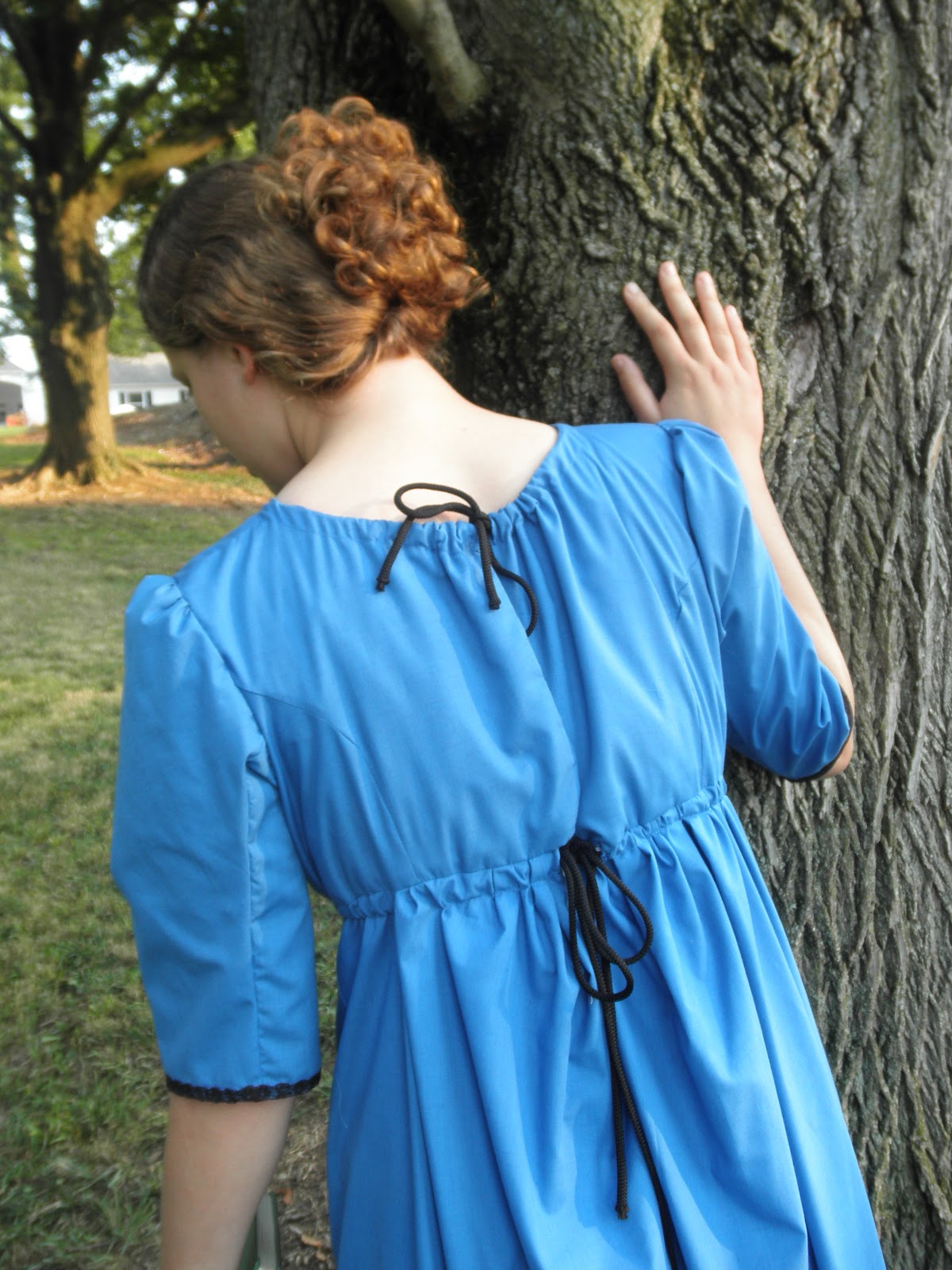
The great day arrived, the dress was duly unwrapped and oohed and ahhed over, and shortly thereafter Anne-girl and I hied ourselves to the backyard with my trusty camera to do a Marianne Dashwood photo shoot.   (I dubbed it a Marianne Dashwood shoot because Anne-girl's hair reminds me of Marianne.  Someone back me up on this.)

Due to privacy concerns and creepers on the Internet and flying purple pirate monsters, we have elected to share only the pictures that do not show Sister Dear's face, as I'm sure you will all understand.  You can scroll to the top of the page for a front view of the dress...


...and here is the back view.


Oh, and at this point I should say that I used Simplicity Patter 4055, dress B, which turned out to be quite simple once I understood the directions and had some help from Melody.  (A friend in need is a friend who flies to her computer and frantically emails her Tween for advice when the placket instructions don't make sense.  A friend indeed is a friend who promptly emails back with minute instructions and is even kind enough to scan a pattern piece into her computer when the friend in need is so silly as to lose piece 17.)


I love how the back is so nice and full for ease of movement.
"But I've BEEN on a walk today!"
"You need another!"


When the photo shoot was over, Anne looked at her hair with the help of a hand mirror and said, "How did you do THAT?"  (She's expert at complex hairstyles.  I do ponytails.)
"Um, I grabbed it and bunched it flat against your head and stuck hairpins in until it stayed up without my hand."
"Yeah... well, it's falling out."

Humph.  It was pretty while it lasted.


The dress pattern does not call for trim on the sleeves, but I felt the black lace added a little flair to them and dressed it up a wee bit.  The sleeves are not intended to be this length, either, but at Melody's suggestion I shortened them from their original wrist-length.  I like them better this way.

"Oh, those Lucases are such artful people indeed. They are all for what they can get!  However, your coming just at this time is the greatest of comforts.  And we are very pleased to hear what you tell us about the latest fashions for long sleeves."
~Mrs. Bennet, P&P95

Monday, August 6, 2012

Sense and Sensibility (2008) Review

{Warning: Excessive long-winded-ness, much rambling and a great deal of nonsense lies ahead.  Also, here be monsters.  Proceed at your own risk.  Dead men tell no tales.}

I've never thought of myself as being much like Queen Victoria.  But in The Young Victoria, Queen Victoria confused stubbornness with strength.  And in the case of Sense and Sensibility 2008, I confused stubbornness with loyalty.

S&S 1995 was the very first movie I reviewed here on YAPDB.  The movie has sentimental connotations for me--it was the second Jane Austen novel I read, the second Jane Austen film adaptation I watched, and the second "just us two" movie that I'd watched with my mom.  It's a stunningly lovely film with superb acting and a well-written script.  So it's only natural that I would think it was the only S&S adaptation I would ever need.

And boy, was I stubborn in that respect.  When Melody suggested that I just give S&S08 a try, I laughed her off.  Surely no other adaptation could even come close to the splendor of the 1995 version.  Besides, hadn't I heard that the first scene was a little iffy?  I didn't want to watch that!


But Melody, bless her heart, kept right on pestering suggesting, reminding me how much fun we had had watching Little Dorrit together last December.  (We both watched the same episodes each night and then emailed each other the next morning to discuss them and quote our favorite lines-- it was loads of fun.)  Now she really wanted me to watch S&S08 with her, and it's hard to say no to my Tween, so I finally caved, ordered S&S from the library, and settled down with Anne-girl to see the first episode.  (By the way, we didn't even have to see a bit of that objectionable first scene-- all you have to do is navigate to the second scene in the scene selection, and then rewind until you get to the opening credits.  And bingo, you've avoided the whole thing.  The rest of the movie is perfectly okay.)

After fifteen minutes had passed, I was hooked.  And Melody was gracious enough not to say "I told you so."  (Well, not in so many words.)

I'm not even going to try to keep myself from comparing the two films in this review, because I know I won't be able to.  So I'll begin by comparing the '08 Dashwood sisters with their '95 counterparts.


First of all, Emma Thompson ('95) is the face of Elinor Dashwood for me.  So what if she was 35 when the movie was filmed and Elinor is only supposed to be 19?  She spoke Elinor, moved Elinor, breathed Elinor.  And I didn't think Hattie Morahan ('08) was going to measure up to Emma Thompson's standard.  (When I first wrote that sentence, I abbreviated Emma Thompson as E.T. ... then I looked at it again and decided not to. :P) Hattie Morahan's voice and manner of speaking are quite similar to Emma Thompson's, and though I don't know if that was intentional or not, it definitely helped me to get accustomed to her portrayal.  She's not very pretty at first glance, but as you get to know her better throughout the film, she becomes more and more lovely.  (I've noticed that with a lot of characters in period drama... they become more aesthetically pleasing as the story goes on and you become better acquainted with them.  Beauty is in the eye of the beholder, I guess.)


As for Charity Wakefield as Marianne Dashwood... well, let's just say that Kate Winslet did a phenomenal job and leave it at that, shall we?

Oh, all right, she wasn't that bad.  I just felt that her portrayal of Marianne was much too self-centered and whiny-- and what was up with her running around with her hair down half the time? I think this movie was probably set around 1795, which was when Jane Austen first wrote it, and women did wear their hair down more often back then... but not as wildly as Marianne did in this movie.  Maybe it was an effort on the filmmakers' part to make her look younger, but I felt it just looked sloppy.  


Mrs. Dashwood and Margaret, however, were very well cast.  I've never been much of a fan of Gemma Jones' weepy Little Bo Peep performance in '95, and it was refreshing to see a Mrs. Dashwood who actually had some backbone.   However, Janet McTeer's performance wasn't quite on par with the Mrs. Dashwood of the book.  Mrs. Dashwood is supposed to be practically a carbon copy of Marianne-- easily swept away by feelings, etc.  She's supposed to be just as enamored of Willoughby as her daughter is (although of course she maintains later that there was always something in his eyes that she did not like).  Yet in this movie, she was shown to be a little suspicious of him, which wasn't exactly a bad thing but it wasn't quite in line with the book.

Lucy Boynton played Margaret quite nicely, and she improved as the story went on, but I still prefer Emelie Francois' performance.  Margaret suffers from a severe lack of personality in the original novel, but in the '95 movie she was made into a funny, likable character.  She's funny and likable in this version too-- "If she comes to live here, I MIGHT even POISON her"--but not quite as much.


Before I saw this adaptation, I was one of those who was firmly convinced that Hugh Grant did a splendid job portraying Edward Ferrars in '95.  This was because I had not yet seen how well Edward's role actually could be played.  I still think Hugh Grant did a good job, but he's no longer Edward in my book.  Dan Stevens brought out everything I liked about Edward (and everything I didn't like, which was good-- Edward's moodiness may annoy me, but it is in the book) and his eyes are much nicer than Hugh Grant's.  Ahem moving on.


I also really liked how Edward's relationship with Margaret was developed.  This may have been a little bit of copying off the '95 movie, but hey, it was cute.  Horseback riding isn't quite as fun as dueling with swords (that one scene where she stabs him in '95 is priceless, admit it) but it was still sweet when Edward took Margaret on his horse because that dreadful little Harry Dashwood was riding her pony.  (Speaking of Harry Dashwood.  That child's face was the single scariest thing in the entire movie.  I cowered under the bed when he came on screen.  Well, okay, not really, but it sounds good to say so.)

{I'd just like you all to know that everything that comes after this note has been rewritten from the original.  Because the original was EATEN by the bad, wicked Blogger, who cunningly and with malice aforethought ATE all the words that it TOLD me it had automatically saved.  And now it is smirking at me.  Blogger, why dost thou mock my pain?}


I also really liked how Edward's honor was portrayed so well in this version.  In '95, you have to draw your own conclusions about Edward's marrying Lucy-- here, they actually, you know, showed him standing up to his mother and keeping his agreement to a young woman who didn't deserve the time of day from him.  And the part where he talks to Elinor after Colonel Brandon's offer was heartbreaking in a very satisfactory way.  I was pleased.  Muchly.

Melody had convinced me not to watch Our Mutual Friend (1998) until I had seen S&S, because she said I would not be able to appreciate David Morrissey's Colonel Brandon if I saw him first as Bradley Headstone (the bad guy in OMF).  I took her advice, but when we began watching S&S, I began to think that Bradley Headstone had nothing to do with it and that I just wasn't going to like this guy.  At all.  He struck me as being just a bit stalker-ish in the way he stared at Marianne, and indeed I was inclined to agree with her when she said, "I think he is the kind of man who likes to find fault with everybody and everything."


But I changed my tune as the series went on and found myself liking this version of Colonel Brandon more and more.  Alan Rickman from '95 will always be my favorite, but I now grudgingly admit that there can be two very good portrayals of one character.  And I will quite freely admit that the Rescue Marianne In The Rainstorm scene is much more romantical in '08 than in '95.  In '95, the Colonel just goes out and carries Marianne in, sopping wet.  In '08, we see him thundering through forests and fields on his horse shouting her name, and eventually finds her and brings her back to the house.  It's far more Dramatic and Touching and "Oh-Look-He-Really-Loves-Her"-ish.

Speaking of which, the rainstorm scene was (in my humble opinion) a complete ripoff of the iconic scene from '95.  In the book, Marianne goes out for a walk and gets a bit chilled--a few days later, she comes down with a fever.  In '95, she goes out to see Combe Magna, says Sonnet 116 with the wet wind blowing her hair, gets rescued by Colonel Brandon and falls ill that very night.  In '08, she goes out walking to no place in particular with the wet wind blowing in her hair and her face turned up to the raining sky (doesn't she know you can drown that way???), gets rescued by Colonel Brandon and falls ill that very night.  It strikes me that '08 is trying to copy '95 as unobtrusively as possible.  I'm on to you, Andrew Davies.


Dominic Cooper was the worst Willoughby ever.  EVER.  Well, the only thing worse would be if they had cast David Tennant as Willoughby, because nobody would be able to hate him and poor Colonel Brandon would get booed off screen.  But I digress.  Dominic Cooper's Willoughby was not at all charming, as Willoughby is supposed to be--rather, he was creepy from the very start.  This did not reflect well upon the Dashwood women.  Mrs. Dashwood, Marianne and Margaret were made to look stupid for liking him in the first place, and as for Elinor (who didn't like him), it was kind of a "well, OBVIOUSLY" thing.

Seriously, if *I* had sprained my ankle and this guy came along offering
a lift, I'd run screaming.  Sprained ankle and all. 
I did, however, like that they included Willoughby's whining about how it's not my fault apology scene.  That is, if "like" is interpreted as "let's all punch Willoughby in the face.  Repeatedly."  But '95 left that scene out entirely, which I've always thought was a pity, and I guess half an apology (or a quarter... or an eighth... or whatever it was...) is better than none.  But why on earth was Marianne listening in?  That was NOT the way it was in the book.  She shouldn't even have been out of bed anyway.  Probably she didn't take her medicine either, the naughty girl.

Back to the characters.  Let's have a nice big round of applause for the Steele sisters, shall we?

... I can't heeeeeeear youuuuuuuuuuuu.

*covers ears*
Much better.


I cannot begin to describe how much I enjoyed the Steele sisters in this version.  They were so much better than in '95, it's almost ridiculous.  For instance, poor Nancy was left entirely out of '95.  And she's ten times more hilarious than her sister.  ("I'm sorry, I'm sorry, it just POPT out!")  Her dimwitted remarks really helped to lighten the more awkward scenes, and she was just all-around funny.  "For my part, I find them vastly agreeable, provided they dress smart and behave civil, but I can't bear to see them nasty and dirty, can you?" Lucy, too, was quite an improvement on her '95 counterpart.  In '95, I never quite understood why Lucy confided in Elinor when they first met-- in fact, when I first saw the movie, I thought they had changed it from the book and made it so that she only wanted to tell her secrets to someone.  But in '08, the Middletons discussed the Elusive Mr. F. right in front of Lucy, which gave her ample reason to treat Elinor to the Hands Off monologue.  In addition, the '08 Misses Steele talked bad grammar and seemed real uneducated, which is the way they was in the book.


I appreciated the addition of Mrs. Ferrars (although there were times when I felt a high kick or two, a la Fanny Dorrit, was in order for her) and you could definitely see where Fanny Dashwood's meanness came from.  "Ohhhh Edward, you know you only say these things to annoooooooy me."

Speaking of Fanny, why on earth did the girls call her "aunt"?  She was their sister-in-law.  Not their aunt.  Did Margaret begin referring to her sisters beaux as Uncle Christopher and Uncle Edward after the weddings?  I think not.  (And yes, I'm aware that the Christopher appellation is from '95 and not the book, but it seems to fit him.)   And did anyone else notice that her hairstyle was stolen straight from '95?  She looked ridiculous and Columbia Pictures should sue.  (Anne-girl is expected to "get" that reference, but she is the only one.)


The ball was interesting, but quite inaccurate to the book, and you're probably tired of hearing me spout off about the book, but hey, this is the treasurer of The Book Is Always Better (TBIAB) club speaking.  Mr. America Robert Ferrars and Colonel Brandon were not supposed to be there, though of course the Colonel was quite handy to have around later in the evening when Marianne had her kinda-sorta fainting thingy.  (Did she actually faint?  Or just... sink?)  I was not at all pleased with the way she shouted Willoughby's name across the room, but it certainly was effective when the whole company went quiet and Miss Grey gave the Look of Death.  If they hadn't played the Willoughby Danger Music right at that moment, I probably would have liked it better.

I'm rambling far, far too much and this review is getting way too long, but I'm afraid I'm being too negative so I do want to stick in some positive elements before I start complaining again.  I really liked Marianne's constant letters to Willoughby (and the poor patient footman who had to deal with Miss Why-hasn't-the-mail-come-yet every single morning).  And the whole Elinor/Colonel Brandon mixup was handled quite nicely indeed.  This was when I really began to like Colonel Brandon.
I like the trimming on this pillowcase.  Yes, that was random.

Marianne's illness, however, was not as good as in '95.  I just didn't feel as sad for some reason.  And Colonel Brandon didn't say my mom's favorite line ever ("Miss Dashwood, give me an occupation or I shall run mad") which was a bit of a disappointment. But then, if he HAD said it, I probably would have complained that they copied from '95, so they really can't win, it seems.  (And was anyone else extremely annoyed by the fact that the Colonel came into her bedroom to say get well soon?  That was not proper in those days, peeps.  Not.  In.  The.  Least.)

As for the minor characters, I'm afraid I was vastly disappointed.  Mrs. Jennings was merely adequate-- there was none of Elizabeth Spriggs' over-the-top hilarity, and Mr. Palmer... ugh.  There is only ONE real Mr. Palmer, and that is Bertie Wooster.  End of story.  Thank you, my dear.

Speaking of the end of the story, I was rather disappointed at first that no weddings were shown.  But then I decided that no Jane Austen wedding can possibly top Throw the Coins in '95, so kudos to the '08 directors for not even trying.  Instead, we got to see Colonel Brandon and his newly tamed horse--er, his bride--riding off into the sunset and we all felt happy and warm and fuzzy.  (Except for the horse taming references.  What was up with THAT??)


As for Edward and Elinor, this proposal ties with the memorable '95 "My heart is and ever will be... yours."  And before I watched S&S08, I honestly thought nothing could top that.  So I was prepared to be disappointed with this version, and instead I got a lovely surprise. Cutest thing ever, ladies.  Just go watch it as soon as possible.  (At this point I should insert a link to a video of that scene, but alas, 'tis not available on YouTube.  So you must do it the old-fashioned way and get thee to the library.)

My conclusion?  These versions almost tie.  That's a huge admission coming from me, considering how much I love the '95 version.  I never thought anything could top it-- and nothing has.  But S&S08 has come pretty close, and I know I'll be watching it again.

Isn't it fortunate, by the by, that it was Willoughby passing when Marianne fell?  I mean, it could have been some uncouth old farmer with no taste for Byron.  Horrors.

Saturday, August 4, 2012

S&S 2008 Trailer

If y'all have been waiting on tenterhooks today for the S&S review I promised--and I'm quite sure you have been, right? Right?--well, I hate to let you down, but the review's not done yet.  So to tide you over until I get it posted (Monday, hopefully) I'm sharing a trailer I created for S&S08.  I used clips from the series, the theme music, and some of the voice-over from the DVD promo (which I don't really like... but at least it has voice-over. )

I'm still pretty new at the movie-making thing so the trailer's a bit choppy in places, but I'm working on that.  :D (And I don't know how to get rid of that ugly green thing on the side.  Ugh.)  But overlooking all that... enjoy! (Oh, and thanks to Miss Laurie for providing the soundbites for the theme music on her S&S YouTube video.)

Saturday, March 3, 2012

Mrs. Gibson Advises and Miss Dashwood Bah-Humbugs

I have here an entry for Miss Elizabeth Bennet's Period Drama Advice contest, but first I have a bit of bah-humbugging to do, so please bear with me.  I had written out this post earlier in the week and this morning was just putting the finishing touches on it (and rather proud I was of the letter I'd written) and then Blogger. Ate. My. Post.

Read that and weep, fellow bloggers.

I'm sure you can all sympathize, because I know I'm not the only one who has suffered the loss of a slaved-over blog post to the greedy, slobbering jaws of Some Computer Server Belonging To Google.   It is a solemn, sad thing to see a nicely laid out blog post suddenly chomped and eaten and then spit back in a sickening conglomeration of HTML code and meaningless strings of numbers, never to rise again.  (This analogy is getting a bit disgusting and I really should stop now.)

All that simply goes to say that I really should write my posts on Word and then save them before posting them on Blogger.  But I am usually in too much of a rush to do that, and I never take my own advice anyway. (Who was it who said he always advised people not to give advice?  Was it Algernon in The Importance of Being Earnest? I can't remember.)

Another reason for me to bah-humbug is that I missed my 100th post.  That is, I missed marking the event.  It was this one, my announcement about the Assembly Rooms.  Incidentally, Melody's 100th post on Regency Delight was her announcement about the Assembly Rooms.  (I guess two hundred-mark posts on the same topic are better than one, eh, Tween? How swellissimus!)  So really it's not a humbug after all, though I should have liked to commemorate the occasion in some way.

Enough blathering.  Here is my entry (rewritten, and alas, not quite the way I had it before) for the Period Drama Advice competition.  Miss Elizabeth Bennet posted a letter seeking advice from Edward Ferrars of Sense and Sensibility, and I have written a reply from Mrs. Gibson of Wives and Daughters.  (If you wish to know more about the Period Drama Advice event, click on the button below.)


Edward's Letter


Dear Period Drama Advice Column,

I find myself in a predicament. Four years ago, I became secretly engaged to a woman named Lucy Steele, the niece of my tutor in Exeter. I thought myself in love, but it was a foolish, idle inclination on my side. I have recently met my sister's sister-in-law, Elinor, and I like her a great deal. I find myself in love with her, but I cannot break my commitment to Lucy. If I were free, I would tell her that my heart is and always will be hers. Her friendship has been the most important of my life. My mother also wants me to marry the rich Miss Morton with 50,000 pounds: all I want, all I've ever wanted is the quiet of a private life, but my mother wants me distinguished.Do you think I am doing the right thing in keeping my promise to Lucy despite all of this?

Sincerely,
Edward Ferrars

Mrs. Gibson’s Response

My Dear Mr. Ferrars,

What a lovely, romantic note you have sent! It quite puts me in mind of my younger days, when half the young men in the local regiment were head over heels for me. I sometimes think it is a pity I was born when I was. I should have liked to belong to this generation.

Now, Mr. Ferrars, about your predicament. It is such a shame that your attentions have turned to another young lady—youth is so very fickle. My daughter Cynthia, for instance, is not very constant. But my dear sir, I am sure you will acknowledge that an engagement is an engagement. If you have given your promise to Miss Steele, you must fulfill your responsibility and marry her.

Perhaps your waning interest in Miss Steele is due to a lack of communication with that young lady? You might try calling at her house one of these days and visiting with the family. Only pray do not call before breakfast, as that sort of thing is quite inconvenient and unappreciated. But if you come bearing flowers, all will be forgiven.

One last thing, Mr. Ferrars—do not be swayed by urgings to marry Miss Morton, despite her 50,000 pounds. Riches are a great snare, you know.

Yours sincerely,
Mrs. Hyacinth Clare Gibson
Hollingford

Wednesday, February 29, 2012

Period Drama Heroines #3: Elinor Dashwood

 "You do not suppose that I have ever felt much.—For four months, Marianne, I have had all this hanging on my mind, without being at liberty to speak of it to a single creature; knowing that it would make you and my mother most unhappy whenever it were explained to you, yet unable to prepare you for it in the least." ~Sense and Sensibility by Jane Austen, chapter 37

We've said it over and over and over again. Whether we're arguing about characters in Les Miserables, vehemently discussing Edward Ferrars' hero qualifications or simply laughing over a funny scene in Pride and Prejudice, this phrase keeps cropping up when I talk at length with my sister Anne-girl: "We are so Elinor and Marianne!"

In case you're wondering, we mean that I'm Elinor and she's Marianne.  She's the uber-excitable one, the one whose sorrows and joys can have no moderation.  I'm the one who generally yanks her down out of the clouds and offers practicality when she flies up on the wings of inspiration.  (We are best friends, however. Let's set the record straight from the beginning.)  She's the emotional one, and I'm the other emotional one. (Heh.) Although, in all seriousness, she's much more emotional than I am.  In general.

Why am I blabbing on and on about my sister and myself when this post is really supposed to be about Elinor Dashwood?

Well, you see, I call myself Elinor Dashwood.  I compare myself to Elinor Dashwood--of all Jane Austen's heroines, she's the one I identify with most.  But really, I'm not as much like Elinor Dashwood as I'd like to be.  In reality, I admire her and want to be like her more than I really am like her.  (Hope that made sense. Sentence construction isn't my strong point.)

So, let's look at Elinor's good points (and bad points) in an organized and thoughtful manner.  (Hah.)

First of all, Elinor is Unfailingly Patient.  One of my favorite scenes in Sense and Sensibility (1995) is the one where all three other Dashwood women have fled to their rooms in tears, and poor Elinor is left alone on the stairs at Barton cottage with a cup of tea in her hand.  She stands there for a moment, listening to the stormy sobs emanating from behind the various closed doors, then philosophically sits down on the stairs and drinks the tea so as not to waste it.

(via)
Elinor's patience comes in handy when the Miss Steeles enter the story.  Anne "Nancy" Steele is annoying but funny--Lucy, her younger sister, is malevolent, manipulative, malicious and mean.  (Miss Dashwood likes alliteration.)  I still haven't figured out how Elinor managed to go for more than ten minutes without landing a Fanny-Dorrit-esque high kick right in Lucy's silly simpering face.  Grrrrrr.


Not only does Lucy tell Elinor about her secret engagement to Edward for the SOLE PURPOSE of making Elinor feel bad, she swears Elinor to secrecy on the subject (even though Diana Barry will tell you that it's dreadfully wicked to swear).  This gives Lucy negative eighteen thousand Miss Dashwood points, because everybody knows that the best part of being told a secret is being able to tell it to somebody else.  (What are sisters for, anyway? Other than borrowing and lending clothes, I mean?)  I hate Lucy Steele.

But I'm not here to talk about Goosey Lucy.  Nor am I here to hurl rotten fruit at the lady I just mentioned.  I'm here to talk about the honorable Elinor Dashwood, and when I say honorable I'm not just being fake-ly formal.  Elinor is the soul of honor.  (Did I really just type "honorability" and then sit there for a minute wondering why it looked wrong? No, of course I didn't.)  Like another person in Sense and Sensibility whom I could mention (hint: he doesn't appreciate poetry, his name begins with an E and ends in DWARD and his last name begins with an F) Elinor does not let people down.  Ever.  Even when those people are not worthy of, say, John Thorpe's attention.

Elinor could have easily rationalized that the ends justified the means and then raced off to spill the dirt on Edward and Lucy to Marianne.  She could have told herself that Lucy wasn't worth making promises to.  But she didn't--she kept her word even when it was little more than mental torture to have to do so.


Of course, all this honor and discretion and ability to keep her lips zipped doesn't mean that Elinor doesn't have feelings.  It just means that she is mature enough to conceal her feelings.   Unlike Marianne, Elinor didn't fling herself down on her bed, cry uncontrollably and refuse even olives when she realized that Edward was betrothed to another woman.  (And all you Marianne fans out there--please, please don't get mad.  I am one of you.  I really am.  But you will admit, I hope, that Marianne's behavior was over-the-top at times.)

If you still don't think that Elinor feels deeply, go to the top of this post and read the beginning quote again.

Now, back to the whole honor thing.  Honor and honesty go hand-in-hand, and Elinor is unfailingly honest.  Except, of course, when Good Manners require her to be otherwise. "It was impossible for [Marianne] to say what she did not feel, however trivial the occasion; and upon Elinor therefore the whole task of telling lies when politeness required it, always fell." ~chapter 21
Whoever said Sense and Sensibility wasn't funny? Eat your words!

We'll talk a little bit more about humor in a minute, but first I want to say just one more thing about honesty.  Elinor possesses a skill that I desperately want to cultivate: namely, she tells the truth, but not when it isn't necessary.  I don't mean that she lies.  I mean that she doesn't just bluntly say things that are true-but-not-nice.  She holds her tongue.  She speaks with discretion.  Like the Proverbs 31 woman, Elinor opens her mouth with wisdom, and in her tongue is the law of kindness.  Elinor thinks before she speaks and doesn't say things without pondering them first.  It's a habit we'd all (yours truly in particular) do well to emulate.


Now, about Elinor's sense of humor--frankly, I think anyone who says Elinor has no sense of humor needs to go read the book again.  Or at least watch the 1995 film.  (Can't vouch for the 2008 miniseries, but Melody is slowly and surely persuading me to see it, so maybe someday I'll have an opinion to offer.)
"Now there is no one to regard [the leaves at Norland]. They are seen only as a nuisance, swept hastily off, and driven as much as possible from the sight," [said Marianne.]
"It is not every one," said Elinor [to Marianne], "who has your passion for dead leaves."
~chapter 16

Consider, too, one of my favorite lines in the movie:

Marianne: When is a man to be safe from such wit, if age and infirmity do not protect him?
Mrs. Dashwood: "Infirmity"?
Elinor: Do you call Colonel Brandon infirm?
Mrs. Dashwood: If Colonel Brandon is infirm, than I am at death’s door.
Elinor: It is a miracle your life has extended thus far.

Oh, and then of course there's this:
Elinor: Marianne, you must change your clothes or you will catch a cold.
Marianne: What care I for colds when there is such a man?
Elinor: You will care very much when your nose swells up.

Practicality is an important character quality, after all.  Sure, it sounds boring, but somebody has to add up the household accounts and tell the hired man not to buy expensive groceries.  ("Do you want us to starve to death?" "No.  Just not to eat beef.")

Okay, enough rambling.  My sister Molly (who enjoys the videos on my blog immensely) is probably clamoring by now for Elinor's Best Scene, so here you go.  The scene of which I speak takes place from 3:18 to 6:05. 


"Edward will marry Lucy. And you and I... will go home."  Simple, not exactly profound, but that one line (okay, two lines) perfectly expresses Elinor's personality.  "Always resignation and acceptance! Always prudence and honor and duty.  Elinor! Where is your heart?" I like this scene not because Elinor finally lets the dam burst and gives Marianne what's coming to her (because honestly, am I the only one who's just a little annoyed with Marianne at this point?) but because of the way the scene ends.  After the soul-outpouring and getting everything off her chest, Elinor turns right back to Marianne to hug her.  Frustrated and heartbroken though she might be, Elinor is not going to let her sister cry without offering some support.


Ultimately, Elinor cares about other people more than she does about herself--and that's the most admirable thing about her.  That's what I most want to emulate in Elinor's character.

That, and Emma Thompson's hair.  Those braided buns are absolutely gorgeous.

Friday, December 16, 2011

Mrs. Dashwood's Reply to Elinor

And here is the final epistle in the Elinor and Marianne series.  Hope you enjoyed!


(I much prefer Gemma Jones as Mrs. Dashwood, as I've only seen the 1995 movie and I think she looks the part, but this picture of the what's her name actress from 2008 suited the letter. :P)


Barton Cottage, January

My dearest Elinor,

Words cannot express the grief and regret which I felt--nay, still feel--upon reading your epistle of Monday last.  I entreat Marianne to bear up with fortitude, lest this disappointment prove dangerous to her health.  It is a cruel thing, a hard thing, & all I can say is that he has used my poor darling very ill.  Indeed, I can say no more, for I am so overcome with distress that I can hardly write.   Poor Marianne! I only wish I could be with you to comfort her.  What a dastardly thing, what a miserly and mean deed!  I cannot believe that Willoughby would do such a thing--yet I must say that I suspected it all along.  You will remember that there was always something in Willoughby, a look in his eyes perhaps, which I did not like.  Miserable man!

I am sure they must have been engaged; her unreserve in his company, her obvious feeling & affection for him, serves only to prove that she thought very highly of him; and surely he cannot have been such a cad as to see her partiality and return nothing.  No, no, I am sure they were engaged.  But of course I could not ask such a question for the world.  What distress would such an inquiry have inflicted, were they not really engaged!  I am so glad now I did not ask, for perhaps after all they were not.  I do not know.  I am in such indecision at present.  He never deserved her.  Her unhappy prepossession for such a worthless young man gives me great pain.

Marianne's heart is not to be wasted for ever on such a despicable young man as Willoughby.  We can only pray that in time there will come one who has a nobler heart, higher ideals & a loving spirit.  I am very sure that even if Willoughby had turned out very amiable, though he proved it oft to the contrary, they could never have been happy together.

But enough of this.  What a comfort it is to know that you are in the hands of Mrs. Jennings, for she is a kind soul & will do Marianne good in this difficult time.  You cannot come back to Barton Cottage at this time, my darling, much as I wish to see your dear faces again.  It is better for Marianne to be anywhere, at this time, than at Barton, where every thing within her view would be bringing back the past in the strongest and most afflicting manner by constantly placing Willoughby before her.  By all means, I recommend that you should not shorten your visit to Mrs. Jennings; the length of which is expected by all to comprise at least five or six weeks, & you have not been there half that time.  A variety of occupations, of objects and of company, which cannot be available at Barton, will be inevitable there, & might yet, I hope, cheat Marianne into even some amusement, though the idea may now be spurned by her.

From all danger of seeing W. again, I count her to be at least equally as safe in town as the country, since his acquaintance must by now be dropped from all who call themselves my daughter's friends.  Besides which, a letter from John has just reached me, in which he tells me that he & Fanny are to be in town before the middle of February, and I judge it right that you should sometimes see your brother.  Give little Harry a kiss for me.

Margaret sends her love and condolence, and I remain
Yours with much love,
MRS. HENRY DASHWOOD

A Missive from Margaret

Those who are experts about such things tell us that Jane Austen may have written Elinor and Marianne, the early draft of Sense and Sensibility, as an epistolary novel (one written entirely in letters).  Melody and I have teamed up to recreate some of those letters (alas, no early manuscript survives!).  We shall present to you four epistles, all written by different characters and all taking place over the winter when Elinor and Marianne were in London.  (Dramatic music please.)  I must admit that in this letter I overstepped bounds a little and based Margaret's "voice" on the Margaret of the 1995 movie.  I know, I know, but she's not very interesting in the book. *covers head and ducks* (The picture, however, is from the 2008 movie... just because I like the way it looks.)


Barton Cottage, January

Dear Elinor and Marianne,

I hope you are enjoying your stay in London! I wish I could go.  It simply is n't fair that I have to stay at home.  Mamma says that I may go when I am old enough to be Out, but I do n't want to wait that long.  I want to go now, and I think that if you talk to Mrs. Jennings, Elinor, she will surely let me come and visit with you. I like Mrs. Jennings; she talks about things & we NEVER talk about things.

Edward still does not come to visit.  It's been weeks since he last came, & even then his last visit was so short! It was really of no signiff signef importance.  Has Marianne seen Mr. Willoughby?  Elinor, do tell me when they are to be married.  Will I get a new dress for the wedding?  Did he kneel down? They always kneel down, you know.

I want Mamma to shew me how to play Cassino, so that I can play with all of you when you & Mrs. Jennings return from London, but she says I am not old enough.  I hate being the youngest.  Elinor, do write to Mamma and say I may learn.  I am quite old enough, I'll be twelve soon!

Oh! I just had a thought! Is Edward in London? Do tell him to come and see us, Elinor.  You know he will if you ask him.  I am dying for the chance to play at swords with someone.  I am planning another expedition to China, and he has promised to go as my servant.  He'll be swabbing the decks of course; I couldn't afford to do it myself as I shall be quite busy with my captainly duties.


Hurry back, Elinor and Marianne.  I miss you dreadfully, and I will go on all the walks you like, Marianne, when you return.

Your loving sister,
in great haste &c,
Margaret Dashwood


(Read the other letters in this series here)

Wednesday, December 14, 2011

Hero? or villain?


"Warthog!"

That's the word my sister Anne spits out every time John Willoughby, Esquire, shows his face on the screen during Sense and Sensibility.  Maybe it's not the most mature way of describing his character, but it does seem to fit.  Charisma, gallantry and good looks are all very well, but when a person is so despicable, those little insignificant details are trodden underfoot.

My sister and I have very strong opinions about Jane Austen's villains.  No, actually we have just one opinion.  We hate them.  Henry Crawford, John Willoughby, George Wickham, William Elliot, Philip Elton and John Thorpe are all universally disliked around here.

Unlike Queen Victoria, we are much amused by the fact that Jane Austen apparently did not like gentlemen whose names began with W (Captain Wentworth excepted).  Willoughby, Wickham, William Elliot... we sometimes consider starting a fan web site called www.janeaustenvillains.com.

You are supposed to be laughing now.

Oh, very well, have it your own way.  The imaginary web site is not the point of my post.  Rather, I wish to talk about John Willoughby and Tom Lefroy.  Specifically, I wish to tell you that I believe John Willoughby's character to be modeled after Tom Lefroy.

Now before you rise up in wrath and throw your Becoming Jane DVDs at me, let me say that I have duly read Miss Laurie's post on Tom Lefroy with great interest, and I have nothing against Tom Lefroy.  I do not mean to slight his character in this post, nor to slight Miss Austen's (or imply that she was bitter).  I am simply Making a Well-Informed Observation.

Jane Austen, as I mentioned in a previous post, was an excellent--nay, amazing--writer who drew from her own experiences, from real life, to write her novels.  Is it, therefore, "incontheivable" that she would base one of her villains on someone in real life?  Think for a moment, if you will, on the parallels between the two.

From what little we know of Jane's brief acquaintance with Tom Lefroy, we see that he was in the Steventon area visiting a wealthy Aunt.  Point number one.  I call to your attention Willoughby's rich relation Mrs. Smith, owner of Allenham.

Second point: we see Tom Lefroy as a mysterious, rather dashing personage, with whom Jane might just have fallen in love.  If she did indeed develop romantic feelings for him, it happened over a very short period of time.  Do recall Marianne's almost instantaneous affection for Willoughby when he rescued her after the ankle incident.

Third point: scandalous behavior on the part of both couples.  Marianne and Willoughby raced around on horseback, coolly toured Allenham despite the lady of the house's absence and danced with no one but each other at gatherings.  Jane and Tom danced and sat exclusively together, perhaps shocking their friends with their literary conversations about the "horrid" novel Tom Jones.

Fourth point: both young men had to suddenly go away, Willoughby to London and Tom... well, I'm not sure where Tom went, but presumably back to college.  Marianne was left heartbroken, while the more self-controlled Jane wrote lightly and brightly to her sister Cassandra of Tom's departure.  

Marianne, we remember, was quite sure that Willoughby would propose to her before he went away.  Jane wrote to Cassandra that she didn't care a sixpence for Tom Lefroy, but that if he proposed to her she would accept, if he were to get rid of his ugly white morning coat.  (Jeeves, anyone?)

Then came the time of wondering: would she ever hear from him again?  Marianne wrote effusive "notes" as she visited Mrs Jennings in London; Jane, it appears, laughed the whole thing off and started to write Pride and Prejudice.  We know that Cassandra Austen burnt many of Jane's more personal letters after Jane's death--could there have been something in those letters to divulge her real feelings? Speculation, speculation.

But then the sad part.  Willoughby, the rogue, married Miss Grey for her 20,000 pounds, while Tom was wed to a woman named Mary Paul (whose family situation I know nothing of).  I don't know if Tom married for money, but from what I've read of him it seems unlikely.  Willoughby, of course... well, we know his back story.

Here lies the biggest difference, however.  Marianne mourned, wept and refused even olives in her distress.  Jane, I think, let the whole matter drop, reconciled herself to spinsterhood and went on to write the best British literature of the nineteenth century.  Marianne ended up happy with Colonel Brandon... maybe because Jane wanted a fairy-tale ending, and knew that the only way she would get it was vicariously.

Did Jane Austen really think of Tom Lefroy as a villain?  I doubt it.  Does his behavior to her parallel that of Willoughby to Marianne (to a certain extent?) I think so.  Was Willoughby based on Tom?  Who knows?

But hey, if there were no speculation, we should be restricted only to "clouding the issue with facts."

Saturday, November 12, 2011

Defending Edward Ferrars

Miss Georgiana Darcy


"Edward Ferrars was not recommended to their good opinion by any peculiar graces of person or address. He was not handsome, and his manners required intimacy to make them pleasing. He was too diffident to do justice to himself; but when his natural shyness was overcome, his behavior gave every indication of an open, affectionate heart."
~Sense and Sensibility, chapter 3

Though he's not at the top of my Favorite Jane Austen Heroes list, I believe that Edward Ferrars is a greatly under-appreciated character. I think it's a real shame that many people find him boring and bland. Nothing could be farther from the truth. Edward is a wonderful person with character, integrity, kindness, a sense of humor, blah blah blah, and, yes, a great deal of awkwardness. But he's not inanimate, nor is he "un-heroic". I realize that many people do believe that he's boring, and I do hope I won't offend anyone by contradicting them in this post. I respect all your opinions, but I'm going to freely state my own. Besides, if no one ever wrote anything controversial, we'd never have anything interesting to talk about, would we? Blog posts would be dull and predictable, and the comments would consist merely of "How true!" and "Yes, I agree entirely!" and we blogging ladies would kill each other with boredom.


Ahem. Back to my point.

Jane Austen describes Edward better than I ever could--see the quote at the top of this post. Edward Ferrars is not the kind of guy who leaps off the page. He's quiet. He's not strikingly handsome. (No, I am NOT going to digress into a litany about the respective appearances of Hugh Grant and Dan Stevens. Sorreeee.)

But Edward, though his manners "require intimacy to make them pleasing" is a kind and tenderhearted person. He thinks primarily of making other people happy, and isn't focused on impressing those around him. The more I think about it, the more I realize that Edward honestly doesn't care what people think of him. I like this little thing he says in the '95 movie: "All I want, all I've ever wanted, is the quiet of a private life, but my mother wants me distinguished." Edward doesn't care about pomp and splendor. He's not a knight on a white horse. (I didn't say anything about a black horse, though...)

Edward's rapport with Margaret Dashwood exemplifies this. Okay, so he and Margaret didn't have much interaction in the book, but the movies really do a good job of showing their relationship. Think about it--most young men from Respectable Families in those days didn't go around playing pirates with little girls. It simply wasn't Proper. Edward, however, is more interested in making Margaret happy than in being Proper and Stuffy and sitting on an Uncomfortable Chair in a dark and gloomy Parlor.

Plus, Edward is FUNNY. Yes, he is. Maybe he's not laugh-out-loud hilarious like Henry Tilney, but he does have a sense of humor. When he and Margaret are discussing what the Dashwoods would do if they had "a fortune a-piece", he suggests that Marianne would buy up every copy of her favorite books "to prevent their falling into unworthy hands; and she would have every book that tells her how to admire an old twisted tree. Should not you, Marianne? Forgive me, if I am very saucy." (ch. 17)

(Love this scene. Just sayin'.)

But when I say Edward isn't interested in being Proper, I'm referring to endless rules and regulations about Polite Society. I'm not talking about good manners, character and integrity. Because Edward has all those, without a doubt. Now, when he was younger he might not have had much sense. I don't dispute that. I mean, seriously, who falls in love with a moron like Lucy Steele? There are a thousand reasons: he was young, she was pretty, her uncle encouraged the match, he didn't want to marry some other goofy girl his mother was trying to force him on, etc. etc. etc. (Et cetera, according to a friend of mine, stands for End of Thinking Capacity. This struck me as being highly amusing, and though it has nothing to do with this post, I thought I'd stick it in there.)

Anyway, though we don't know why Edward proposed to Lucy Steele in the first place, we do know that he is much too honorable to break off the engagement. He made a promise, he's going to stick to it. I admire that. Too many romance stories involve someone promising to marry someone else, then meeting their soulmate and snapping off the engagement without another thought. Look, that may sound romantic, but it's not. Think about it. How do you know that the said person isn't going to break off THIS engagement?

Hmmm, I seem to be going off on a lot of irrelevant tangerines tangents today. My apologies.

Let me also add something here on that topic. I've heard it said that Edward had no business "leading Elinor on" when he was engaged to Lucy, and that he should have told Elinor exactly what was up with him and Miss Stingy Steele. I don't agree. Edward promised Lucy that their engagement would be kept secret, and he kept his word. Lucy didn't keep hers, but what else would you expect from a girl like her? (Oh, and Edward did not lead Elinor on, for the record. It wasn't his fault that Marianne and Mrs. Dashwood read too much into his friendship with her.)

Well, Edward might be much too honorable to break off his engagement with Lucy, but we have to be glad that Lucy wasn't that honorable. "I'll marry Edward! He'll have lots of money when his mother dies. Oops! His mother found out that he's going to marry me. I need to get some duct tape for my sister Nancy's mouth... Where was I? Oh, yes, Edward isn't rich anymore. Ooh, but his younger brother IS... Hi Robert! Want to dance?"

So we can all give Lucy a round of applause. (Why? Because now the E's can get together, that's why!) Whether or not you are armed with rotten tomatoes as you "applaud" Lucy is your business and I will not be held liable.

And so Mr. F and Elinor were married. And Edward's mother's sister came to live with them soon after, and was known as Mr. F's Aunt. Okay, not really, but I had to stick that in.

And they lived happily ever after.

Thursday, November 10, 2011

Sense and Sensibility Book Quotes

Miss Georgiana Darcy

In honor of Sense and Sensibility Week, my Quote of the Week post will revolve around--you guessed it--Sense and Sensibility. Miss Georgiana Darcy already posted all my favorite quotes from the movie (no, I don't hold it against her, I'm too nice) so I will have some fun posting quotes from the book. Here are a few of my favorites.

Disclaimer: I'm currently rereading S&S, and I'm only about halfway through it. These are the quotes I've encountered as I reread, and are most certainly not a comprehensive list of all the good quotes in the book. If you think of one (or several) that I've left out, please do leave a comment so we all can enjoy it.

"Esteem him! Like him! Cold-hearted Elinor! Oh! worse than cold-hearted! Ashamed of being otherwise. Use those worlds again and I will leave the room this moment."
~Marianne Dashwood.


"People always live forever when there is an annuity to be paid them."
~Fanny Dashwood

On every formal visit a child ought to be of the party, by way of provision for discourse. In the present case [the Dashwoods' visit with Lady Middleton and her little boy] it took up ten minutes to determine whether the boy were most like his father, or mother, and in what particular he resembled either, for of course every body differed, and every body was astonished at the opinion of the others.
~chapter 6


[Mrs. Dashwood and Marianne] gave themselves up wholly to their sorrow, seeking increase of wretchedness in every reflection that could afford it, and resolved against ever admitting consolation in future.
~chapter 1
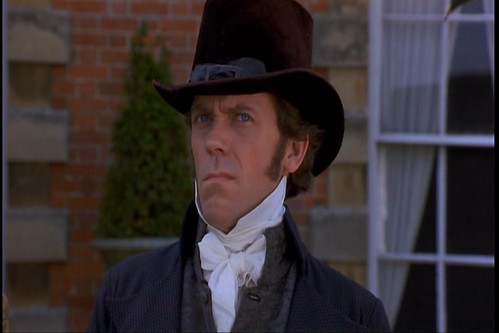
It was impossible for her to say what she did not feel, however trivial the occasion; and upon Elinor therefore the whole task of telling lies when politeness required it, always fell.
~chapter 21

[Colonel Brandon's] pleasure in music, though it amounted not to that ecstatic delight which alone could sympathize with [Marianne's] own, was estimable when contrasted against the horrible insensibility of the others; and she was reasonable enough to allowe that a man of five and thirty might well have outlived all acuteness of feeling and every exquisite power of enjoyment. She was perfectly disposed to make every allowance for the colonel's advanced state of life which humanity required.
~chapter 7

"As for Marianne, I know her greatness of soul, there would not be music enough in London to content her. And books!--Thomson, Cowper, Scott--she would buy them all over and over again; she would buy up every copy, I believe, to prevent their falling into unworthy hands; and she would have every book that tells her how to admire an old twisted tree."
~Edward Ferrars

"I wish," said Margaret, striking out a novel thought, "that somebody would give us a large fortune a-piece!" ~chapter 17
"Now there is no one to regard [the leaves at Norland]. They are seen only as a nuisance, swept hastily off, and driven as much as possible from the sight."
"It is not every one," said Elinor [to Marianne], "who has your passion for dead leaves."
~chapter 16

"Oh, dear, yes, I know [Mr. Willoughby] extremely well! Not that I ever spoke to him indeed; but I have seen him for ever in town." ~Mrs. Charlotte Palmer


"How horrid all this is! Such weather makes every thing and every body disgusting. Dulness is as much produced within doors as without, by rain. It makes one detest all one's acquaintance. What the devil does Sir John mean by not having a billiard room in his house? How few people know what comfort is! Sir John is as stupid as the weather."
~Mr. Palmer

Mrs. Palmer's eye was now caught by the drawings which hung round the room ... "I declare they are quite charming! I could look at them for ever." And then sitting down again, she very soon forgot that there were any such things in the room.
~chapter 19


"Well, said I, all I can say is, that if it is true, [Willoughby] has used a young lady of my acquaintance abominably ill, and I wish with all my heart that his wife may plague his heart out." ~Mrs. Jennings