Showing posts with label Classics Club. Show all posts

Monday, February 18, 2013

The results are in...


...and my Classics Club spin book is 1984 by George Orwell.

Well, whoop-de-do and Tyler too.

I'll confess I was a bit disappointed when I saw that #14 had been picked and that I'd be reading one of the books in my ho-hum section-- and to be honest, I'm a little scared to attempt this book.  But I said I'd abide by the rules, and abide by the rules I will.  Animal Farm wasn't that bad, after all-- I can survive 1984.

What did you end up with, now that the spin has spun?

Monday, February 11, 2013

Let's Go For a Spin

"...take your turn, take a ride on the merry-go-round..."
~Masquerade, Phantom of the Opera

(I find it amusing that this girl is neglecting her needlework
in favor of a book.  Ahem.  Cough.)

The Classics Club is sponsoring a Classics Spin from now until April 1st.  The rules are simple--list twenty books from your Classics Club list in a separate post on your blog and number them.  They can be any twenty books you choose.  I've separated mine into four categories, as you can see below.  On Monday the 18th they'll announce a number over at the Club, and the assignment is to read whatever book corresponds to that number before April 1st.

I'm in!

I'm posting these here because I want to keep myself accountable-- if the number turns out to be, say, 19 and I'm stuck with Moby Dick, I want Moby Dick to be listed ast #19 on my blog so I can't back out and rearrange my list at the last minute.  :D So, in essence, you are all holding me to this list.   *dramatically lays hand over heart*  I shall not fail you, my friends.

Re-reads
1. Mansfield Park (Jane Austen)
2. Little Dorrit (Charles Dickens)
3. El Dorado (Baroness Orczy)
4. Jane Eyre (Charlotte Bronte)
5.  Eight Cousins (Louisa May Alcott)

New Reads I'm Excited About
6. Lorna Doone (Richard Blackmore)
7. A Portrait of a Lady (Henry James)
8. Hamlet (William Shakespeare)
9. The Grapes of Wrath (John Steinbeck)
10. The Sword in the Stone (T. H. White)

Not Particularly Excited, But Not Dreading
11. The Tenant of Wildfell Hall (Anne Bronte)
12. The Hunchback of Notre Dame (Victor Hugo)
13. He Knew He Was Right (Anthony Trollope)
14. 1984 (George Orwell)
15. Frankenstein (Mary Shelley)

Viewing With Some Trepidation
16. The Brothers Karamazov (Fyodor Dostoevsky)
17. Far From the Madding Crowd (Thomas Hardy)
18. The Count of Monte Cristo (Alexandre Dumas)
19. Moby Dick (Herman Melville)
20. Daniel Deronda (George Eliot)

Will you be spinning with me?

Monday, February 4, 2013

The Classics Club: North and South


Today, I have a confession to make.  A little one, yes, but a confession nonetheless.

I was hesitant--really, really hesitant--to join the Classics Club.

My sister went before me.  And though she's younger than me, in many ways I behave like the younger sister.  "If Anne-girl's going to do it, then I'm gonna do it too."  She put her name on the Classics Club membership roll, made a list of fifty or so titles, and started reading.  And since she did it, I took the plunge and did it too.  And then... I kinda-sorta started to regret my decision.

Don't get me wrong; I love classic literature.  Reading books is one of my passions.  It wasn't the reading that made me fidgety-- it was the reviewing.  Because I can't stand writing book reviews.  Being objective is practically impossible for me when I'm talking about a book I love, and trying to make the story sound interesting to others without spoiling it is... um.... not my strong point.  And so each and every book post I've written since joining the Club has been... well... difficult.

My dear Melody and I read North and South together during the month of November (okay, so I overlapped a wee bit into December... your point?) and though I thoroughly enjoyed it, all the time I kept thinking in the back of my mind, "I'm going to have to review this on my blog when I finish..."  Not liking the prospect, I put it off and put it off.

And then earlier this week I read a fantastic (yes, truly fantastic) post by Mabel, a fellow book blogger and Classics Clubber.  Her blog is private, so I won't link to it here, but if she's reading this I just want her to know that she made my week.  Because this fantastic post she wrote was all about writing one's thoughts about a book as opposed to writing an objective review, and how both approaches are perfectly acceptable.  
"For me," Mabel says, "expressing that beauty [of discovering people through literature] is the thing. Fumbling through it, journaling, shooting out half-baked ideas and questions about books. That’s so much more fulfilling to me than analysis, which absolutely contributes to the journey for me — but is by no means the soul of it. I know that analysis can allow us to see books from different perspectives. But the human factor, the emotion, the intuition, the visceral reaction, the journey! It’s vital. To dismiss it as unimportant to the literary conversation goes against everything I believe literature stands for.
Thank you, Mabel. That was completely what I needed to hear.  I've been trying all this time to write left-brained reviews for the Classics Club and pushing off my impressions of the books because they didn't sound focused enough to be truly good.  I mean, who wants to read my personal opinion on books?  If people are looking for a book review, they want to know the bare bones of the story (premise only, no spoilers) and how long it is and whether there are any boring parts.  Right?  Right??

Eh, maybe not.  Maybe not always.  After all, that's not the kind of review I look for.  I like to know what people think of books, what parts they liked best and which character they identified the most.  Why shouldn't I write reviews that fit that bill?

So today I bring you my thoughts and impressions of North and South.  If you haven't yet read the book and are looking for a good review to determine whether you want to read it or not, this isn't the post for you.  But if you, like me, have read N&S and enjoyed it, then please do stick around and add your two cents.

I think the most outstanding aspect of this N&S reread (and I'm using the word in the sense of "something that really stood out") was Margaret Hale's character.  I felt that I got to know her far, far better this time around than I did the first time, and certainly better than I would have if I had only seen the movie.  For though the movie's portrayal of her is excellent, there are certain wee Margaret-details that got lost in the translation from book to movie.  So little of Margaret's inner struggle during the Hales' uprooting (uprootment?) from Helstone is shown in the movie, yet the book deals with her feelings quite unflinchingly.   I felt myself identifying with Margaret so much more in the book than I ever could in the movie.

Take the hand-shaking scene, for another example.  Sure, in the movie there's a wee explanation after the fact about how Margaret wasn't accustomed to taking a gentleman's hand like that.  But it still rather looks as if she's just being haughty.  In the book, however, the real circumstances are made quite clear.  "It was the frank familiar custom of the place, but Margaret was not prepared for it.  She simply bowed her farewell; although the instant she saw the hand, half put out, quickly drawn back, she was sorry she had not been aware of the intention."

"Quiet strength" was the phrase that kept coming to mind when I read about Margaret.  And I think that very well may be the attribute I admire most in a heroine.  Elinor Dashwood comes to mind when I think of that phrase; so do Amy Dorrit, Esther Summerson, even Anne Shirley to a certain extent.  Because quiet doesn't necessarily mean silent.  Margaret, indeed, is pretty outspoken.  Yet she remains a lady no matter what: gracious, dependable, anything but a wimp or shrinking violet, yet feminine.  That's what a heroine ought to be.

Mr. Thornton, too, was more likable in the book-- NO NO STOP THROWING ROCKS.  I DO NOT MEAN THAT HE IS NOT LIKABLE IN THE MOVIE.  I only meant that I got to know him better in the book, that I understood where he was coming from, so to speak.  I liked how Mrs. Gaskell shows us things from his point of view now and again.  I tend to get annoyed with narrative in contemporary fiction that switches back and forth between the hero and the heroine, but in this case it didn't annoy me at all.  (Though I must say, things that annoy me in "modern books" almost never seem to annoy me when it comes to older books.  Either I'm a snob or they Just Don't Write the Way They Used To.  Take your choice.)  I think I may write a post entirely about Mr. Thornton sometime soon-- I seem to have a great deal to say about him, and not much space for it today.

Henry Lennox is also dealt with more gently in the book than in the movie.  I abhor his character in the movie.  One gets the feeling that if he really HAD helped Margaret to explain her business proposition, it might have been "explained" a wee bit differently and with, perhaps, some more violence than she had bargained for.  (Um. Sorry. Inside joke.)  In the book, he's a genuinely nice young man who is interested in Margaret because he likes her, not because... well, in the movie there really isn't any reason for him to like Margaret because their relationship is too rushed.  (Why is this post suddenly becoming a book-to-movie comparison?  Maybe because my entire life is made up of book-to-movie comparisons.  I need to find a new hobby.)  The Henry Lennox who appeared in my head when I read about him looks somewhat like Benedict Cumberbatch in a top hat, not a scowling koala with caterpillar sideburns.   I want the Henry Lennox of the book to have a happy ending with some other nice girl (not Margaret.  Obviously).  I want the Henry Lennox of the book to end up with Ann Latimer.  Evidently, something was lost in the translation from book to movie.

However, I do prefer Mrs. Thornton's characterization in the movie.  In the book, she's too stern, too unbending, too proud and prejudiced.  I have a grudging respect for her in the book, I suppose, but we see too little of her tender relationship with her son for me to truly like her the way I do in the movie.   In the movie you get the feeling that she will eventually love and accept Margaret for John's sake-- in the book, Margaret's last line does not exactly convey that idea.  "Hush, or I shall try and show you your mother's indignant tones as she says, 'That woman!'"

All in all, though, I have to return to my broken recording recurring theme-- the book is always better.  Always.

Just go read it.

Thursday, November 29, 2012

Wives and Daughters Read-Along

Long, long ago, when summer was here, I visited the Classics Club blog--this page in particular.  Jillian was, at the time, asking for volunteers to host read-alongs for classic books (do tell) over the next twelve months, and because I revel in over-committing myself and signing up to do things I don't actually have time for, I spontaneously offered to host a Wives and Daughters read-along for the month of December.

Which is why on Saturday a month-long read-along of Wives and Daughters will begin here on Yet Another Period Drama Blog.  There will be tags.  There will be discussion questions.  There will be a character throwdown.  There may be games.  There may even be a movie review, but that will be extracurricular because the event's supposed to be about the book, you know.   What do you have to do to join?  Follow this blog and read Wives and Daughters during the month of December-- that's it!  Oh, and snag this cute wee button for your blog, just to let everyone know you're participating (and leave me a comment).


I'm reading Elizabeth Gaskell's Wives and Daughters during the month of December... are you?

Monday, October 29, 2012

A box of old books


It was a seemingly simple question, phrased in ordinary language, appearing on The Classics Club in a quiet and unassuming font and size.   Yet as soon as I saw it, it took into account all the Wheaties it had been eating and did the proverbial leap off the webpage.

Why do you read the classics?

Until then, I hadn't answered any of the Classics Club's monthly meme questions--a combination of "not enough time" and "I'm not really that interested."   But this one... this one wouldn't leave me alone.  I hadn't the time to answer it when I first saw it, as I was in a flurry preparing for houseguests, but now I have a bit more time on my hands and I'm just squeaking in under the wire.  There IS a little bit left of October, after all.

So.  It's probably evident to anyone reading my blog that I read classics.  But the question isn't whether I read classics or not--it's why do I read the classics?


The short answer to that question would be that I am an unashamed book snob and that I prefer reading classics because they tend to be far superior to almost all modern books out there.

"I'm sorry, I'm sorry! It just POPT out!"

The long answer is much less rude and takes quite a bit more time to articulate (do tell, Amy! Is that why it's called the long answer?  What a clever creature you are, to be sure!).

Since the long answer is such a biggie, I'm going to channel my inner organizational nut and use bullet points. Yay for bullet points! For some reason they always make me feel so Academic.  Am I the only one?

I read the classics because...

  • I could not live without books.  And classics are books, as I am sure you will all agree.
  • I love me a big, thick tome.  A book that I can get my teeth into (figuratively speaking).  A book that will last me a long, long time.  Classics tend to be like that.  
  • I like reading about the past, whether it be non-fiction history books, historical fiction or literature written in a bygone era.  I sometimes think I was born in the wrong century.  


  • I love me a big, thick tome.  A book that I can get my teeth into (figuratively speaking).  A book that will last me a long, long time.  Classics tend to be like that.  
  • I like reading about the past, whether it be non-fiction history books, historical fiction or literature written in a bygone era.  I sometimes think I was born in the wrong century.
  • Classics tend to focus on people and how they relate to each other rather than galloping plotlines.  Don't get me wrong, I'm not saying a classic book doesn't have a plot.  But I tend to be more attracted to the characters and what they think about the world than to the adventure the characters move in.  And classics are stories that have remained timeless, because in general they focus on people.  People don't change.  Societies change, times change, the whole world changes, but people have been the same since Adam and Eve.  

  • There's a certain sense of satisfaction, accomplishment, lean-back-and-stretch-after-a-job-well-done that comes with reading a good hefty classic.  I've yet to experience that with reading most modern fiction.
  • There are so many friends to be found within classic books.  You don't mean to tell me that anyone could forget Emma Woodhouse after once reading about her, do you?
  • Classics tend to be inexpensive and easy to find at used bookstores.  It is the truth, and there is no shame in admitting it.


  • "In reading great literature I become a thousand men and yet remain myself."  (C.S. Lewis)  Could it possibly have been said any better?  
  • I love the smell of a good, old book.  I will never own a Kindle or Nook if I can possibly help it.  There is no substitute for real, old-fashioned paper and binding.
  • I have met so many kindred spirits through reading classics... why, without Jane Austen and Charles Dickens and the like, this blog would never have begun.  Smoke on your pipe and put THAT in!


"...she is too fond of books, and it has turned her brain..."
~Louisa May Alcott

Why do you read the classics?

Thursday, September 27, 2012

Classics Club: To Kill a Mockingbird


"Until I feared to lose it, I never loved to read.  One does not love breathing."
~To Kill a Mockingbird, chapter 2

Scout Finch and I are almost as unlike as any two little girls could be.  The first and most obvious difference might be that at the ripe old age of seventeen-going-on-eighteen I no longer consider myself a little girl.  However, this really isn't a difference at all, because at the advanced state of antiquity known as eight-going-on-nine, Scout no longer considered herself a little girl either.

Secondly, Scout's a rambunctious ragamuffin.  And though I was never the most prim and proper little girl--nor the very model of a modern major general--I wasn't in the habit of sealing deals with spit, cussing about ham or beating up kids who said bad things about my father.  (Now, if I had had an old inner tube to spin down the sidewalk in, I certainly wouldn't have been opposed to that form of entertainment, but that's neither here nor there.)

Thirdly, Scout's family life is completely different from mine.  I have two parents and four younger siblings--Scout has a father, an overbearing aunt, an elderly housekeeper and a bossy older brother.  Her dad is a lawyer, mine a pastor.  She goes to public school (bored stiff, of course) and I've been homeschooled for the last thirteen years.

Yet in just a few ways, we're a lot alike.  (Wow, can anyone tell that I had to write a lot of compare-and-contrast papers in ninth grade?  Old habits die hard.)  We both have been reading almost as long as we can remember.  We both puzzled mystifying things out for ourselves and didn't bother to ask people about them when we were little.  We both have, at various times, listened to our fathers voice an unpopular opinion (and though I'm not going into personal details here, we've both seen the consequences of standing up for what is right).


"The one thing that doesn't abide by majority rule is a person's conscience."
~Atticus, chapter 11


If I'd been nine years old in Depression-era Alabama--or if Scout had been seventeen years old in twenty-first century [insert state name here]-- would we have been friends?

Who can say?

Nevertheless, Scout became one of those literary phenomenons to me when I read To Kill a Mockingbird.  She was completely and indisputably real.  Sure, there are hundreds of fictional characters out there who are likable and empathetic and even memorable.  But there are just a handful, when you get right down to it, who step right off the page and onto the sofa beside you.  (And in Scout's case, I doubt she'd bother to remove her shoes before tramping on the cushions.)

I read TKAM for the first time last summer, and had to force myself to drag it out so I wouldn't devour it in one afternoon.  I like my books long, and I like them to last.  TKAM is, sadly, not so long as I might have wished-- yet I really can't fault it for that, because Harper Lee told her story in just the right amount of words and stopped at the perfect time.  I can't ask for any more.  When I reread it this August (yes, I know... my Classics Club reviews are perpetually late...) I couldn't stop marveling over what an amazing book it is.  Seriously.  It is.  Books like this are the kind that all but depress me and make me never want to attempt writing again.  (Never fear, the feeling passes, and no doubt more quickly than it should.)

I sound like a broken record, I know, but in order for me to truly love a book, I must have a connection with at least one of the characters.  In TKAM, I connected with almost all of them.  Peering over Scout's shoulder and seeing everything as she saw it, being alternately annoyed and charmed with Dill, enduring Jem's know-it-all superiority.  Reverencing Atticus with something akin to hero-worship (the fact that I heard Gregory Peck's voice in my head every time he spoke may have helped somewhat... ahem...), feeling safe under Calpurnia's stern motherliness, standing up straight and resisting the urge to fidget in Aunt Alexandra's domineering presence.  Coldly hating Bob Ewell and regarding Mrs. Dubose with a sort of horrified, pitying fascination.  Pitying Mayella Ewell, too, in a way, and crying over the horrible turmoil poor Tom Robinson was flung into.

This isn't a book for the wimpy.  This is a book that will reach in and grab you by the heart and refuse to let go until you've finished it.  It's not the kind of book that can be put in a box. It's not a romance (though familial love plays a big part in it), it's not a comedy (though I defy you not to roar at certain sections), it's not a drama in the strictest sense of the word (though if you can make it through the courtroom scenes in utter calm, you are obviously a robot).  It's a book about folks.  People and how they relate to each other and the terrible things that one human being can do to another without even realizing it.  People who are cowards and heroes, tough little girls and determined old ladies, little boys who run away from home and judges with long beards who don't kiss their wives much.

It's a sad book, it's a funny book, it's a heartwarming book, it's a make-you-want-to-tear-your-hair-and-scream book.  It's a book that will (hopefully) make you sit up and take stock of the people all around you, to see them through the eyes of a child, to remind you of the first impressions you formed when you were little, to stop and think about how you treat those who are different.

It's a book you'll ration, so you won't read it too fast.  You won't want to waste a single word of it, or to let it end too soon.  It will end eventually, of course, and you'll sigh and go back and underline all your favorite quotes, and put it back on your shelf for next time.

Because of course there will be a next time. You'll be reading it again.

And again.
And again.
And again.


P.S.  Couldn't figure out how to artfully weave all my favorite quotes into this post, so I'll just slam them all at you in one fell swoop.

"First of all," he said, "if you can learn a simple trick, Scout, you'll get along a lot better with all kinds of folks.  You never really understand a person until you consider things from his point of view--"
"Sir?"
"--until you climb into his skin and walk around in it."
~chapter 3

"I wanted you to see what real courage is, instead of getting the idea that courage is a man with a gun in his hand.  It's when you know you're licked before you begin, but you begin anyway and you see it through no matter what.
~Atticus, chapter 11

"Miss Jean Louise, stand up.  Your father's passin'." 
~Judge Taylor, chapter 21

"How could they do it, how could they?"
"I don't know, but they did it.  They've done it before and they did it tonight and they'll do it again and when they do it-- it seems that only children weep."
~chapter 22

"Naw, Jem, I think there's just one kind of folks.  Folks."
~Scout, chapter 23

Monday, September 3, 2012

Classics Club: A Tale of Two Cities

The sure mark of an unliterary man is that he considers "I've read it already" to be a conclusive argument against reading a work.
~C.S. Lewis, An Experiment in Criticism

It was the best of books.  It was the worst of books.

...and that 's a line that's been used so many times, I'm almost embarrassed to put it in my review.  Yet it so perfectly sums up my thoughts regarding A Tale of Two Cities that I just couldn't resist.

It was the best of books in that it almost overwhelmed me in its intricacy of characterization, clever narrative, feel-like-you're-there description and page-turning plot.  Sure, I knew how it ended but that didn't make me any less tense when... you know... things happened.

It was the worst of books in that it almost overwhelmed me in just how well-written it was.  I usually don't go all Drama Queen in my writing journal, but when I finished ATOTC on August 8th, this is what my entry for the day looked like: {WARNING SPOILERS}

Bawling unashamedly over the last few pages of ATOTC.  The worst of it all is that Sydney Carton never even got to actually SAY his iconic last words-- they were only a might-have-been like the rest of his life.  I wish I could write like that.  I did a good bit on The Color of the Sky this afternoon but I don't want to do any more today.  Not after that.  (Must have my melodrama, you know.)

I really did write the part about melodrama.  Must stick in my side comments at all times, you know.

Back to ATOTC.  It hasn't yet bumped Little Dorrit off the top spot in my list of Favorite Dickens Novels, but it's taking second right now.  (Sorry, Bleak House...)  And that is a huge concession for me.  Because, you see, this was my second go-round for ATOTC.  I'd read it in seventh grade during a big unit study on the French Revolution, and though I'd liked it well enough--it was, after all, the first school assignment that ever made me cry (tears of frustration don't count)--it didn't thrill me.

This time, it did.

I couldn't believe how much I'd missed the first time I read it.  From the first couple of pages, I was hooked.  Completely hooked.  Never mind the fact that it was a re-read.  I couldn't put it down.  I actually had to pace myself, drag it out to make it last.  That's unusual for Dickens.  (Sorry, but he tends to be weighty.  I had to set requirements each day to get through the first half of Little Dorrit--then the story picked up and I flew through the second half.)  Before I'd finished Book One, I'd come to the conclusion that I had done this wonderful novel a great wrong in not loving it the first time.

You know who else I wronged?
Lucie Manette.

She's not actually as wishy-washy as I thought she was.  Oh, she's no Esther Summerson, nor Amy Dorrit for that matter.  But she has a strength of character that I hadn't noticed before (having spent too much time snickering over her rather frequent fainting spells).  This woman stuck by her husband and her father through everything, shielded her daughter from the horrors of the Revolution and went every day to stand outside her husband's jail cell.  Not so that she could see him (she couldn't) but so that he could see her.  Two hours, every day, without fail, in the hopes that he might be cheered up for five minutes.  This woman is not a wimp.  Even if she does carry smelling salts everywhere.

Charles Darnay... eh, sorry, still not loving him too much.  He's okay.  But only okay.  Moving on.

As for Sydney Carton (hands down my favorite character in the whole shebang), he's moved himself up to a right nice spot in my list of top ten literary heroes. The fact is that I can't bring myself to remove any of the other heroes from the list to make room for Sydney, however, so my top ten heroes list is now really a top eleven list.  (Well, top twelve, since I have two gentlemen in the number one spot.)  I think he's going to have to get a post of his own sometime in the near future, though, so I'll let him slide at present and leave you with this quote:

Sadly, sadly, the sun rose; it rose upon no sadder sight than the man of good abilities and good emotions, incapable of their directed exercise, incapable of his own help and his own happiness, sensible of the blight on him and resolving himself to let it eat him away.
~book 2, chapter 5

You know who else was pretty doggone amazing, though?  Mr. Lorry.  I'll wait while you rack your brain and try to remember who he was... oh, all right, I'll help you out.  He's the old lawyer guy who preserves, protects and defends the Manettes and Darnays throughout the course of the story.  Lawyers can sometimes get a bad rap in Dickens' books (think Mr. Tulkinghorn) but Mr. Lorry is the epitome of the old-school gentleman whose loyalty can't be shaken.  "Think now and then that there is a man who would give his life, to keep a life you love beside you," Sydney Carton says to Lucie.  He's referring to himself, of course, but the words could just as easily be applied to Mr. Lorry-- and I for one am grateful that Mr. Lorry at least wasn't called upon to do that very thing.

I could probably devote another whole blog post to dear Miss Pross (and maybe I will) but for now I'll just say that she's hilarious, loyal (hmm, theme going here), unswerving and tough as nails.  On the outside, that is. Inside she has a heart of gold.

Notwithstanding Miss Pross's denial of her own imagination, there was a perception of the pain of being monotonously haunted by one sad idea, in her repetition of the phrase, walking up and down, which testified to her possessing such a thing.
~book 2, chapter 6

Of course I can't possibly forget the wealth of Dickensian villains, most notably Madame Defarge and Jerry Cruncher.  Ally's dream cast probably had something to do with it, but I couldn't get Alun Armstrong's face out of my head every time Jerry appeared.  I could hear his voice in the words, see him snarling at his poor wife... yep, the character's practically Jeremiah Flintwinch all over again.  Only funnier.

Mr. Cruncher himself always spoke of the year of our Lord as Anna Dominoes: apparently under the impression that the Christian era dated from the invention of a popular game, by a lady who had bestowed her name upon it. 
~book 2, chapter 1

Madame Defarge, however... well, I have mixed feelings about this woman.  When I first read ATOTC, I had pretty much no idea of how the story was going to play out.  (Yeah, the whole ending thing with Carton and Darnay?  Did NOT see that coming.  I was in tears for an entire afternoon.)  So when Madame Defarge was first introduced, I decided I liked her.  She seemed like a strong-minded character, a welcome alternate to Lucie's wimpiness (although I've since retracted my less-than-favorable opinion of poor Lucie).  And hey, she was working with her husband to free the oppressed people of France from the wicked aristocrats, right?  Right?  (I hadn't read TSP yet.  Cut me some slack.)  So I was quite distraught when she was revealed to be the villainess.  Even today, I still like her a little bit.  A little bit.  It's probably just a testimony to Dickens' amazing ability to write well-rounded characters.  (And partially the fact that I tend to like people I'm not supposed to... ahem, Fanny Dorrit, Chauvelin, Carver Doone...)

I laughed over this book.  I cried over this book.  I bit my nails (figuratively) over this book.  Would I recommend it?

I would indeed.  And I'd recommend reading it twice at the very least.  It will stir you, thrill you, move you and humble you.  Trust me on this--after you finish the last page, you will never want to write again for the next twenty-four hours.  

But it's worth reading anyway.

Thursday, July 26, 2012

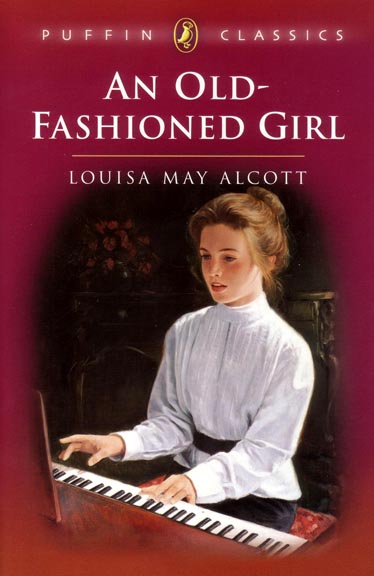
The Classics Club: An Old-Fashioned Girl

"Young men often laugh at the sensible girls whom they secretly respect, and affect to admire the silly ones whom they secretly despise, because earnestness, intelligence, and womanly dignity are not the fashion."
~An Old-Fashioned Girl by Louisa May Alcott

I first tried reading An Old-Fashioned Girl when I was ten and had run out of things to read.  I think I got about halfway through the first chapter before I tossed the book down in disgust.

I don't know what I was thinking.

When I picked up AOFG again, I must have been about twelve.  This time, the story came alive for me.  Polly, Fanny, Tom, Maud, Grandma Shaw, Will, Mr. Sydney all seemed so tremendously real, even more so than the March sisters in Little Women (sacrilege, I know).  Since then, I've read AOFG a good half-dozen times, and this most recent re-read was the best yet.

Polly Milton, the protagonist, is one of those overlooked literary heroines.  She's sweet without being sloggy, funny without being over-the-top, old-fashioned and charming but not prudish, pleasant and likable but not without her faults... in short, she's the kind of girl everyone would want for a friend, and I don't know why she isn't more well-known in the bookish world.  When the story begins, she's fourteen, but the book skips ahead six years about halfway through, and for the rest of the story she's twenty.  I liked her in the beginning, of course, but I liked her even better in the second half of the book.  I'm not quite sure why, but she just seemed more real somehow.

For those of you who don't know the story, Polly is a country girl who comes to stay with her friend Fanny Shaw in the city, and during her stay she's exposed to a lot of unfamiliar things in a much faster-paced world (it's the 1870's, mind) than what she's been accustomed to.  She embarrasses Fanny at times with her lack of airs and graces, but by the time she goes home again, the girls are closer friends than before and the entire Shaw family (including Fanny's incorrigible brother Tom and spoiled sister Maud) is (are) sad to see Polly go.  (I know "family" is a singular word, but I always want to put "are" instead of "is," especially when I'm specifying people in parentheses... anyways.)

Then the narrative takes a six-year leap and suddenly Polly's back in the city again, this time to earn her own living as a music teacher.  Fanny's an unhappy young society woman, Tom is a college dandy and Maud an attention-hungry schoolgirl.  And this time a little bit of romance starts to creep into the story, and refreshingly enough it doesn't quite look like there's going to be a happily ever after until the very last chapter (in which there IS a happily ever after--yes, I know I just spoiled that, you're welcome.)

Fanny always annoyed me a bit when I read the book in previous years.  She struck me as a silly little snip who didn't appreciate what a good friend she had, and even after Polly's good influence didn't seem to change much for the better.  But when I re-read AOFG a few weeks ago, I saw Fanny in a different light-- maybe it was the fact that I hadn't read the book in over a year, or maybe it's that I'm getting older and more mature (now wouldn't THAT be nice) or maybe it's that I just missed stuff the first few times.  But at any rate, I found myself liking and pitying Fanny more than ever before, and truly rooting for her to have a happy ending.  (Yes, of course I knew how the story turned out, but there's still that feeling of suspense, you know?)


"Do go along, or you'll be too late; and then, what will Polly think of me?" cried Fanny, with the impatient poke which is peculiarly aggravating to masculine dignity.
"She'll think you cared more about your frizzles than your friends, and she'll be about right, too," [said Tom.]

Tom is one of my favorite characters in the story.  At fourteen he's funny, mischievous, prank-playing, a good sport and a bit annoying at times but well-meaning.  At twenty, he's suddenly become a bad student, far too attentive to his appearance (and not in a Sir Percy way--Tom is just annoying) and, horror of horrors, engaged to a girl with the loathsome name of Trix.  (What were her parents thinking?  I bet they worked for General Mills.  Yes, that must be it.)  Yet he still has a good heart underneath, and though he gets into trouble even more as a young adult than as a teenager, you can't help liking him.  At least, I couldn't.

Maud was simply hilarious when she was a spoiled-brat six-year-old, and quite likable and cute at twelve.  She seemed to be much more of a real person in the second half of the book, but I was always amused at her lisping whines in the first part.

...and a little girl, of six or seven, came roaring in. She stopped at sight of Polly, stared a minute, then took up her roar just where she left it, and cast herself into Fanny's lap, exclaiming wrathfully, "Tom's laughing at me! Make him stop!"
"What did you do to set him going? Don't scream so, you'll frighten Polly!" and Fan gave the cherub a shake, which produced an explanation.
"I only said we had cold cweam at the party, last night, and he laughed!"
"Ice-cream, child!" and Fanny followed Tom's reprehensible example.
"I don't care! it was cold; and I warmed mine at the wegister, and then it was nice; only, Willy Bliss spilt it on my new Gabwielle!" and Maud wailed again over her accumulated woes.

One thing that particularly stands out to me in AOFG is the simplicity of the dialogue.  The way the characters speak is so very real--there are a few times in Little Women and, yes, even Eight Cousins where the conversations come across as rather stilted and unnatural.  Not so in AOFG (though AOFG might seem more likely to have saccharine dialogue--the title itself, you'll have to admit, sounds rather hopelessly Victorian and rosy and cutesy).  Now, of course, Little Women was scribbled out over a period of six weeks without much wiggle room for editing, so it's only natural that some parts of it should be not quite on par with the rest, but AOFG is still my favorite as regards the dialogue.    As Alice says, a book is no good if it has no pictures or conversations, and though I don't quite agree about the pictures (sounds too much like Gaston...) I have to agree that a book with dry conversation is apt to be a dry read on the whole.  And AOFG is jam-packed with interesting conversation, the kind that makes you really want to find out what happens on the next page.


"Don't do that again, chicken, or you'll blow me away. What's the matter?" asked Tom, throwing down his book with a yawn that threatened dislocation.
"I'm afraid I can't go to Polly's," answered Maud, disconsolately.
"Of course you can't; it's snowing hard, and father won't be home with the carriage till this evening. What are you always cutting off to Polly's for?"
"I like it; we have such nice times, and Will is there, and we bake little johnny-cakes in the baker before the fire, and they sing, and it is so pleasant."
"Warbling johnny-cakes must be interesting. Come and tell me all about it."
"No, you'll only laugh at me."
"I give you my word I won't, if I can help it; but I really am dying of curiosity to know what you do down there. You like to hear secrets, so tell me yours, and I'll be as dumb as an oyster."

And now I'm going to be mean and say that if you, too, are dying of curiosity to know what Maud and Will and Polly "do down there," you'll have to read the book and find out for yourself, because I'm not going to tell you.  Horrid of me, I know.

My rating-- nine out of ten stars.  I'm hesitant to give it ten out of ten, simply because that would mean it's absolutely perfect, and I wouldn't say it's quite perfect.  It has one major shortcoming, and that is that it's simply not long enough and there's no sequel.

Oh, well, never mind-- no sequel means I get to make up the post-ending myself, and that's always fun.

Tuesday, June 12, 2012

The Classics Club: Northanger Abbey

(This isn't the same copy that I have, but I
couldn't find a picture of mine, and this
one was purty so I just decided to use it.)
"The person, be it gentleman or lady, who has not pleasure in a good novel, must be intolerably stupid." ~Henry Tilney, Northanger Abbey

I've joined up with Jillian's Classics Club over at A Room of One's Own-- you can see my list of 61 titles here.  So from now until 2015 (provided this blog stays around that long, that is--and I do hope it does) book reviews will be popping up hither, thither and yon on Yet Another Period Drama Blog.  I'm not sure if that was the proper usage of "hither, thither and yon" but it's fun to say.

Northanger Abbey was the first title that I read, (I may or may not actually have begun reading it before I joined the Classics Club... *cough*) and it's quite fitting that the first novel on the list should have been written by my most favorite author.  Pride and Prejudice occupies the top spot in my opinion of Jane Austen's books, and for the longest time Sense and Sensibility was second, but now I'm wavering between S&S and NA.  Because it's just that good.


If you aren't acquainted with the plot of NA, never fear! I'll be quite happy to wait while you go over and read the Wikipedia summary.

Now we can get to the good stuff.  NA is hands-down the funniest of all Jane Austen's novels.  In my not-so-humble opinion, that is.  The narrative is witty and satirical (not that Jane Austen's narrative is ever anything but), the dialogue is often hilarious and the plot is clever and fast-paced.

Catherine is probably my least favorite of all Jane Austen's heroines, but that doesn't mean I dislike her.  Her wide-eyed naivete and tendency to look at the world through bookish spectacles make her an endearing character, and I even see myself in her at times.  (Searching through a wardrobe for a hidden journal or letters? Guilty!)

Henry Tilney, however, is definitely one of my six favorite Jane Austen heroes.  (And I'm not just listing all of them to be funny--there are actually seven heroes from her six major novels.  You can guess, if you like, who I'm leaving out.) Henry provided a wee bit of inspiration for the hero of my own novel, so I can't help but like him.  Has anyone else noticed how Jane Austen treats Henry a little less reverently than most of her other heroes?  He's frequently referred to by his Christian name (instead of always "Mr. Tilney") and his method of address is rather different from that of, say, Mr. Darcy or Colonel Brandon.  "Now I must give one smirk, and then we may be rational again."

Isabella Thorpe had the dubious privilege of being one of the funniest and most infuriating characters in the story. "But do not insist upon my being very agreeable, for my heart, you know, will be some forty miles off." She's hilariously quotable (check out this post for some great Isabella quotes) and though she's completely insincere in everything she says, she never fails to make me laugh.  She's even influenced me to refer to certain friends as "my dearest creature" at times (you know who you are!).

NA was the last Jane Austen novel I read, for two reasons.  First, I'd heard somewhere that it was a spooky Gothic story (ha, my informer must have been quite misinformed), and I was disinclined to try it... but then I heard that the hero was incredibly funny and wonderful, and since I have a soft spot for hilarious heroes, I decided to read it after all, and saved it for last.  Ironically enough, NA was the first of Jane Austen's novels to be published, but I'm glad I left it for last.  I think anyone, really, would appreciate the humor in it no matter how many of Jane Austen's books she'd read already.  But still, I'm glad I read it last.  P&P was funny, but not as funny as NA, and I think I appreciated the subtle wit more after being previously exposed to Jane Austen's style.

My rating for this book: nine and a half out of ten! My only complaint was that the proposal was not detailed.  I likes me my proposal scenes, and was quite disappointed to be deprived of this one. But other than that, the book was excellent. It's Jane Austen-- what else can I say?

Since I've pretty much rambled myself out (I do hope you weren't expecting anything more than a rather haphazard review of this book...), I'll just share a few of my favorite NA quotes.  (I think I'll make a habit of doing that with all my Classics Club reviews. After all, the book authors can say it far better than I can!)

To look almost pretty is an acquisition of higher delight to a girl who has been looking plain the first fifteen years of her life than a beauty from her cradle can ever receive.

"Why should you be surprised, sir?"
"Why indeed?" said he, in his natural tone; "but some emotion must appear to be raised by your reply, and surprise is more easily assumed, and not less reasonable than any other."


"And what are you reading, Miss – ?"
"Oh! It is only a novel!" replies the young lady, while she lays down her book with affected indifference, or momentary shame. "It is only Cecilia, or Camilla, or Belinda"; or, in short, only some work in which the greatest powers of the mind are displayed, in which the most thorough knowledge of human nature, the happiest delineation of its varieties, the liveliest effusions of wit and humour, are conveyed to the world in the best-chosen language.


"As far as I have had opportunity of judging, it appears to me that the usual style of letter-writing among women is faultless, except in three particulars."
"And what are they?"
"A general deficiency of subject, a total inattention to stops, and a very frequent ignorance of grammar."


As a celebrated writer has maintained, that no young lady can be justified in falling in love before the gentleman’s love is declared. It must be very improper that a young lady should dream of a gentleman before the gentleman is first known to have dreamt of her.


"Ah, Mother! How do you do?" said [John Thorpe], giving her a hearty shake of the hand. "Where did you get that quiz of a hat? It makes you look like an old witch."


"And such is your definition of matrimony and dancing. Taken in that light certainly, their resemblance is not striking; but I think I could place them in such a view. You will allow, that in both, man has the advantage of choice, woman only the power of refusal; that in both, it is an engagement between man and woman, formed for the advantage of each; and that when once entered into, they belong exclusively to each other till the moment of its dissolution; that it is their duty, each to endeavour to give the other no cause for wishing that he or she had bestowed themselves elsewhere, and their best interest to keep their own imaginations from wandering towards the perfections of their neighbours, or fancying that they should have been better off with anyone else."


"Oh! Mr. Tilney, I have been quite wild to speak to you, and make my apologies. You must have thought me so rude; but indeed it was not my own fault, was it, Mrs. Allen? Did not they tell me that Mr. Tilney and his sister were gone out in a phaeton together? And then what could I do? But I had ten thousand times rather have been with you; now had not I, Mrs. Allen?"
"My dear, you tumble my gown," was Mrs. Allen’s reply.


"Miss Morland, I think very highly of the understanding of all the women in the world – especially of those – whoever they may be – with whom I happen to be in company ... Miss Morland, no one can think more highly of the understanding of women than I do. In my opinion, nature has given them so much that they never find it necessary to use more than half."


And then his hat sat so well, and all the innumerable capes of his great-coat were so becomingly important!


Her greedy eye glanced rapidly over a page. She started at its import. Could it be possible, or did not her senses play her false? An inventory of linen, in coarse and modern characters, seemed all that was before her! If the evidence of sight might be trusted, she held a washing-bill in her hand.


Happy the glance that first distinguished Catherine! Happy the voice that proclaimed the discovery! But whether such happiness were the lawful property of George or Harriet could never be exactly understood.