Showing posts with label movie reviews. Show all posts

Monday, July 17, 2017

Hidden Figures (2016): The First Movie Review On This Blog In Basically Forever

"There are twenty bright, highly capable Negro women in the west computing group, and we're proud to be doing our part for the country. So yes, they let women do some things at NASA, Mr. Johnson. And it's not because we wear skirts. It's because we wear glasses."
~Katherine Goble

The average lifespan of a raccoon in the wild is about three years, and I was going to open this post by saying that I haven't written a movie review in a coon's age, but then I thought that was probably a slight exaggeration.

In reality it's been two years and eleven months.  Um. Ahem.  (Yeah, even I couldn't believe it's been that long. I had to go back and check. And re-check.) Saving Mr. Banks was the last movie I reviewed on this blog, and if you feel like refreshing your memory, you can go here. For what it's worth, I did have a few drafts lying around that I poked at from time to time, but... yeah. I don't have much of an excuse beyond the general "well, life is busy!" Sure, life is busy. But if you want to write, you have to make time to write. 


(...I may make my next post an update on various things that have made my life busy lately, by the way.  If anyone would care to read about that. I have no intention of shoving my personal life down your throat, but I know I get curious about the lives of people whose blogs I read, so if you would find such a thing interesting, please give me a shout in the comments, because I do have a few updates that may be of interest.)

Oh, and when I started writing this post, I had also been sick for the last week and today {that is, the day I started this... in May... heh...} I am actually well enough to sit up and look at a laptop, but not well enough to go to work, and a blog post felt like a good idea since my brain is beginning to feel like little gray cells again, and not oatmeal. 

So here I am, writing about a movie that I actually saw on the big screen. WILL WONDERS NEVER CEASE.

Hidden Figures does not quiiiiiiite fit the bill of fare around here. It's a stretch to call it a period drama - my grandparents are around the ages of the characters in the film, give or take a few years, and some of the real women on whom the film was based are still alive today.  But there are pencil skirts and long-finned Cadillacs and an IBM computer that takes up an entire room... which means the movie portrays another world in the past, to some degree, so I'm letting it slide on my Historical Films radar.  (Not that that radar is particularly strict to begin with... I have a half-finished review of Sherlock's The Abominable Bride in my drafts, too. Ahem.) However, it's my blog, and my rules, and blah blah.

So here we go.  (Spoilers GALORE. Although if you didn't at least vaguely know that John Glenn successfully orbited the Earth in 1962 then maybe you need to go to back to school and stop reading movie reviews.) 

I knew I was going to love this movie from the very first present-day scene. (The opening with Katherine as a small child being a math whiz was fun, and set a good backdrop, but the movie didn't really get going until the story catapulted us into 1961.)  There were several factors - Mary's clothes. Mary's sass. Katherine and Dorothy's comebacks and bed-bath-and-beyond-done-ness with Mary's sass. Oh, and my dream car. Because yeah, that car of Dorothy's has been my dream car for YEARS. That may have been a silly reason to fall in love with the movie so quickly (especially considering I'm really not a car person... like, at ALL) but humans are weird creatures and reactions are visceral and sometimes you just KNOW you're gonna like something, you know? 


(This is a behind-the-scenes photo but I couldn't find another good shot with the car in it. :P)

Katherine Goble was one of those people I just knew I was going to like.  She's patient, she gets the job done, she deals with miles upon miles of setbacks and she just keeps pushing forward.  When she gets a position with Mr. Harrison's team, checking code for other mathematicians, and she puts her name alongside of Paul Stafford's report (rightly so, because she did just as much work as he does), he gets annoyed and refuses to let her take credit for the work she did.  And yet the next time she puts her name back again. And again. And the next time.  And every time he takes it off, destroys the cover sheet, tells her to do it over, and she doesn't get mad - she just puts her name right back the next time, and I loved that.  It's a simple gesture that says, "I know my work matters, and I know that you don't believe that it matters, but that doesn't change the fact that it does matter, and I will keep right on saying that just as long as you keep erasing it." 

Katherine isn't one to immediately speak her mind the way Mary is (getting to Mary in a second), but she makes her voice heard when it needs to be heard.  The scene where she breaks down and loses her temper at Harrison over not having access to a ladies' room is one of the most well-played scenes in the whole movie, and the following scene where a chastened Harrison knocks off the segregation signs with a crowbar and tells the dumbstruck crowd, "Here at NASA, we all pee the same color," is one of the most satisfying.  (Yeah, you probably never thought you'd see that word on this blog, but guess what, it's in the movie, and though I try to be reasonably ladylike around here, I do not skip over a good pithy statement when I see one.)


One of the things I really liked about the movie's portrayal of Katherine is that it shows her first and foremost as a mathematician.  She is also a mother, and she also has a romance (that plays out in a very lovely way and I was delighted to find that it ended very happily in real life as well), but the story is not about Katherine's struggle to balance work and home life and find her real place in the world as a working mom. She has a job, about which she's very passionate, with which she supports her three girls (and presumably her mother, who doesn't seem to work outside the home as she appears to be in her upper 70's). End of story.  When one of her daughters brings up the subject of Katherine coming home late, she simply says, matter-of-factly, that she has to be both mama and daddy since their daddy's in heaven, and that's all there is to it. And while a movie based solely on Katherine's career is not quite what this is (getting to the romantical part in a moment), I appreciated the fact that the focus wasn't detracted from the work at hand by a spin-off on the whole working-single-mother thing. (Although if someone DOES want to make a spin-off of this movie, about Katherine's personal life, I would totally watch that.) 


I was not a fan of Jim Johnson's character at first, but he definitely grew on me. I was really happy to see how he interacted with Katherine's daughters and with Katherine herself in a relatively short space of time (that is, screen time), and the proposal scene was... well, adorableness. I'm already spoiling things right and left for anyone who hasn't seen the movie yet, but I also appreciated that the romance wasn't made the focal point of the movie.  It was a sweet side note, and historically accurate since Katherine Goble really DID marry Jim Johnson (and they were married for fifty-some years!), but it wasn't the point of the movie and I was pleased by the fact that the filmmakers didn't try to divert attention from the real story at hand with a sugar-coated Hollywood romance.

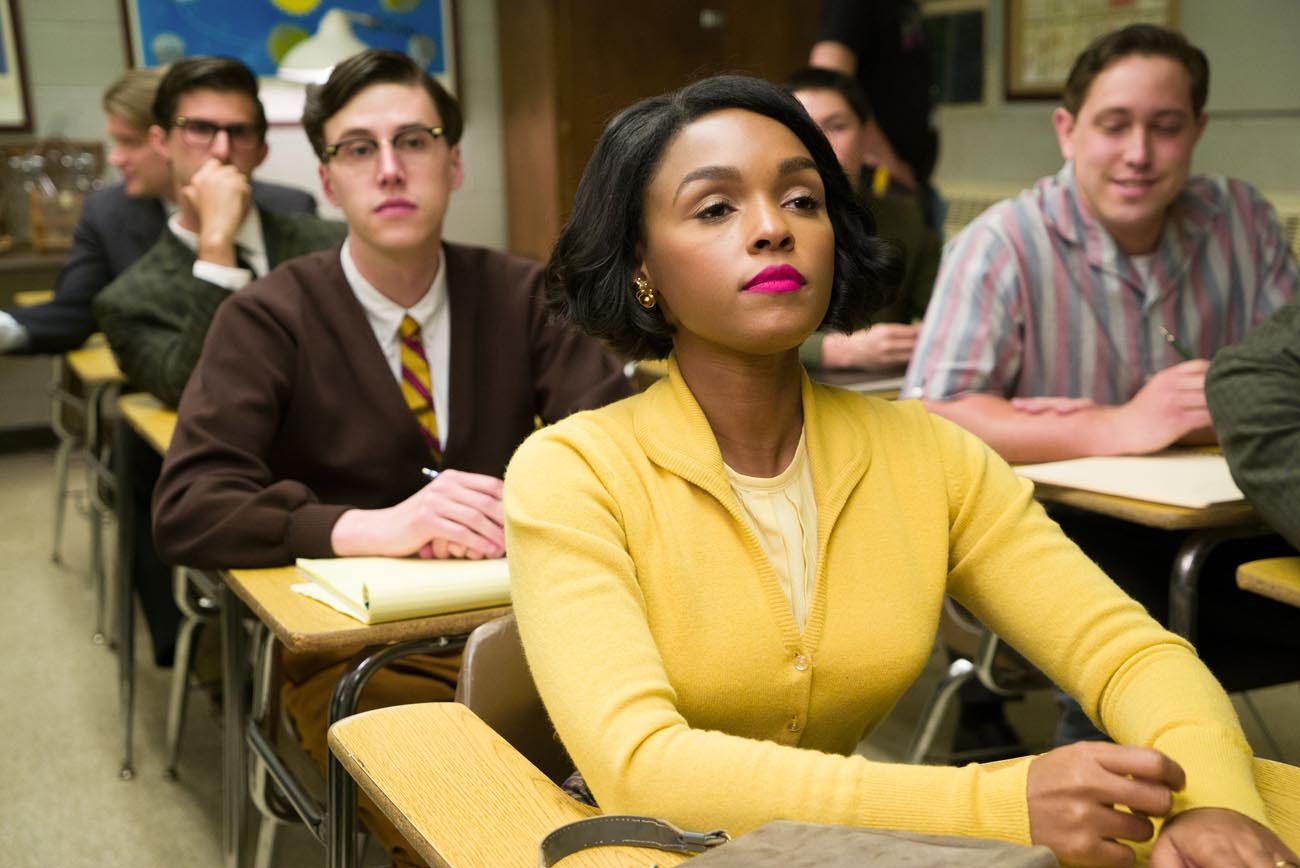
Quick note on Katherine's clothes--  because clothes are my Thing and you know I couldn't *not* talk about them-- aaaaaaaah, if it weren't for the Cold War and communism and racism and sexism and lack of central air-conditioning, what I wouldn't GIVE to live in the fifties/early sixties! I loved how her styles really set her apart from the other mathematicians, aside from her obvious gender and ethnicity - the pops of color she brought to that largely black-and-white-and-grey room were very visually appealing, and I enjoyed that. I basically just want all of her dresses. Yes? Yes. Please and thank you.

Moving on to Mary.

"I plan on being an engineer at NASA, but I can't do that without taking them classes at that all-white high school, and I can't change the color of my skin. So I have no choice, but to be the first, which I can't do without you, sir. Your honor, out of all the cases you gonna hear today, which one is gonna matter hundred years from now? Which one is gonna make you the first?"
~Mary Jackson

The only thing that kept Mary from being my favorite character in the movie was the fact of Katherine's existence. Seriously, if it hadn't been for Katherine Mary would have been my #1. She's hilarious, she's snarky, she gets stuff done, she has brilliant fashion sense and she's not afraid of anything.  I loved how she was constantly dressed in bright colors and sharp, clean-cut styles - it went a long way towards pinpointing her vibrant, edgy personality.

I wish Karl Zielinski, the older engineer who mentored Mary at the beginning of her assignment on the test rockets, had had a larger role in the movie, because I'd be very interested to know more of his story.  This exchange between them after Mary had identified the air-resistance problem with the wind tunnel is one of my favorites:
"Mary, a person with an engineer's mind should be an engineer. You can't be a computer the rest of your life."
"Mr. Zielinski, I'm a negro woman. I'm not gonna entertain the impossible."
"And I'm a Polish Jew whose parents died in a Nazi prison camp. Now I'm standing beneath a spaceship that's going to carry an astronaut to the stars. I think we can say we are living the impossible. Let me ask you, if you were a white male, would you wish to be an engineer?"
"I wouldn't have to. I'd already be one."

And then... she more than entertained the impossible. She went and did it. Because she is awesome.

We didn't see quite as much of Mary's relationship with her husband Levi as we did of Katherine and Jim, but I was pleasantly surprised by the realness in the portrayal of their marriage.  Again, I was afraid that we'd be treated to an angsty wrist-on-forehead agonizing on Mary's part - WHICH is more IMPORTANT? her HUSBAND and CHILDREN or her CAREER? and he will NEVER BE suPPORTIVE?!?!?!?!

While such things certainly have happened, that didn't seem to be the case with Mary and Levi, and I was happy that the movie chose to show his initial opposition to her court case (pleading her right to take night classes at the high school to become an engineer) as only the first step in their story.  By the end, he was right there beside her, and she succeeded with his full support. Whether this is actually historically accurate or not (I did buy the book on which the movie is based, and am anxious to start it soon!), it was a nice thing to see. The filmmakers could easily have set up an ending in which Mary chose the scientific path despite Levi's protests (a "nevertheless, she persisted" type of situation that necessitated her persistence past her loved ones as well as the bigotry of strangers), which would have been somewhat depressing, but instead their mutual desire to see justice served and prove wrong the people who wanted to push them back made for a really satisfying ending.

Dorothy Vaughan had a little less screen time than the other two, I thought, and perhaps that was part of what made me a little less interested in her.  Her story is still intriguing, and her quiet push for the right, though not as sassy as Mary's or bold as Katherine's way of making their voices heard, is still inspiring. I'd previously seen Octavia Spencer in a more firecracker-type role, as Minny Jackson in The Help, but I think I liked Dorothy's character almost as much. 


I felt Dorothy's relationship with Vivian Mitchell (little Amy March, all grown up!), though somewhat fictionalized (both Mrs. Mitchell and Paul Stafford were composite characters, drawn from several different people, and did not have actual real-life counterparts), hit pretty close to home even for today. "Despite what you may think, I have nothing against y'all," Vivian tells Dorothy near the end of the movie.  "I'm sure you believe that," Dorothy replies. It's a seemingly innocent and quick exchange, but it called up so many similar conversations I've had and observed even in my own rather sheltered, white, Northeastern existence.  Sometimes bigots and racists don't come dressed in flowing white robes and pointed hoods, or goose-stepping brown uniforms with skulls and crossbones. Sometimes they're people you know, people you respect, people who think that they don't harbor any hatred in their hearts toward people who aren't just like them.  And yet the truth comes out in little snippets here and there-- "it's just the way things are" and "I don't make the rules," easily translate to, "I don't have any problem with the rules, and would rather allow an injustice to continue because I don't want the bother of admitting that the injustice goes on because of people like me." 

I was happy that Vivian's character had softened a bit by the end, though - and in keeping with the movie's use of the main characters' first names (and my own practice in this post), I'm trying to refer to her by her first name, though Dorothy always respectfully calls her Mrs. Mitchell.  She doesn't have a choice in the matter, but by the end of the film Vivian has called her Mrs. Vaughan. I'll admit to a couple of fist-pumps when that happened. :D 

As mentioned above, Paul Stafford wasn't a real person either, but I think his addition to the movie was a good storytelling choice. Every fairy tale needs a good old-fashioned villain, and though this was real life and not a fairy tale, every story needs a well-defined antagonist to let us know why the main character does not get The One Thing They Are Searching For right off the bat.  Paul's character was stuffy, narcissistic, incredibly smart, and maybe just a little too perfectly opposed to everything Katherine wanted (anyone else think he was the mind behind the separate coffee pot?).  Perhaps the mish-mashing of various people who made Katherine's job difficult was a bit heavy-handed, and Paul came across as two-dimensional at times, but again, I can't really complain. Poetic justice was served at the end when Katherine finally put her name alongside his in a report and he brought her a cup of coffee, and I for one wasn't complaining.  It feels good to see that the good ended happily, and the bad unhappily. Miss Prism in The Importance of Being Earnest would tell us that that is what Fiction means, but it's nice to think that it's what real life means sometimes too. 

Oddly enough, this movie isn't about writing.  There's a little nod to the creative/linguistic process in the recurring shot where Katherine types up Paul's notes and relentlessly adds her own name in the byline - she did just as much of the work as he did, and deserves credit for the effort it took to tie all their joint work into a cohesive and concise narrative.  Writing is important, and yet over and over Katherine's writing is discredited because Paul won't stand for a woman's name on the title page alongside his - but the movie still isn't about writing.

Yet I felt the familiar tug of writing-inspiration while watching the movie.  That's part of the highly subjective rubric by which I determine how much I liked a movie. Did I come away from it feeling a creative itch, a wanting-to-learn-more itch, a desire to imagine what could have happened next?  Hidden Figures is based on historical fact, and the blending of fiction and real events fascinated me (in much the same way that Saving Mr. Banks did a few years ago).  I love the way the story came to life through the imagination of the filmmakers - yes, they changed a few things to make the narrative flow more smoothly, but they brought a previously poorly-recognized scientific contribution to light for so many people who might not have known about it otherwise. That, to me, might be one of the highest forms of art achievable. I don't mean to deride fantasy or pure imagination, but in my mind, to take something real and make it seem more real with the power of the right words strung together... that's a feat. That's the kind of thing I want to write.

Someday, that is, when I actually take/find/squeeze out/contrive the time and discipline to sit down and write it. 


P.S. If you're interested in purchasing a copy of Hidden Figures on Amazon, you can do so below!

Thursday, August 21, 2014

Saving Mr. Banks (2013) Review


"Mary Poppins and the Banks'... they're like family to me."
~P.L. Travers, Saving Mr. Banks

"Every so often, I encounter a movie that touches me in a very personal way."  That was how I was planning to begin this post, but for some reason I kept being bugged by the thought that I'd used that phrase before.  A couple of hours and lot of post-sifting later (peoples, there are a TON of words floating around on this blog. seriously, it might be in the millions.), I discovered that I used that sentence to open my review of Little Dorrit back in January 2012, so apparently minds-that-belong-to-the-same-person-but-are-separated-by-two-and-a-half-years think alike.   Who'd-a-thunk it.

Anyways.

When I was little, Mary Poppins was my favorite movie in the whole world.  My parents were particularly careful about what movies my sister and I were allowed to watch, and Mary Poppins, Little Bear, The Incredible Journey, So Dear to My Heart, Winnie the Pooh and Peter Pan were about the extent of our repertoire from when I was four to seven.  Mary Poppins, though, was the be-all, end-all as far as I was concerned.  I knew all the songs by heart (still do), could recite practically any line in the movie (even all the jokes that went over my head) and worked out a complicated Supercalifragilisticexpialidocious choreography with my sister, using my Winnie the Pooh umbrella as a stand-in for Mary's parasol.   (Er, sorry, Mary Poppins.  Never, ever just Mary.)


So you can imagine how excited I was when I heard "they" were making a movie based on the making of the movie.  I mean, how cool is that?  The thrills were tinged with the slightest bit of apprehension, though-- I knew the story behind Mary Poppins wasn't entirely a happy one.  We had the old VHS tape with the behind-the-scenes video (it included actual footage from the premiere, the height of glamour to my young mind) and so I already knew a good bit about how Mary Poppins traveled from page to screen.  And I knew P.L. Travers, the author, was less than thrilled with the way the movie turned out.  So it was with some trepidation that I watched Saving Mr. Banks for the first time, because if there's anything that bums me out when watching a movie, it's a depressing ending.  And from what I knew of the facts, a depressing ending was heading the viewers' way with all the relentlessness of an uptight British author who wouldn't see things any way but her own.

(Please note that depressing endings and sad endings are not at all the same thing and I love a good sob-fest as much as the next Deep Person out there.  I was recently informed by a friend that her youngest sister speaks of me as, "Oh, I remember her! She likes sad movies!" Yes. Yes, my child, you speak the truth.)

Anyways.  Proceeding.  Let's take a look at this movie.  Bit by bit.

I'm a huge fan of instrumental versions of movie songs (musical overtures are THE BEST), so when the credits began with a haunting piano version of Chim Chim Cher-ee, I was pretty much hooked.  I can't say enough good things about this movie's soundtrack.  Seriously.  Thomas Newman's music is always gorgeous, but when his original work is combined with new arrangements of the Sherman brothers' masterpieces... well, let's just say it's one of my favorite movie scores ever.  Childhood favorite songs blended with lovely new pieces combining a soaring classical sound with a vintage swing vibe?  YES PLEASE.

(Um, please note that this review is going to be really long and really rambling and probably a lot more personal than many of my other reviews, so hang in there and stay till the end and I'll like you for always.)

ALSO IT WILL BE RIFE WITH SPOILERS SO CONSIDER YOURSELF WARNED.


Before SMB, I'd seen Emma Thompson in just two and a half films-- her brilliant 1995 adaptation of Sense and Sensibility, the wittily hilarious 1993 version of Much Ado About Nothing, and her (sadly short) scenes in Kenneth Branagh's Henry V.  (Okay, maybe that's more like two-and-an-eighth.)  Anyways, I knew she was a fabulous actress, but I was used to seeing her in more lighthearted, almost ingenue roles.  (Elinor Dashwood may be serious and sedate, but she's still young and in love and knows how to have fun.)  Which is why I was so blown away by her performance as P. L. Travers-- she was self-centered, embittered, tired and misunderstood and mean to people, and yet you wanted so badly for her to just win.  She was unreasonable, demanding, tactless and abrupt, unfriendly-- at times she was even acting like an angry person-- but Emma Thompson's phenomenal acting ability made her lovable all the same.  Because you could see that deep down she was still that little girl who lived in a world inside her head--  a world that was so much better and brighter and clearer than the real one, a world her father had helped her to set in motion, a world that started disintegrating when she lost him for good.  She still had a little bit of her childhood self in her, no matter how much she denied it, and she hadn't lost her ability to laugh.  Or cry.  Or listen to people and realize that they're not really out to get you.  Or, in the end, to forgive herself.

In short, she was practically perfect in every way.  (Yes.  I had to do that.)  And so, so relatable-- for me at least.  Grammar stickler, check.  Tea fanatic, check.  Bossy, check.  Insistent that the movie be like the book? CHECK CHECK CHECK.

...ahem.

"NO, NO, NO.  Mr. Banks does NOT have FACIAL HAIR."
"Tea is balm for the soul.  Don't you agree?"
"It is blasphemy to drink tea from a paper cup."
"And you [Mickey Mouse] can stay there until you learn the art of subtlety."


Tom Hanks does not look like Walt Disney.  I know it.  He only sounds sort of like Walt Disney.  I know that too.  And yet I was totally willing to overlook all that because he was so much fun.  Sneer at my vapidity if you choose-- I'm fully aware that I am deeply shallow.  But seriously, he was splendid.  "Nope, I brought you here for monetary gain.  Had a wager with the boys that I couldn't get you on a ride... I just won twenty bucks."  *ka-chow*

However,  I also liked how the film didn't portray him as this perfect guy who lived merely to make other people happy and had no vices of his own.  Showing his smoking habit onscreen was apparently pretty controversial, but I for one applaud the choice.  (I don't approve of smoking, obviously, but I did appreciate that they were being realistic about a man who's been romanticized a great deal over the last sixty years.)  And when he took Travers to Disneyland and handed out pre-printed autograph cards... well, that seemed a little bit cheesy and commercial, too, but I'm also glad they didn't try to sugarcoat that either.


Their relationship was so sweet, too.  (Um, not hinting there was any romance going on there or anything, haha.  Just a note for those who may have disregarded the spoiler warning and are reading this without having seen the film.)  P.L. Travers was so terribly prickly and cold and yet Walt Disney managed to make her laugh and smile and even ride King Arthur's Carrousel, for Pete's sake.  (WHY does a Disney carousel need two R's when all the rest of the world gets along fine with just one?  Huh?)  "Get on the horse, Pamela."

I realize that in reality, P.L. Travers and Walt Disney did not part friends.  The film doesn't even try to say that.  Yet I still loved how, despite their clashing ideas, they managed to share some truly special moments with music and similar memories and even strolling through Disney's dollar-printing machine.   Er, Disneyland.  We'll talk about this more in a few paragraphs, but for now I'll just say that I was okay with the way happiness prevailed when Disney was around, despite Travers' sharpness and frowns.  


Paul Giamatti as Ralph was definitely one of my favorite characters in the movie.  He was so warm and happy and friendly and upbeat... I just loved him.  The only American I ever liked... no, you may not ask why.

"The rain brings life."
"...So does the sun."
"Be quiet!"


Richard Schwartzmann and B.J. Novak look absolutely nothing like the real Sherman brothers.  Hair color, all right.  I'll give them that, but it ends there.  Does it matter?  DOES.  IT. MATTER.
Nah, not really.  They were absolutely hilarious and I still can't decide which one I liked better.  Robert is snarkier (and gets snapped at more) but Richard is adorabler ("wait, are we getting real penguins?").

"No, no, adorabler is NOT a WORD."
"I made it up."
"WELL, UN-MAKE IT UP."


Surprisingly enough, I didn't enjoy the flashbacks to Travers' childhood half as much as I did the main story.  You would think that a period drama nut would prefer the scenes set in the early Edwardian era to those set in 1960's L.A., but I must shock my readers now and again or life would get a bit dull, now wouldn't it?

Annie Rose Buckley was splendid as Young Helen.  (If you haven't seen the movie, all this name stuff is probably confusing you to no end... sorry.  :()  (Okay, a sad face combined with an end-parenthesis looks really weird.)  Sometimes child actors who are supposed to be particularly cute or pathetic can be really annoying, but she somehow nailed the combination of dreamy/imaginative and endearing-child-who's-going-through-a-lot-of-trauma without alienating the audience.  (Well, this member of the audience, anyway.)  Plus she's just adorable.  I loved how her kinky curls stayed the same through adulthood... okay, the adult curls were probably helped by bobby pins but hey, continuity.  Don't ruin my theories.

Colin Farrell as Travers Goff was... well, he was pretty doggone good.  If we're using the word "good" to mean "excellent at making me really really annoyed at him for about 80% of the time he was onscreen and really really sorry for him for about 18% and admiring his ingenuity and imagination for the other 2%."   Which may have been just what the filmmakers were going for.  I don't know.  I can't get inside anyone's head but my own.  

...No, wait, I'm a writer.  That's a stupid thing to say.
Whatever.

Anyways, yeah, Travers irritated me a LOT.  And yet he was quite pitiable.  But I just wanted him to PULL himself TOGETHER.  I know alcoholism is a crippling addiction-- I don't mean to make light of that.  Yet he had no desire to change himself, even though he seemed to know just how terrible a toll his drinking was taking on his family.  I won't pretend I was terribly sad when he died-- I mean, I felt bad for his poor daughters and wife, especially Helen of course, but you could see his death coming a mile away and he was making life miserable for everyone around him and... well... yeah.

(Probably some of my distaste for his character also came from the fact that he reminded me very much of Michael Landon and I'm not the world's biggest fan of Michael Landon.  Haha.)

I do wish this scene had been included in the final cut, though-- gives you a glimpse of the happier, more hopeful side of the Goff family.


Ruth Wilson as Margaret Goff was also very good in the part she played-- again, pitiable but not exactly my favorite character.  Though I did like and admire her wayyyyyy more than her husband.  She's a much more sympathetic character (look at what she goes through!) yet she doesn't seem to have much of a personality or backstory or motivation or any of that.  I'm not nitpicking, I promise-- but that suicide attempt scene seemed to just come out the blue.  At first I thought she was leaving her husband-- but then she didn't take her kids with her-- and then she just walked right into the pond and I was like, um, NOOOOOOOOO.  (Melody and I watched this movie together for the first time and it was about 11:30 at night at this part and we were freaking out.  Ha.  Good times.)  I wonder what became of her afterwards, too... one would assume she got her life back together once Ellie arrived and Took Charge, but we never do find out.  (In reality, Travers Goff died unromantically of influenza-- brought on by alcohol abuse-- and Margaret Goff took her three daughters to live in New South Wales.  But this wasn't mentioned in the film.)


So, let's go back to the 60's.  As I said, I preferred these parts of the movie-- the clothes were of course cooler in the 1910's but the overall feel of the story was happier and more interesting in Travers' adult years, and I'm a sucker for Happy and Interesting.  

Take Dolly, for instance.  She was a hoot and a half.  And her jello molds were fantastic.  Plus, she has some really quotable lines.  "She only wants to eat green vegetables and broth... I don't know what that is.  Oh, and she doesn't want any red in the movie.  ...At all."  She added quite a few lighthearted giggles to scenes that could have turned frustrating because of Travers' persnicketiness.  (Hmmm, 'twould appear that IS a word.)  


On the one hand, I really can see where Travers was coming from with all her fidgeting and do-ing and don't-ing.  When you create a story and give it everything you've got and write it exactly the way you see it in your head, I imagine it would be very very hard to see someone else exploring a totally different vision for it and changing it up.  I'm a pretty strict by-the-book purist for stories I haven't written-- I can't imagine how exacting I'd be if someone were making a movie out of something *I* wrote.  (Probably worse than P.L. Travers.  Heh.)  However, I do feel sorry for Don DeGradi and the Shermans-- putting up with Travers day after day, listening to her tear their creations to bits, couldn't have been easy.  I think they all handled her remarkably well, really. 


I love all the little references to the movie in the production/storyboard scenes.  Obviously you can't make a movie about the making of Mary Poppins without referencing parts of the dialogue or story, but nonetheless I felt a little squeal-y every time I recognized a tidbit from the finished film.  Like the debate about Mrs. Banks' first name, for instance. I didn't need IMDb to know that the names they consider all come from that scene with the penguins where Bert reels off the list of women who can't compare to Mary Poppins.  (And yes, I can recite the list at a rate of about 300 words per minute. "Iiiiiiiit's truethatMavisandSybil'avewaysthat'rewinningand...")


Feed the Birds has, for a long time, been one of my favorite Disney songs, period, and probably my all-time favorite Mary Poppins song.  I knew it was Walt Disney's favorite as well, so one of my first thoughts when I heard about SMB was that I hoped they'd include a scene in which he gets to hear the song.  And, of course, because this movie is practically perfect, they did.  I exercised my proficient tearing-up skills, naturally.  I don't know what it is about that song, but... 

...yeah.  

Anyways.


If Feed the Birds is my favorite Mary Poppins song, then Let Us Go and Fly a Kite is my second favorite.  Definitely.  It's just so full of elation and glee and fun and it seeeeeends youuuuuu soooooooaaaaaring... ahem.  And by the time that song showed up in SMB, I was ready for some elation and fun.  Because we'd had scene after scene of frustration and long nights and painful childhood memories and Travers being a human cactus, and we needed a song.

And we got it.  And for just one glorious, happy-go-lucky moment, nothing in the world mattered except the piano and the singing and the dancing-- the dancing!  I'm so sorry, but she's dancing! Mrs. Travers, she's dancing with Don!-- and nobody cared whether "let's go fly a kite" was correct English or not.

Coming from P.L. Travers-- and from me, if we're being honest here-- that's a pretty big concession.


Even though this is a Disney movie, it couldn't end there with the kite song sequence, though.  I would have been happy if it had ended there, but deep down I know that wouldn't finish the story.  And in order to finish the story, there had to be more hurt feelings, more frustration, more storming out of offices and flying back to London.  But before Travers went back to her house with her giant plush Mickey Mouse (am I the only one incredibly touched by the fact that she did take it with her?) and her noticeably softened hairstyle (yay for little touches of symbolism!), she stopped to tell Ralph the driver that he was the only American she'd ever liked, and that difficulties can be overcome and his daughter Jane could be anything she wanted to be.

Hang on, there's something in my eye.


And then the film production people messed with reality, because in real life Walt Disney didn't catch the next plane to London and follow Travers to her home so they could have a heart-to-heart.  Prosaically, he just picked up the phone and called her long-distance.  But-- and we'll get to this in a moment-- the concept of him going all the way across the ocean to have this conversation with her was very important, and so I think it was a wise storytelling choice.

"Because it's not the children she comes to save.  It's their father.  It's your father."

Fathers and their children are the theme of this movie, no bones about it-- though I'll admit it took me until the third viewing to realize it's Travers Goff who's reciting the opening voice-over lines.  "Can't put me finger on what lies in store... but I feel what's to happen, all happened before."  Walt Disney and his father, Helen Goff and her father, Jane and Michael Banks and theirs... they all had difficulties.  Jane and Michael's father's story grew out of the reality of Helen Goff's own father, with one little tiny change-- Jane and Michael's father was saved in the end.  Mary Poppins came and fixed everything when Aunt Ellie wasn't able to.

And that was the heart of the story.  The part that mattered.  The part that, finally, Walt Disney understood.

"Give her to me, Mrs. Travers. Trust me with your precious Mary Poppins. I won’t disappoint you. I swear that every time a person goes into a movie house, from Leicester to St. Louis, they will see George Banks being saved. They will love him and his kids, they will weep for his cares, and wring their hands when he loses his job. And when he flies that kite... they will rejoice. They will sing. In every movie house all over the world, in the eyes and the hearts of my kids, and other kids and their mothers and fathers for generations to come, 
George Banks will be honored. 
George Banks will be redeemed. 
George Banks and all he stands for will be saved."


After that one revealing moment in Travers' prim London sitting room, the rest of the film seems to go by pretty quickly.  Production wraps, royalties are paid, Travers begins working on a new book and hires her maid back again (much to the amusement of her lawyer, who-- did I mention?-- is none other than Wilmott from Jeeves and Wooster.  Fun fact of the day for you.)  And then the film premieres, Travers comes back to California despite not being invited (I was cheering her on the whole way :D) and, dressed in a lovely white evening gown and a wrap I can only imagine she swiped from a hospital operating table, she goes--with Ralph!-- to see Mary Poppins on the big screen.

I knew, before I saw SMB, that P.L. Travers was notoriously displeased with Mary Poppins.  I knew that she refused to talk much of it in interviews later.  I knew that she reportedly left the theatre in tears.  And yet I watched the final scenes of the movie hoping desperately that there would be a happy ending anyway.  That she'd hug Walt Disney and tell him the movie was perfect.  That Jane would somehow be able to walk again.  That Dick Sherman would get his live trained penguins.

None of that happened.

Instead, P.L. Travers sees her creation-- and Walt Disney's-- living and breathing and talking and singing in the theatre.  And she sees the family, at the end, running off to go fly the kite, slang possessive verbs thrown to the breeze.  And she starts to cry.

Not because she hates the movie.  Not because she finds it a travesty.  But because it ended as it should have.  Because Mr. Banks was saved.  Because the heart of her story was preserved.  Because her father was, in some small way, redeemed.

And also, ostensibly, because she can't abide cartoons.


Perhaps that was not really why P.L. Travers cried at the end of Mary Poppins.  Perhaps, in reality, she didn't derive satisfaction from seeing Mr. Banks get his happy ending with singing and dancing.  But the stickler in me, the one who insists on having everything by the book no matter what, is okay with that.

Because when you tell a story, you don't always stick to facts.  That's what storytelling is all about.  Fixing life up a little bit with imagination.

"George Banks and all he stands for will be saved. Maybe not in life, but in imagination. Because that's what we storytellers do. We restore order with imagination. We instill hope again and again and again."

As a storyteller, that quote resonated with me more than any other line in the film.

Instilling hope.

That's what I want a story to do.  Sure, I want realism.  I want a sense of "being there."  I want a good plot and relatable characters and a good moral message.  But ultimately, I want to use words to instill hope in people.

The ending of Saving Mr. Banks, a movie about storytellers and love and families and song and persnickety authors and beloved children's movies, instills hope.  For me, anyway.  For the hyperactive four-year-old who sat enthralled in front of the 11-inch television set watching Julie Andrews sing and dance and be practically perfect in every way.  For the bookworm eight-year-old who decided she was going to be a writer someday, plain and simple.  For the frustrated sixteen-year-old who wondered if maybe the stories in her head, happy-ful and everyday and down to earth, weren't worth writing.  

But a story that's happy-ful and everyday and down-to-earth is worth writing.  And reading.  And loving.  Because a story can instill hope.  

Tuesday, May 20, 2014

My Fair Lady (1964) Review


"Next week, on the 20th of May, I proclaim 'Liza Doolittle Day..."
~The King of England, imagined by Eliza Doolittle, My Fair Lady

(note from Miss Dashwood: The real king of England has not actually sanctioned a 'Liza Doolittle Day on May 20th.)
(note from John Watson: You do know we don't have a king, right?)


Today, in case you haven't noticed, is the 20th of May, and as a self-professed musical geek, I'm celebrating 'Liza Doolittle Day with a vengeance.  My mode of celebrating-with-a-vengeance involves listening to the movie soundtrack, loudly singing the movie soundtrack with my sister in the car, and writing a review of My Fair Lady for all my lovely blog followers.  (That's you.)  So please read and pay attention, because this blog post may prove very interesting.  If you refuse to do so, you will be the most ungrateful, wicked blog readers, and the AAAAAAAANGELS will WEEEEEEEEP for you.  (shush, Whovians, that was not a reference.)

Anyway.

I first saw My Fair Lady when I was nine years old, and at the time the only other musicals I'd seen consisted of the ubiquitous Sound of Music plus various Disney films.  Having always had a liking for dry humor and gorgeous, over-the-top costumes, I fell in love immediately.  In fact, I wrote the movie letters expressing my feelings two or three times every day.  Sheets and sheets.  (What are you sniggering at?)

I've seen MFL probably about a dozen times... I'm not sure of the exact number, but suffice it to say that it ranks high among my favorite musicals and even among my favorite movies of all time.  One of the proudest moments in my fan-ship includes the day I talked my best friend into watching it-- not that she really required that much coaxing-- and she became a steadfast admirer as well.  We even watched it together and talked through... um... most of it.  Okay, moving on... some of you may remember the glorious day two years ago when the BBC Proms broadcast a live performance of My Fair Lady at the Royal Albert Hall, starring our own beloved Anthony Andrews as Henry Higgins.  You can read my extremely jumbled and fangirl-y review of that delightful event here.

On to the movie review-- I believe I've blathered on about nothing long enough.  You must be sick of words by now.  Or maybe you're just sickened by a few days of MY sunshine.  Well, I'm dashed.

Anyway.

I should mention that this review is going to be even more higgledy-piggledy than my usual offerings here-- I'm working on the assumption that everyone reading this has either seen or is relatively familiar with MFL.  Therefore I will feel free to jump around and talk about whatever I want in whatever order I want to talk about it, just like a motorbus-- all bounce and go and no consideration for anybody.  Or for anybody's poor nerves,  either.

So, onward.


I've listened to a live concert version of MFL, seen it performed onstage, listened to the original Broadway cast recording and seen the movie many times-- and for me, Audrey Hepburn is and always shall be the one and only Eliza.   I know her singing was dubbed.  (and for the record, I don't think that's a bad thing-- it wouldn't hurt to dub a few other movie-musical performers' voices now and then, cough cough, lookingatyouRussellCrowe, cough cough.)  I know Julie Andrews' voice blows everyone else's out of the park and that a lot of people felt that she and not Audrey should have played the role.  But you know what?  To me, Audrey Hepburn embodies Eliza in a way that no other performer that I've seen has ever been able to do, and if you don't like my opinion you don't have to read this post.  Please don't think I'm being rude-- although the real question here is really not whether I've treated you rudely, but if you've ever seen me treat anyone else better.

Seriously, though, Audrey Hepburn is one of the best actresses the 20th century ever produced and she's amazing as Eliza.  Also hilarious.  And she delivers snarky lines like nobody's business.  "My name is no concern of yours whatsoever."  (Fun fact: years ago, my sister and I used to watch this movie on the computer in thirty-minute segments after our younger siblings went to bed, and it took us an entire evening just to get through that scene where Eliza comes to Henry Higgins' house, because we kept backing it up and replaying that one line and nearly killing ourselves laughing.)


 Since this review is going to hop, skip and jump all over the place, let's talk for a moment about Eliza's clothes.  If I can stop drooling over the dress pictured above for long enough to write about it, that is.  Because that is, hands down, my favorite of her dresses.  You can't see the skirt in that spot, but it's got three tiers and they've all got this superb scalloped edge. I want to make a replica of this dress someday.  (In, um, a size that is not 0.  Heh.)  Known colloquially (read: between Melody and myself) as the Just You Wait dress, it's probably the cutest outfit in the whole movie.  I'm not such a fan of the hair bow, but now that I think about it, this hairstyle is probably one of Eliza's tamer ones, so whatever.


I also really like her outfits in the lessons sequence-- in fact, I just love the whole lessons sequence, period.  The lamp flame, the strawberry tarts, the pline kike (er... plain cake), the xylophone (which was so kind to let me come) and of course the infamous marbles.
"I say, Higgins, are those pebbles really necessary?"
"If they were necessary for Demosthenes, they are necessary for Eliza Doolittle!"

(Bonus: Demosthenes and his pebble-curing stutter are mentioned in another drama set in the early Edwardian era... anyone care to venture a guess as to which one?)


Then of course there's the classic Rain in Spain moment-- the climax of all the stress and study and wails of frustration that we've experienced for the last half hour.  Say what you will about Henry Higgins (we'll get to him in a moment) but his English Language Pep Talk remains one of my favorite quotes from this movie.  

 "I know your head aches; I know you're tired; I know your nerves are as raw as meat in a butcher's window. But think what you're trying to accomplish. Think what you're dealing with. The majesty and grandeur of the English language... it's the greatest possession we have. The noblest thoughts that ever flowed through the hearts of men are contained in its extraordinary, imaginative, and musical mixtures of sounds. And that's what you've set yourself out to conquer, Eliza.  And conquer it... you will."

When I was in eighth grade (why does that suddenly sound like a very long time ago) I competed in various levels of the Scripps National Spelling Bee, and some of the studying that went into that rather grueling process reminded me at times of Eliza's struggle to master proper English.  One day I was particularly Down and Out about the whole thing (because really, why does vichyssoise have two s's preceding one and not one preceding two as logic would dictate?) and in a random moment of inspiration, went to IMDb, found the exact wording of the Pep Talk quote, wrote it out in my best handwriting (in INK) on the inside cover of one of my spelling notebooks, and read it over to myself every time I sat down to study.  I still get chills and goosebumps at that part in the movie.  And then even more when Eliza finally says it right.  (Been known to tear up once or twice too, not gonna lie.)

"The rain... in Spain... stays mainly... in the plain."
"By George, she's got it.  By George!  She's got it!"


While we're on a sappy note, let's talk a little about Freddy Eynsford-Hill.  (Yes, I know we haven't gotten to Henry Higgins yet, and yes, I know he's a more important character.  But he'll get his turn in time.  You don't think I'm a heartless guttersnipe for making him wait so long, do you?)  This guy is the most annoying dweeb ever to derp his way through a movie, and I have on occasion been guilty of fast-forwarding "On The Street Where You Live."  *cough*  However, he provides excellent comic fodder, and he's definitely quotable on occasion.  "It's the new small talk.  You do it so awfully well."

Small talk is a bore sometimes, but Eliza is totally not.  "My aunt died of influenza, so they say.  But it's my belief they done the old woman in."  This comedy-gold scene has become more or less iconic in my family-- we all know it by heart and whenever something goes unexpectedly missing, it becomes a contest to see who can be the first to shout "Somebody PINCHED it!" I can't decide who's funnier at the Ascot races-- Eliza ("why should she die of influenza when she come through diphtheria right enough the year before?"), Henry Teacup-on-the-Hat Higgins, or Henry's mother.  "Henry, what a disagreeable surprise."  I love her.  :D  Eliza's dress... not so much.  "Oh, she's being pinned.  Some of the clothes we got her didn't quite fit.  I TOLD Pickering we should have brought her with us."  The dress, in my humble opinion, resembles a Picasso painting of salt and pepper shakers.  Or maybe a zebra. (Though I wouldn't mind wearing her hat just for fun.)


The Embassy Ball is another highly entertaining spectacle... Eliza's dress, hair and jewelry, for starters, and then Zoltan Karpathy's entire existence, and Henry Higgins' complete disregard for good manners, and of course Queen Dracula herself.  Er, the queen of Transylvania.  (But seriously.  The fact that she looks like a vampire cannot possibly be mere coincidence.)  Oh, and all the guests talking smack about Eliza behind her back in what looks exactly like a super-sophisticated game of Whisper Down the Lane-- until it gets to Higgins, of course, at which point it turns into Obnoxious Guffawing in the Ballroom.

Now let's talk about Eliza's hair.  Behold.


I mean, what is it supposed to be?  A rhinoceros horn?  If so, it's on backwards.  Is it supposed to mimic some bizarre Edwardian style that somehow got erased from all fashion records?  If so, George Cukor could have done better.  Also, Eliza just does not have that much hair on her head.  In fact, I'm willing to bet that all the principal members of the cast don't have that much hair between them (excluding Mrs. Higgins, who's probably wearing false hair too).  The dress is kind of weird too but you don't notice it so much because you're so busy wondering how in the world she balances that thing and if it's hollow inside and how long it took to make it and how many cans of hairspray were used and whether the blue M&Ms are really and truly better than the red ones.  (note: they are.)


 So let's talk a little bit about Henry Higgins, the misogynistic jerk who can tell what street you live on simply by listening to you talk for a sentence or two.  He's self-absorbed, annoying, way too proud of his own achievements, and he pouts when his mother doesn't pay attention to him.  He's also hysterically funny, but that is no excuse and I'm not using it as one.  In short, I do not like Henry Higgins, nor do I condone any of his actions, but the movie would not be the same without him and he really is a lonely person deep down inside.  And he makes really great one-liners.  "Pay the bills and say no to the invitations."   "I don't want one of those dresses with weeds here and weeds there."   "But if you are naughty and idle, you shall sleep in the cellar amongst the black beetles and be walloped by Mrs. Pierce with a broomstick."

Also, his singing is abominable.  Rex Harrison's, that is.  Anthony Andrews did a swell job of actually, y'know, using the music for the songs when he performed the part.  And Henry Higgins really does have some good songs.  "I'm An Ordinary Man" is moderately hilarious if done tongue-in-cheek, and though "A Hymn to Him" gets old rather fast, "I've Grown Accustomed to Her Face" is very touching and almost romantic.  (One must be quick with the remote control and hit the mute button at the psychological moment when the song begins, though, to avoid a four-part repetition of a four-letter word.  Ahem.)

*random pretty picture of Eliza in Mrs. Higgins' house*


Mrs. Higgins, by the way, is amazing, as aforementioned.  "Henry and the Bishop, together?  I shall be excommunicated."  I wish she had further appearances.  I like to think she and Eliza got together for tea regularly after the story ended and made snarky remarks about Professor Higgins and made friendship bracelets and wouldn't give him one.

I should also mention Colonel Pickering and Mrs. Pierce-- they're both dryly hilarious and they put up with a lot of nonsense from Henry Higgins, which says a great deal for their characters.   But this review is already beginning to run long and I want to get to bed so I won't say much more about them.  Feel free to elaborate in the comments if you think I left important stuff out.


So let's talk about the ending, shall we?  MFL is left famously open-ended when the credits begin to roll, and people have various theories about how things should have turned out.  George Bernard Shaw (a man with a beard, who wrote a play called St. Joan, all about Joan of Arc-- SUPER MAJOR kudos to you if you caught that reference) claims that Eliza and Freddy got married, but he also believed that the story made its way along well enough without any songs in it, so what does he know.  I think that Henry Higgins was in love with Eliza, and it took her absence to make him realize that, but that they really weren't suited to each other in a romantic fashion.  Sure, he was special to her, and she couldn't just walk out of his life forever, but they weren't meant to get married.  I like to imagine that she met someone else, someone younger and less pompous, who fell in love with her and she with him (and this someone was NOT Dweeby Eynsford-Wimp) and they got married and moved into 27B Wimpole Street, where she and Henry Higgins remained friends and next-door neighbors until the end of their days-- and Colonel Pickering stuck around at 27A and occasionally he and Professor Higgins would take jaunts to India together and come back with fantastically egotistical stories about the escapades they had, to which Eliza would listen politely and say interested things, and then tell Mrs. Higgins about them afterward and they'd have a good howl together.  Oh, and Zoltan Karpathy married the Queen of Transylvania but when she died he retired from public life and went and got a job wearing a cape and teaching math on some kids' TV show with muppets in it.  Everybody else lived happily ever after, especially Eliza, who wore lovely clothes all the rest of her days.

As for the slippers... she told him to get them himself.