Showing posts with label top ten heroines. Show all posts

Tuesday, March 13, 2012

Period Drama Heroines #1: Anne Shirley


Yet Another Period Drama Blog

"Isn't it splendid to think of all the things there are to find out about? It just makes me feel glad to be alive-- it's such an interesting world. It wouldn't be half so interesting if we know all about everything, would it? There'd be no scope for imagination then, would there?"
~Anne Shirley, Anne of Green Gables, ch. 2


Now before you all look at the title of this post and go, "What? Wait a minute..." and then scramble through my back posts wondering what on earth happened to Heroine #2, let me just say that she's coming.  Eventually.  But she isn't Anne, and I wanted to do Anne for Anne week, and so I muxed things ip a little.  You'll survive.


So, my favorite period drama heroine of all time.  I'm actually rather nervous about writing this post.  I so badly want to do Anne justice, and I don't quite feel equal to the task of writing about someone I love and admire so much (yes, she's fictional--your point?). 

Mark Twain once said that Anne Shirley was the dearest and most lovable child in fiction since the immortal Alice (of Wonderland fame, for all you non-Lewis-Caroll-fans out there).  This sweet comment almost makes up for his crack about Jane Austen.  (The gall of that man.  I don't care if he did write some of the best American literature ever, NOBODY says that kind of stuff about my Miss Austen and gets away with it.  Nobody.  Mark Twain is hereby subjected to the Miss Dashwood Malicious and Menacing Menace.)   

See? This is Anne's reaction to Twain's audacity.
I'm going off on a rabbit trail again.  Back to Anne.  

So, why do I love Anne-spelled-with-an-E Shirley? Or should I say, how do I love her?  Let me count the ways.

Firstly, she was born in March and all people born in that delicious month are automatically amazing in my book. :D Secondly, she is just so ridiculously endearing.  She may be over-the-top at times, she may talk as if her tongue was hinged in the middle, she may get into countless scrapes, but you can't help loving her anyway.  Anyway? What am I saying? You can't help loving her because of all the aforementioned aforementions! 


One of the things I love about Anne is her refreshing real-ness.  I firmly believe that the characters are the best part of any book worth reading, and Anne just makes her books sparkle.  You can really imagine just sitting down and having a good conversation with her.  She says things whenever they come into her head, with no worries or self-consciousness.  This quote is one of my favorites:  "I'm always afraid going over bridges. I can't help imagining that perhaps just as we get to the middle, they'll crumple up like a jack-knife and nip us. So I shut my eyes. But I always have to open them for all when I think we're getting near the middle. Because, you see, if the bridge did crumple up I'd want to see it crumple."

Anne talks.  A Lot.  Which is something that I can completely identify with, because I talk a lot too.  "But I can stop when I make up my mind to it, although it's difficult."  

But of course it's not that difficult to stop when it's physically impossible to say a single word.

Anne's imaginative.  She's dreamy.  She makes up things in her head when the reality before her isn't up to snuff.  She doesn't let things get her down.  Oh, sure, she's dramatic and emotional and has been known to sob her eyes out over the fact that her bosom friend will someday marry and leave her (I love that part) but in general she's an incurable, cock-eyed optimist.

Marilla: You set your heart too much on frivolous things and then crash down into despair when you don't get them. 
Anne: I know. I can't help flying up on the wings of anticipation. It's as glorious as soaring through a sunset... almost pays for the thud. 
Marilla: Well, maybe it does. But I'd rather walk calmly along and do without flying AND thud.

I'm more like Marilla, to be honest-- I'd rather do without the thud, and if it means doing without the flying, I'm okay with that.  But Anne is not.  Anne would rather fly.  And then thud.  Which she does, briefly, up on Moody Spurgeon's kitchen roof. :P


Anne is also one of the friendliest heroines I've ever been acquainted with.  Obviously she and Diana Barry are besties, but just think of all the unlikely friendships that Anne forms over the course of the books and movies.  Imagine, if you will, how sad and lonely Katherine Brooke's life might have been if it weren't for Anne.  Without Anne, Leslie Moore would still be bitter and resentful, Philippa Gordon would be frivolously frittering her life away, Davy Keith might have grown up to be a juvenile delinquent and Josie Pye might have been even worse than she already is.  Because how do you know that Anne didn't have a good influence on her?  I mean, if Josie had never met Anne, she might have been a gazillion times more snotty and insufferable.  If that is possible.  My dad loves to quote Diana's line from the movie" "Josie doesn't have to cheat.  She just does it 'cause she's a Pye."

But lest you begin to think Anne's perfect, I'll set you straight.

The real problem with Anne is that she doesn't see what's right under her nose for three entire books and two entire movies.  She's so caught up in the "wings of anticipation" and her romantic dreams that she doesn't see the Prince Charming walking her home from teaching school every day.  Roy Gardner and all his melancholy inscrutability seemed more attractive to her than the realistic, humorous, sweet, wonderful (and handsome, can't forget that) Gilbert Blythe.  Now, we all know that she got over the childish grudge regarding the slate by the end of the first movie (and the first book), but it took her FOUR HOURS of movie-time in The Sequel (and two more novels) to finally realize that Gil was the one for her.  And really, if he hadn't gotten typhoid, she might still be waltzing around with her head in the clouds... without him.  That typhoid germ-virus-thingy was the real matchmaker.  Emma Woodhouse can't even compete.

But anyway, regardless of how or when or where, she finally did come to her senses and realized that she didn't need diamond sunbursts or marble halls...

Everybody say "awwwww."  Right now. (Please.)

(I didn't make this, by the way, but I can't remember where I found it.) 
I've been known to frequently match songs with characters as if I were creating musicals, and when I think of Anne Shirley, the two songs that come to mind are "Pure Imagination" and "I See The Light".  The latter especially. 

All those days watching from the windows
All those years outside looking in

All that time never even knowing
Just how blind I've been
Now I'm here, blinking in starlight
Now I'm here, suddenly I see
Standing here, it's all so clear
I'm where I'm meant to be!

All those days chasing down a daydream
All those years living in a blur
All that time never truly seeing
Things, the way they were.
All at once, everything looks different
Now that I see you.


"I don't see how you could keep on loving me when I was such a little fool ... I don't want sunbursts and marble halls. I just want YOU. You see I'm quite as shameless as Phil about it. Sunbursts and marble halls may be all very well, but there is more `scope for imagination' without them. And as for the waiting, that doesn't matter. We'll just be happy, waiting and working for each other--and dreaming. Oh, dreams will be very sweet now." 
~Anne of the Island, ch. 41

Wednesday, February 29, 2012

Period Drama Heroines #3: Elinor Dashwood

 "You do not suppose that I have ever felt much.—For four months, Marianne, I have had all this hanging on my mind, without being at liberty to speak of it to a single creature; knowing that it would make you and my mother most unhappy whenever it were explained to you, yet unable to prepare you for it in the least." ~Sense and Sensibility by Jane Austen, chapter 37

We've said it over and over and over again. Whether we're arguing about characters in Les Miserables, vehemently discussing Edward Ferrars' hero qualifications or simply laughing over a funny scene in Pride and Prejudice, this phrase keeps cropping up when I talk at length with my sister Anne-girl: "We are so Elinor and Marianne!"

In case you're wondering, we mean that I'm Elinor and she's Marianne.  She's the uber-excitable one, the one whose sorrows and joys can have no moderation.  I'm the one who generally yanks her down out of the clouds and offers practicality when she flies up on the wings of inspiration.  (We are best friends, however. Let's set the record straight from the beginning.)  She's the emotional one, and I'm the other emotional one. (Heh.) Although, in all seriousness, she's much more emotional than I am.  In general.

Why am I blabbing on and on about my sister and myself when this post is really supposed to be about Elinor Dashwood?

Well, you see, I call myself Elinor Dashwood.  I compare myself to Elinor Dashwood--of all Jane Austen's heroines, she's the one I identify with most.  But really, I'm not as much like Elinor Dashwood as I'd like to be.  In reality, I admire her and want to be like her more than I really am like her.  (Hope that made sense. Sentence construction isn't my strong point.)

So, let's look at Elinor's good points (and bad points) in an organized and thoughtful manner.  (Hah.)

First of all, Elinor is Unfailingly Patient.  One of my favorite scenes in Sense and Sensibility (1995) is the one where all three other Dashwood women have fled to their rooms in tears, and poor Elinor is left alone on the stairs at Barton cottage with a cup of tea in her hand.  She stands there for a moment, listening to the stormy sobs emanating from behind the various closed doors, then philosophically sits down on the stairs and drinks the tea so as not to waste it.

(via)
Elinor's patience comes in handy when the Miss Steeles enter the story.  Anne "Nancy" Steele is annoying but funny--Lucy, her younger sister, is malevolent, manipulative, malicious and mean.  (Miss Dashwood likes alliteration.)  I still haven't figured out how Elinor managed to go for more than ten minutes without landing a Fanny-Dorrit-esque high kick right in Lucy's silly simpering face.  Grrrrrr.


Not only does Lucy tell Elinor about her secret engagement to Edward for the SOLE PURPOSE of making Elinor feel bad, she swears Elinor to secrecy on the subject (even though Diana Barry will tell you that it's dreadfully wicked to swear).  This gives Lucy negative eighteen thousand Miss Dashwood points, because everybody knows that the best part of being told a secret is being able to tell it to somebody else.  (What are sisters for, anyway? Other than borrowing and lending clothes, I mean?)  I hate Lucy Steele.

But I'm not here to talk about Goosey Lucy.  Nor am I here to hurl rotten fruit at the lady I just mentioned.  I'm here to talk about the honorable Elinor Dashwood, and when I say honorable I'm not just being fake-ly formal.  Elinor is the soul of honor.  (Did I really just type "honorability" and then sit there for a minute wondering why it looked wrong? No, of course I didn't.)  Like another person in Sense and Sensibility whom I could mention (hint: he doesn't appreciate poetry, his name begins with an E and ends in DWARD and his last name begins with an F) Elinor does not let people down.  Ever.  Even when those people are not worthy of, say, John Thorpe's attention.

Elinor could have easily rationalized that the ends justified the means and then raced off to spill the dirt on Edward and Lucy to Marianne.  She could have told herself that Lucy wasn't worth making promises to.  But she didn't--she kept her word even when it was little more than mental torture to have to do so.


Of course, all this honor and discretion and ability to keep her lips zipped doesn't mean that Elinor doesn't have feelings.  It just means that she is mature enough to conceal her feelings.   Unlike Marianne, Elinor didn't fling herself down on her bed, cry uncontrollably and refuse even olives when she realized that Edward was betrothed to another woman.  (And all you Marianne fans out there--please, please don't get mad.  I am one of you.  I really am.  But you will admit, I hope, that Marianne's behavior was over-the-top at times.)

If you still don't think that Elinor feels deeply, go to the top of this post and read the beginning quote again.

Now, back to the whole honor thing.  Honor and honesty go hand-in-hand, and Elinor is unfailingly honest.  Except, of course, when Good Manners require her to be otherwise. "It was impossible for [Marianne] to say what she did not feel, however trivial the occasion; and upon Elinor therefore the whole task of telling lies when politeness required it, always fell." ~chapter 21
Whoever said Sense and Sensibility wasn't funny? Eat your words!

We'll talk a little bit more about humor in a minute, but first I want to say just one more thing about honesty.  Elinor possesses a skill that I desperately want to cultivate: namely, she tells the truth, but not when it isn't necessary.  I don't mean that she lies.  I mean that she doesn't just bluntly say things that are true-but-not-nice.  She holds her tongue.  She speaks with discretion.  Like the Proverbs 31 woman, Elinor opens her mouth with wisdom, and in her tongue is the law of kindness.  Elinor thinks before she speaks and doesn't say things without pondering them first.  It's a habit we'd all (yours truly in particular) do well to emulate.


Now, about Elinor's sense of humor--frankly, I think anyone who says Elinor has no sense of humor needs to go read the book again.  Or at least watch the 1995 film.  (Can't vouch for the 2008 miniseries, but Melody is slowly and surely persuading me to see it, so maybe someday I'll have an opinion to offer.)
"Now there is no one to regard [the leaves at Norland]. They are seen only as a nuisance, swept hastily off, and driven as much as possible from the sight," [said Marianne.]
"It is not every one," said Elinor [to Marianne], "who has your passion for dead leaves."
~chapter 16

Consider, too, one of my favorite lines in the movie:

Marianne: When is a man to be safe from such wit, if age and infirmity do not protect him?
Mrs. Dashwood: "Infirmity"?
Elinor: Do you call Colonel Brandon infirm?
Mrs. Dashwood: If Colonel Brandon is infirm, than I am at death’s door.
Elinor: It is a miracle your life has extended thus far.

Oh, and then of course there's this:
Elinor: Marianne, you must change your clothes or you will catch a cold.
Marianne: What care I for colds when there is such a man?
Elinor: You will care very much when your nose swells up.

Practicality is an important character quality, after all.  Sure, it sounds boring, but somebody has to add up the household accounts and tell the hired man not to buy expensive groceries.  ("Do you want us to starve to death?" "No.  Just not to eat beef.")

Okay, enough rambling.  My sister Molly (who enjoys the videos on my blog immensely) is probably clamoring by now for Elinor's Best Scene, so here you go.  The scene of which I speak takes place from 3:18 to 6:05. 


"Edward will marry Lucy. And you and I... will go home."  Simple, not exactly profound, but that one line (okay, two lines) perfectly expresses Elinor's personality.  "Always resignation and acceptance! Always prudence and honor and duty.  Elinor! Where is your heart?" I like this scene not because Elinor finally lets the dam burst and gives Marianne what's coming to her (because honestly, am I the only one who's just a little annoyed with Marianne at this point?) but because of the way the scene ends.  After the soul-outpouring and getting everything off her chest, Elinor turns right back to Marianne to hug her.  Frustrated and heartbroken though she might be, Elinor is not going to let her sister cry without offering some support.


Ultimately, Elinor cares about other people more than she does about herself--and that's the most admirable thing about her.  That's what I most want to emulate in Elinor's character.

That, and Emma Thompson's hair.  Those braided buns are absolutely gorgeous.

Monday, January 16, 2012

Period Drama Heroines #4: Amy Dorrit

"I would never hurt you, Father."
~Amy Dorrit, Little Dorrit (2008)

(In case you're wondering where #5 went, I wrote about her during Sense and Sensibility Week back in November.)

In one of my favorite books, The Hiding Place, Corrie ten Boom tells of how her father comforted her when the man she loved married another woman.
"Corrie," he says in chapter three, "do you know what hurts so very much? It's love.  Love is the strongest force in the world, and when it is blocked that means pain.  There are two things we can do when this happens.  We can kill the love so that it stops hurting.  But then of course a part of us dies, too.  Or, Corrie, we can ask God to open up another route for that love to travel.  God loves Karel--even more than you do--and if you ask Him, He will give you His love for this man, a love nothing can prevent, nothing destroy.  Whenever we cannot love in the old, human way, Corrie, God can give us the perfect way."

At this point you are probably raising your eyebrows and saying, "That's a perfectly lovely quote, Miss Dashwood, but what on earth does it have to do with Amy Dorrit?"

Lots.

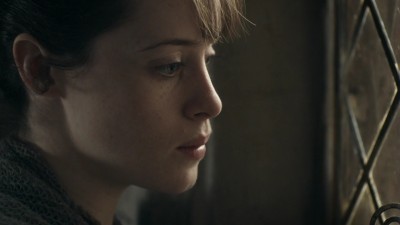
Claire Foy as Amy Dorrit
Amy Dorrit, also known as Little Dorrit because of her diminutive stature, was born in the Marshalsea debtors' prison and raised as a pauper.  Looked down upon by her snobby, selfish family and forced to work as a seamstress to put bread on her father's table, Amy has a hard life, but she never complains.  When she meets the kind, caring and compassionate Arthur Clennam--a man who is facing problems of his own, yet takes the time to try and help the Dorrit family--Amy falls in love with him.  The only problem is, Arthur (15 years Amy's senior) sees her as a child... and fancies himself in love with someone else.

Matthew Macfadyen as Arthur Clennam with Amy Dorrit
(Are you starting to see parallels?)

Meanwhile, John Chivery (assistant turnkey at the Marshalsea and longtime family friend of the Dorrits) is desperately in love with Amy, and proposes to her in complete confidence that she'll accept him.  But she doesn't.  She turns him down, because she knows she's in love with Arthur and could never love John in the way that a wife should.

This might look like selfishness, since she effectively broke John's heart in refusing him (and the hearts of all the movie viewers... sigh...).  But it's not.  It took courage for Amy to say no to John.

"I'm sorry, John, but I could never feel about you that way.  The way you'd like me to."
"But... you might come to."
"No.  I'm sorry, John.  I know I never shall."

Then he asks her if there is someone else, and.... why am I transcribing this whole thing if I could just show it to you?   Here you go.  Amy's Best Scene.  The part I refer to is from 2:29 to 5:12, but if I were you I'd just watch the whole thing. :)


You notice that when John asks if there is anyone else, she evades the question with, "I don't believe I shall ever marry."  It wasn't necessary to hurt him further by saying that there was someone else.  Little Dorrit firmly believed she didn't have any hope of Arthur's love, so she didn't make matters worse by mentioning him.  

And then, after all this had ended, she went on with her life.  She was still in love with Arthur and that never changed, but she didn't let herself mope about it.  To die for love? Not Amy Dorrit. (Marianne would not have approved, heehee.) 

Amy Dorrit's character is one that is best seen through her love of people.  She's stuck with probably one of the worst families in period drama  history (okay, maybe Anne Elliot could rival her for that title) but she is always patient with her demanding father, brother and sister.  No matter what they say or do to her, she responds with gentleness and humility. She loves them in the perfect way that Caspar ten Boom spoke of.  "Love is patient, love is kind.  It does not envy, it does not boast, it is not proud..."

I've heard it said that Amy Dorrit is too good, too perfect, that she has no backbone and can't even stand up for herself.  I disagree.  Amy is not a doormat.  She may not speak up for herself, but when someone else is wronged, she springs to the defense.   Her rascally brother, Edward "Tip" Dorrit, writes a rather rude letter to Arthur Clennam asking for a loan, and Arthur politely refuses to comply (knowing that Tip will just waste the money).  Upon receiving Arthur's reply, Tip goes into a tirade against Arthur, and when Amy gently remonstrates, he lashes out at her.  Then comes Amy's applause-inducing speech. :)

"How dare you speak like that to me?! And how dare you insult a man who is worth ten of you? Have you any idea who got your debts paid? --I love you Tip; but sometimes I'm ashamed to have you as my brother!"

(It's during this scene that my favorite music, dubbed the Tragedy Theme, plays. FYI.)

GO, AMY.

Sarah Pickering as Amy Dorrit
Things only get worse for poor Amy when the Dorrits inherit a fortune and Mr. Dorrit hires a gentlewoman by the name of Mrs. General to teach Amy and Fanny how to be Ladies Of Society (properly pronounced as Sow-Sigh-Uh-Tee).   Under Mrs. General's scrutiny, everything Amy does--even calling her father "Father"--is wrong.  Yet Amy bears it all without complaint.

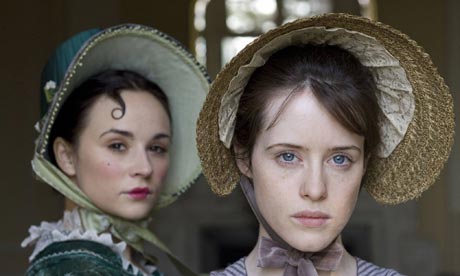
Emma Pierson as Fanny Dorrit and Claire Foy as Amy
Then tragedy strikes again... and again.  Amy is left alone in the world and, simultaneously, Arthur is thrown into the Marshalsea prison.  Amy goes to the Marshalsea to nurse Arthur back to health after he falls ill, and that is when she learns that he loves her, too.  

But the story isn't over, because Amy begs Arthur to allow her to pay his debts... but he says no.  He will not be beholden to her, but that doesn't stop her from coming to see him.  Then the Evil French Guy (alias whatever alias he's using at the time) gives Amy a mysterious letter, and old Mrs. Clennam (who employed Amy as a seamstress in the dear dead days gone by never to be spoken of) reveals a dark secret to Amy, begging for her forgiveness.
Irrelevant, but doesn't she have the most beautiful blue eyes?
And this is what Amy says to her (from the book, not the movie, haha).  
"O, Mrs Clennam, Mrs Clennam," said Little Dorrit, "angry feelings and unforgiving deeds are no comfort and no guide to you and me. My life has been passed in this poor prison, and my teaching has been very defective; but let me implore you to remember later and better days. Be guided only by the Healer of the sick, the Raiser of the dead, the Friend of all who were afflicted and forlorn, the patient Master who shed tears of compassion for our infirmities. We cannot but be right if we put all the rest away, and do everything in remembrance of Him. There is no vengeance and no infliction of suffering in His life, I am sure. There can be no confusion in following Him, and seeking for no other footsteps, I am certain."

Yeah, you won't find that on a 2008 TV miniseries.  

Here's another part where the book and movie differ-- in the book *SPOILER ALERT!!* Little Dorrit never tells Arthur the truth about his mother.  She burns the paper that Mrs. Clennam gave her and never mentions it to anyone, even though it means she loses the legacy, because she doesn't want to hurt Arthur.  I'm glad that in the movie Tattycoram gave Arthur the box and he learned the truth, because I think he deserved to know, but I admire Amy-of-the-book for giving up the inheritance to spare Arthur pain. *END OF SPOILER*
Love bears all things, believes all things, hopes all things... love never fails.

But then the question of money is swept aside in the tumultuous final chapters (and episode) and Arthur and Amy come to an understanding.  :) And Arthur's business comes booming back again.  And then they get married.  

And Miss Dashwood is made happy (albeit in need of a box of Kleenex or two), because who deserves a perfectly perfect ending more than Miss Amy Dorrit?

Button made by Miss Dashwood :P

Tuesday, December 27, 2011

Period Drama Heroines #6: Molly Gibson

Justine Waddell as Molly Gibson in Wives and Daughters (1999)
Of all the period drama heroines in my acquaintance, it is Molly Gibson whose story most resembles that of Cinderella. I mean, think about it. Girl's mother dies, girl and her father live happily together for sixteen years (or whatever it is), girl's father remarries. Girl is not exactly happy about this, especially since the new stepmother is overbearing and ridiculous, and insists on dragging a stepsister into the relationship who is... actually kind of nice.

Okay, the similarities end there.
Anthony Howell, Bill Paterson, Francesca Annis, Justine Waddell and Keeley Hawes in
Wives and Daughters (1999)

Or do they?  Enter Prince Charming (and his brother).  Enter stepmother's scheming. Enter engagement between Prince Charming and evil flirtatious stepsister.  Enter... no fairy godmother.

Cinderella had a magic wand, a gaggle of rodent friends, a pair of glass slippers and the tiniest feet in the kingdom at her disposal when she fell in love with the prince.  Molly Gibson had.... uh.... well, she liked insects.  And she was clever, intelligent, eager to learn, a good listener and of a most forgiving nature.

Justine Waddell as Molly Gibson
Of the two, I think Molly has much more in her to respect than Cinderella ever did.  I admire Molly, not because she "secured" the man of her dreams, but because she was willing to give up the man of her dreams if he was in love with someone else.  (I still maintain he wasn't really in love with Cynthia. "Boyish fancy", and all that.)  Books and movies are full of the guy who gives up the girl so she can marry the man she really likes (John Chivery *sniffle*), but there are few stories that tell of the girl who gives up the guy.

Molly, at the beginning of Wives and Daughters, is just the wee-est bit spoiled.  She's grown up under her father's loving care, and for years it's been just the two of them.  Then in come Hyacinth Clare (why? why?? why must there be such a name on the face of this planet???) and her daughter Cynthia Kirkpatrick, and proceed to make Molly's life miserable.  Not, perhaps, intentionally, but it happens nonetheless.  Mrs. Gibson crumbles everything special that Molly and her father shared (she even bans cheese!) and Cynthia waltzes in and manages to captivate the man Molly is in love with.
You know who she is by now.  Hopefully.
And Roger, like an idiot, falls for Cynthia.

My parents watched Wives and Daughters for the first time this summer, and they both loved it, though my dad told me that there were times he felt like smacking Roger over the head with a two-by-four.

My sentiments exactly.

Molly, unfortunately, is so sweet and inclined to think well of people that she won't let Roger or Cynthia see how she really feels about their engagement.  She can't help liking Cynthia (how can anyone?) even though Cynthia has basically ruined her life.  She's prettier than Molly (well, actually that's debatable because I personally think Molly's lovely), more accomplished and certainly more charming.  Theoretically, any man would fall head over heels for her.  (If he were an idiot.)  And yet Molly is the one who understands Roger, who takes an interest in his interests, who reads his letters over and over and charts his travels on her maps.  Cynthia takes Roger's love for granted, and though Molly could easily hint as much to Roger, she's far too honorable to do so.  Instead, she tries to persuade Cynthia to be a little less nonchalant about the whole thing.  "Yes, he's in love with you!  And he depends upon you, so you should try to deserve him!"


Poor Molly.  Have I mentioned how much I like her?  Well, I do.

The story of Molly's heroism doesn't end there-- and lest from the last few paragraphs you have developed the highly mistaken idea that Molly is a doormat, may I hasten to prove that theory wrong.

Without going into details (this post is too long already), I'll tell you that Molly was instrumental in saving her stepsister's reputation in the incident with Mr. Preston.   Cynthia was too chicken to confront the odious man herself (odious but still kinda pitiable... I SAID KINDA) and so Molly, the convenient Molly, was sent to do it for her.

And she did a marvelous job.
Molly's Best Scene


And then.... AND THEN Roger comes back from Africa.  Ta-dah-dum!  And he and Molly go to a ball together, and Lady Hawwiet pulls a few strings, and as they say (who? who says?), the rest is history (with one of the sweetest kiss-less proposals ever).  And Molly and Roger live happily ever after.

Because hey, it's a book (and a movie).  And because Molly totally deserves a happy ending.

Even if she did keep her shoes on the whole time.

Sunday, November 6, 2011

Period Drama Heroines #5: Marianne Dashwood

(Note: I had previously intended to make Marianne #5 in my Period Drama Heroines series, with Molly Gibson as #6. But I decided to switch them so that Marianne could appear in S&S Week.)

"Mama, the more I know of the world, the more am I convinced that I shall never see a man whom I can really love."
~Marianne Dashwood (Sense and Sensibility 1995)

Marianne Dashwood. Her very name inspires a vivid picture of her personality. She is one of the most real of Jane Austen's characters (not that any of JA's girls are un-real!) and she's a delight to read about. Romantic and high-spirited, passionate and full of feeling, Marianne leaps off the page. Of Jane Austen's heroines, she is the one who grows and matures the most throughout her book. The ambiguous title (is it Sense along with Sensibility or Sense versus Sensibility?) captures Marianne very well. Sensibility, or emotion, defines her. She's never flat or indifferent. As Austen herself said, "She was sensible and clever, but eager in everything. Her sorrows, her joys, could have no moderation. She was generous, amiable, interesting: she was every thing but prudent." Marianne doesn't sit back and let the world go by; instead, she dances out in the midst of it.


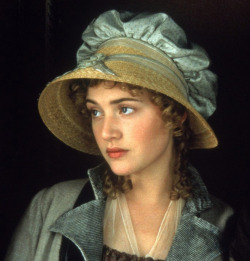
Kate Winslet as Marianne (1995)

Marianne may be Jane Austen's prettiest described heroine. (I'm talking about how Jane Austen wrote about her characters, not how we view them.) Elizabeth is supposedly much plainer than her sister Jane; Fanny is most definitely un-striking (though sweet); Anne Elliot has passed her bloom; Emma Woodhouse is described as handsome, but not many particulars are given; and Elinor, Marianne's sister, pales beside her exuberant younger sister. And Catherine Morland is supposed to be "girlish" and "sweet" but we don't really know how pretty she is. Sir John Middleton frequently describes Marianne as a "monstrous pretty girl". Sir John's use of adjectives is probably not the most appropriate in the world (how many pretty monsters have you seen?) but we get the idea.


Charity Wakefield as Marianne (2008)

Marianne's impulsiveness, though endearing, doesn't serve her well. She gets swept up in her exuberant feelings and often doesn't stop to think; and when John Willoughby comes on the scene, she falls for him like a ton of bricks. (That's an overused cliche, but at the moment I can't think of anything better.) Willoughby is charming, handsome and pleasant, and he reads poetry with great expression. On the surface, he seems to be the perfect one for Marianne. Until, of course, she discovers his true character.


Greg Wise and Kate Winslet as Willoughby and Marianne (1995)

Then there's Colonel Brandon, who's in love with Marianne but doesn't say anything about it because he thinks he's too old for her. He's more concerned with her happiness than with his own. And Marianne, though she likes Colonel Brandon, thinks he's boring and unromantic. She firmly believes in love at first sight, heroes on white horses and the undying love of Romeo and Juliet. (Romeo and Juliet? Ewwww.)

I think S&S has a running theme of "appearances can be deceiving". Obviously Willoughby is not what he seems. Nor is Colonel Brandon--he's ultimately the hero. Edward Ferrars really isn't the shy, stuttering person that Marianne condemns for a lack of feeling. Lucy Steele is most certainly not sweet and charming. (I have to say, though, that I liked her at first. Well, I did. How was I to know how awful she really was? I honestly thought she was just confiding in Elinor, not gloating.)


Charity Wakefield and Hattie Morahan as Marianne and Elinor (2008)

It's Marianne, though, that I'm talking about here. Marianne is impulsive and idealistic, naive and exuberant, governed by her emotions, seemingly a little shallow. But by the end of the book, the reader realizes that Marianne isn't quite what she seems. She's not shallow or flighty; she has a depth of perception that developed over the course of the novel. At first she didn't think twice about Colonel Brandon, but by the time the story ends, she appreciates him for who and what he is. Maybe the Colonel's not the dashing prince she dreamed of, but in the end he is the hero (and Willoughby's the bad guy). Character wins out over charisma.

I love this (unfortunately very short) scene of Marianne and Colonel Brandon--I only wish the movie showed more of their developing relationship. Marianne is finally beginning to realize that her true hero was there all along... and the Shakespeare sonnets make it 10x more romantic, of course. :)


Marianne is eager in everything, as Jane Austen says, and that includes eagerness to learn. And that's what she does: she learns from Colonel Brandon, from Elinor, from Edward, and even from Willoughby himself. She grows and matures throughout Sense and Sensibility--and in the end, the title fits her perfectly. She's acquired some sense, but she hasn't lost her sensibilities. She's toned down a little, but she's still Marianne.


Kate Winslet as Marianne in one of the best weddings ever (1995)

And really... if she weren't, the book might not be worth reading.

Wednesday, October 26, 2011

Period Drama Heroines #7: Jane Eyre


"If all the world hated you, and believed you wicked, while your own conscience approved you, and absolved you from guilt, you would not be without friends."
~Jane Eyre

To describe Jane Eyre in one word is really not so hard, as long as the word you choose is either "principled", "moral" or "steadfast". Do not, under any circumstances, use the word "boring" to describe Jane; if you do so, that is clear proof that you do not understand her.

Now before you give a great huff and close your browser window with exasperation at my pomposity, let me assure you that I don't pretend to understand Jane Eyre. That is why I like her. She's complex.


Mia Wasikowska as Jane Eyre (2011)

At first glance, Jane seems like a pitiable character. Brought up under the cruelty of her aunt (wow, she and Esther should get together!), sent away to a horrendous boarding school (who else always wants to smack Mr. Brocklehurst every time he appears on the page?) and left to take care of herself in an unforgiving world, Jane's story sounds a little like a soap opera. Or at least a melodramatic Victorian novel.

Wait, it IS a melodramatic Victorian novel. Never mind.

But though Jane's story may seem a bit contrived and over-the-top, it has many redeeming qualities--the biggest of which being Jane herself. I mean, you can't help but root for this girl!

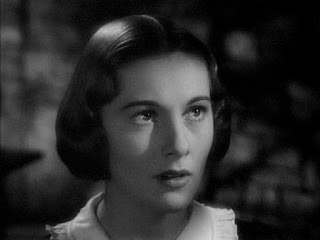
Joan Fontaine as Jane Eyre (1943)

Jane is meek and timid--in her own words, "poor, obscure, plain and little". Jane also possesses great strength of character, steadfast beliefs and a pepperpot temper when she's provoked. In that memorable scene when Mr. Rochester asks her to marry him (in an extremely roundabout way--annoying man!) she tells him in no uncertain terms why she wants to leave Thornfield. "Do you think I can stay to become nothing to you? Do you think I am an automaton? a machine without feelings?... You think wrong! I have as much soul as you, and full as much heart!" In general, Jane is a very gentle person, but there are times when she just can't take it any longer. I'm not commending angry words, but I will admit to being excessively pleased when I read this passage. Take that, Mr. Rochester!

Jane is not a people-pleaser. She speaks candidly and with complete honesty. "I like rudeness a great deal better than flattery. I had rather be a thing than an angel." As a child, this often got her in trouble with her odious schoolmaster and horrible aunt. And if she had been employed by a man who was not in love with her, this talent probably would have cost her her job, too. :)

Jane is opinionated without being outspoken. She has her standards and her beliefs, and she won't be shaken in them--but she doesn't cram what she thinks down people's throats. However, her book is told in the first person, so the reader at least gets a healthy dose of Jane's opinion on everything. "Conventionality is not morality. Self-righteousness is not religion. To attack the first is not to assail the last."

There is but one thing in which I cannot admire Jane---why, why, why did she fall in love with Mr. Rochester???

Ruth Wilson and Toby Stephens in Jane Eyre (2006)

In case you hadn't noticed yet, I'm not a big fan of Edward Fairfax Rochester. He's a liar. He's willing to be a bigamist. He's moody and strange. (That's not attractive, ladies.) He's violent. He's had an immoral past (and is rather unrepentant when Jane confronts him). Jane, on the other hand, is truthful, loyal, open, forthright, moral, just, and a woman of integrity. Could two people ever be less suited to each other?

You know the basic story. Mr. Rochester wants to marry Jane, but one tiny detail stands in their way--his insane wife, locked in the attic. Jane leaves Thornfield as soon as she finds out about Mrs. Rochester (not without intense emotional trauma). "Jane Eyre, who had been an ardent expectant woman--almost a bride--was a cold, solitaray girl again: her life was pale; her prospects desolate." I feel so sorry for Jane at this point--does the whole world have to be against her?

"Don't worry," Hayden says in her review of Jane Eyre on her blog, "the book ends with a happily-ever-after. It just takes a really long time to get there."

It takes a little too long, in my opinion. Jane deserves a happy ending now. But it's all okay, because there's one more virtue of Jane's that I forgot to mention.

She's unbelievably patient. She can wait for a happy ending.


Josephine Serre and Charlotte Gainsbourg in Jane Eyre (1996)

P.S. I have not seen any of the film adaptations of Jane Eyre, so I don't have a video clip for this post.

Thursday, October 20, 2011

Period Drama Heroines #8: Esther Summerson

A little note: In order to write about Esther Summerson, it is necessary for me to describe key plot points in her story. If you have not read or watched Bleak House, you may wish to skip this post, because it will contain A LOT of spoilers.

"True beauty comes from within." It's a phrased so overused as to become cliche; perhaps that's why it's the first thing that comes to mind when I think of Esther Summerson, the heroine of Charles Dickens' Bleak House.

I was recently browsing the archives of Miss Laurie's delightful blog Old-Fashioned Charm, when I chanced upon these verses written by one of my (and Jane Austen's!) favorite poets, William Cowper. Again, Esther's lovely face popped into my mind.

Sweet stream that winds through yonder glade,
Apt emblem of a virtuous maid -
Silent and chaste she steals along,
Far from the world's gay busy throng;
With gentle, yet prevailing force
Intent upon her destined course;
Graceful and useful all she does,
Blessing and bless'd where'ere she goes,
Pure-bosom'd as that wat'ry glass,
And Heav'n reflected in her face.

~William Cowper

Esther Summerson grew up knowing little more than harshness and hardship. Throughout her childhood she was told that she was her mother's disgrace, that she was good for nothing. And yet she never allowed her aunt's cruel words to tear her down. Esther's sweetness shone through no matter what.
When Esther goes to become a companion to Ada Clare, one of her first observations about Ada is that she is beautiful. Esther candidly admits that she herself is not. (I would beg to differ, but we'll get to that in more detail later.) Though some girls might resent a position such as Esther's, serving a young lady who is "superior" (I use the term loosely) in class and appearance, Esther really doesn't know the meaning of the word "resent".


Naturally, Esther isn't perfect (if she were, I probably wouldn't like her). She has an overwhelmingly strong sense of justice and can take a great dislike to people she feels are unworthy. A certain scheming, conniving, sponging, self-centered idiot by the name of Harold Skimpole, for instance. Esther handles him brilliantly, letting him know exactly what she thinks of him without ever once stooping to his level. Bravo, Esther!


Esther also possesses a great deal of tact. She isn't at all interested in Mr. Guppy's hilariously awkward declarations of love, yet she doesn't push him aside or belittle him--she kindly but firmly tells him that she cannot marry him. Esther would never intentionally hurt another person's feelings.

When she contracts smallpox, her face becomes terribly scarred. At first she doesn't want to let anyone see her, because she's afraid of offending them, not because her vanity has been hurt.

Because Esther thinks so little of herself, you see.

The inner turmoil Esther undergoes when she SPOILER ALERT finally meets her mother and cannot tell anyone END OF SPOILER reminds me of Elinor Dashwood's similar experience. Both handled the situation in a remarkable manner, never letting on how upset they were.

And if that business weren't enough, Esther has still more problems with the romance in her life. She finds herself in love with Alan Woodcourt, but after her illness is convinced that he can never love someone who is so changed. She accepts Mr. Jarndyce's proposal with a sense of gratitude, but then Alan returns from his time at sea and the music becomes thunderous! (Well, not really. But in my head, when I was reading the book, it did.)


Alan proposes to Esther (he's a true gentleman, not to be swayed by a few scars), but she remains loyal to Mr. Jarndyce and gently refuses Alan. This is Esther's best scene and the epitome of her self-sacrificial personality--please tell me I wasn't the only one crying when this happened (even though I'd already read the book....).

(I couldn't find a clip of Alan's proposal alone--Esther's Best Scene goes from 2:07 to 3:48, with a bit of the wedding at the end. I'd recommend you watch the whole thing. :))


And yet Esther's happiness isn't sacrificed, because Mr. Jarndyce (dear man!) makes a sacrifice too. (I'm using that word too much...) Esther and Alan lived happily ever after, and there are few heroines who more richly deserve an ending such as Esther's. As I said before, Esther's true beauty shines from within. Outwardly, she is rather plain, but inwardly, she is loveliness itself--and that loveliness manifests itself in her countenance.


That's true beauty. That's Esther. She's the kind of lady that I want to be.

All pictures except for the second, third and sixth (which are from Google Images) are from http://s145.photobucket.com/albums/r207/bleakhouse/

Friday, October 14, 2011

Period Drama Heroines #9: Emma Woodhouse

"People--their hopes, their dreams, their aspirations--there I am the expert."
~Emma Woodhouse, Emma (2009)

Emma is fascinating. As we all know, Jane Austen wrote of Emma, "I have created a heroine whom nobody but myself will much like." Far be it from me to dare to differ with Jane Austen, but... how could you help liking Emma?

The best word to describe Emma Woodhouse's personality would be vivacious. Emma is brimming with fun and lightheartedness,
bubbly mirth and optimism. She's sweet, entertaining, and delightfully, humorously meddlesome.

But Emma is not without her faults. In fact, Emma's entire story is about the development of her character. It's the only one of Jane Austen's novels to feature a character's name as its title--and that's not a mistake. Pride and Prejudice, Sense and Sensibility and Persuasion are all about those traits and how they're exemplified in the books' characters. Mansfield Park is about a specific place, a girl who grew up in that place and how it influenced her life. (Northanger Abbey is a little different. Maybe I'll write about Northanger Abbey in a later post. That is, if I can write a sensible post without gushing like a fan-girl over Henry Tilney.)

Romola Garai as Emma (2009)

Emma is, in short, about Emma. The book begins by telling us about Emma Woodhouse, who is handsome, clever and rich, and who has thus far gone through life with very little to distress or vex her. Jane Austen didn't waste any time in getting to the point about her heroine (unlike Leo Tolstoy, who allegedly didn't introduce the heroine into Anna Karenina until the thirtieth chapter). Emma is the focus of the story, and around Emma the first sentence revolves.

Back to what I was saying: Emma isn't perfect. From the very beginning, she shows herself to be thoughtless and even a little condescending in her treatment of her friends. She believes herself to know exactly what is best for everyone. In fact, she believes that she can find the perfect match for each one of her friends. I love the scene in the 2009 movie in which Emma's sister and Mr. Knightley's brother are getting married. (Emma, incidentally, predicted their marriage.) Mr. Knightley leans over the back of the pew and whispers to Emma, "Lucky guess." Emma raises an eyebrow and replies, "Nothing lucky about it. Just talent... and intuition."

Romola Garai as Emma (2009)

Emma definitely has a slight superiority complex, but she is genuinely interested in the well-being of her friends. She truly wants Harriet Smith to find a good match. When she advises Harriet against marrying Robert Martin because he isn't rich, she is displaying snobbishness, but she's also acting in what she thought were Harriet's best interests.


Louise Dylan and Romola Garai as Emma and Harriet Smith (2009)

"Well, look here. 'The wealth and pomp of kings.' Kings. What does that suggest?... Perhaps court. And 'the monarch of the seas.' Seas? Maybe a ship." (Emma, 2009)

Unfortunately, she carries all this a bit too far. "One day," Mr. Knightley reproves, "you will bitterly regret your meddling." But as yet, Emma doesn't regret her meddling. She greatly enjoys planning matches and getting involved in everything. I have to take a moment here to rave about Jane Austen's brilliance. Just listen to this passage from chapter nine. "She was sorry, but could not repent. On the contrary, her plans and proceedings were more and more justified, and endeared to her by the general appearances of the next few days." Does that not hit the nail of human nature on the head?


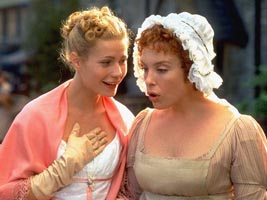
Gwyneth Paltrow and Toni Colette as Emma and Harriet (1996)

Emma's penchant for wit and humor endear her to many (including the reader) but, again, sometimes she carries it too far. At the Box Hill excursion, she thoughtlessly insults Miss Bates through trying to be funny. Cue the Mr. Knightley lecture. (Go, Mr. Knightley!) Emma doesn't stop to think about Miss Bates' feelings because Miss Bates doesn't fit into her little circle of friends. She isn't young or pretty or brilliant enough to meet with Emma's complete approval.

However, lest you think that I'm coming down too hard on Emma (I'm not, really I'm not! I'm just seeing a lot of myself in her), she is not unwilling to admit her faults once she finally realizes them. And it takes Mr. Knightley's rebuke to wake her up. "What have I done?" When she understands the full impact that her unkind words had on Miss Bates, she does everything she can to make amends.


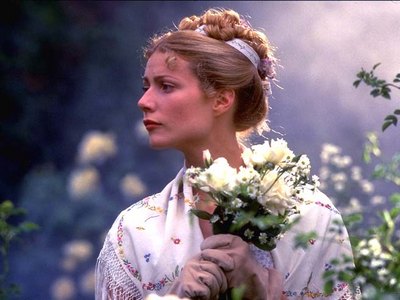
The lovely Gwyneth Paltrow as Emma (1996)

Emma doesn't realize that she's in love with Mr. Knightley until she realizes how much she doesn't deserve his love--as one of my friends pointed out, it's actually a parallel of our relationship with Christ. Once she finally comes to grips with her feelings, the meddlesome part of her personality begins to fade away. Mr. Knightley, the true hero of the novel, is the one who brings about Emma's change. His proposal to Emma, beautifully acted in the 2009 miniseries, is followed by Emma's best line in the whole movie. "I find I... do not know what to think." For once the verbose, witty and always-correct Miss Woodhouse is completely at a loss for thoughts as well as words.
The just-as-lovely Romola Garai as Emma (2009)

But they don't live happily ever after quite yet. There is still the question of what will become of Mr. Woodhouse. Cue my second favorite Emma line in the 2009 movie: "You know I love you, and I always will. But we can never marry. That's all." Here is Emma's selflessness finally brought to light. It was hidden a little too long, but now each one of us can see it and admire her for it. She's willing to give up happiness with Mr. Knightley for the sake of her father--to paraphrase Mr. Knightley: "Well done, Emma."

(See the clip below for Emma's Selfless Scene--don't you just love the little hand-holding thing at the end? Have I mentioned how much I love Mr. Knightley?)


And that's my analysis of Emma Woodhouse. She's vivacious, she's funny, she's hasty, she's conceited, she's sweet, she's meddlesome, she's repentant, she's loving, she's delightful.

She's Emma.