Showing posts with label Emma. Show all posts

Friday, December 20, 2013

Emma: Homeschool Edition (Chapter Three)


 Mr. Woodhouse was fond of fellowship in his own way. He liked very much to have his friends come and see him; and from various united causes, from his long residence in the neighborhood, and his good nature, from his high standing in the homeschool community, his in-ground pool, and his daughter, he could command the visits of his own little circle, in a great measure as he liked. He had not much intercourse with any families beyond that circle; his horror of late hours and large potluck suppers made him unfit for any acquaintance, but such as would visit him on his own terms. Fortunately for him, the Highbury church family comprehended many such. Not unfrequently, through Emma's persuasion, he had some of the chosen and the best over for dinner with him, but game nights were what he preferred, and, unless he fancied himself at any time unequal to company, there was scarcely an evening in the week in which Emma could not make up a Boggle table for him.

    Real, long-standing regard brought the Westons and Mr. Knightley; and by Pastor Elton, a young man living alone without liking it (after all, the Bible itself states that it is not good for man to be alone!), the privilege of exchanging any evening spent with his laptop and a frozen dinner for the cheerful chatter and board games of Mr. Woodhouse's living room (not to mention the smiles and conversation of his attractive and single daughter), was in no danger of being thrown away.

    After these came a second set; among the most come-at-able of whom were Mrs. and Miss Bates and Mrs. Goddard, three ladies almost always at the service of an invitation from the Woodhouses, and who traveled there and back so often that Mr. Woodhouse thought it no hardship for their health to be venturing out in the weather, as they were used to it. Had it taken place only once a year, it would have been a grievance.

    Mrs. Bates, the widow of a former Highbury pastor, was a very old lady, almost past every thing but instant coffee and Wheel of Fortune. She lived with her single daughter in a very small house, and was considered with all the regard and respect which a harmless old lady, under such untoward circumstances, can excite. Her daughter enjoyed a most uncommon degree of popularity for a woman neither young, stylish, well-to-do or possessing a Better Half. Miss Bates stood in the very worst predicament in the world for having much of the public favor; and she had no intellectual superiority to make atonement to herself, or frighten those who might hate her, into outward respect. She had never boasted either beauty or cleverness-- she had been in the science fair as a child but have never got past preliminary competition. Her youth had passed without courtship or any other distinction, and her middle age was devoted to the care of a failing mother, and the endeavor to make a small income go as far as possible without the help of food stamps or other government assistance.  And yet she was a happy woman, and a woman whom few named without a smile. It was her own universal goodwill and positive attitude which worked such wonders. She loved every body, was interested in every body's happiness, quick-sighted to every body's talents and skills; thought herself a blessed woman, and surrounded with blessings in such an excellent mother and such a good church family, and a home that wanted for nothing. The simplicity and cheerfulness of her nature, her contented and grateful spirit, were a recommendation to every body and an example to the young children in her Sunday School class. She was a great talker upon little matters, which exactly suited Mr. Woodhouse, full of trivial communications and harmless gossip.  Indeed, her Twitter account was in danger of being suspended because she constantly misinterpreted 140 characters as 140 words.

    Mrs. Goddard was the principal of a local private girls’ school-- a Christian, conservative, well-regulated establishment that held to good old-fashioned principles regarding skirt length and language in the hallways.  The school was held in some reasonable regard by the homeschooling elite of the Highbury church-- it was not, after all, the same as good parental education, but several church members did send their daughters there and one had to be respectful of other people’s views even if they weren’t as good as one’s own.  Besides, Mrs. Goddard herself was a cousin of Mr. Woodhouse, as well as being a kind, motherly sort of woman.  She who had worked hard throughout her whole life, and enjoyed the treat of an occasional visit at Hartfield; and having formerly owed much to Mr. Woodhouse's kindness, felt his particular claim on her to drive out to his house every so often for a round or two of Scrabble.

    These were the ladies whom Emma found herself very frequently able to invite; and happy was she, for her father's sake; though, as far as she was herself concerned, it was no remedy for the absence of Mrs. Weston. She was delighted to see her father look comfortable, and very much pleased with herself for contriving things so well; but the lengthy deliberation before each turn and consulting of the Scrabble dictionary from three such women made her feel that every evening so spent, was indeed one of the long evenings she had fearfully anticipated.  Being neither antisocial nor rude, she could not feel comfortable hiding her face in her phone all evening, and so she was compelled by politeness to sit beside Miss Bates and wait while that worthy lady deliberated over what sort of word she could devise with the letters ACODAVO.

    As she opened her iPad one morning, looking forward to exactly such a close of the present day, an email arrived t from Mrs. Goddard, requesting, in most respectful terms, to be allowed to bring Harriet Smith with her; a most welcome request: for Harriet was a girl of nineteen whom Emma knew very well by sight and had long felt an interest in, on account of her excellent sense of modest fashion. A very gracious invitation was returned, and the evening no longer dreaded by the fair homemaker of the Woodhouse domain-- in fact, Emma hopped up straightaway to set about making some bran muffins to pass around that evening as a little treat.

    Harriet Smith was the daughter of parents who traveled extensively and had placed her, several years back, at Mrs. Goddard's school.  She had graduated the year before with few honors but a reasonably good report in all subjects, and owing to her natural ability to connect with young children, had acquired the position of assistant teacher at the school.  She had no visible friends but what had been acquired at the Highbury church, and was now just returned from a young ladies’ retreat at a summer mountain camp, at which she had met some young women who happened to live nearby.  She and the Martin girls, in consequence, had become rather friendly and indeed their family had begun attending services at Highbury with some regularity.

    She was a very pretty girl, and her beauty happened to be of a sort which Emma particularly admired. She was short and perhaps inclined to plumpness (an attribute she sought to correct by abstention from carbs in any form, a fact Emma only remembered after she had taken the bran muffins out of the oven), with a lovely smile, blue eyes, light hair, regular features, and a look of great sweetness; and before the end of the evening, Emma was as much pleased with her manners as her person (though of course Emma knew better than to judge a person on looks alone), and quite determined to continue the acquaintance.  

    She was not struck by any thing remarkably clever in Harriet’s conversation (what, after all, could be expected from a girl who had attended a boarding school?), but she found her altogether very engaging -- not inconveniently shy, not unwilling to talk -- and yet so far from being obnoxious, showing such nice manners, seeming so pleasantly grateful for being invited to one of the almost-famous Hartfield game nights, and so artlessly impressed by the appearance of every thing in so superior a style to what she had been used to, that she must have good sense and deserve encouragement. Encouragement should be given. Those soft blue eyes and all those natural graces should not be wasted on the inferior society of Mrs. Goddard’s school and its connections. The acquaintance she had already formed were unworthy of her. The friends from whom she had just parted, though very good sort of people, must be doing her harm. Emma knew quite a bit of the Martin family, as she made it her business to know all she could about every attendee at Highbury (without the slightest idea of gossiping, of course) and though they seemed a genteel sort of family, the parents both worked outside the home and the children had all gone to public school.  They were by now graduated, and the eldest son showed a creditable interest in an agricultural career, but they must certainly have experienced ungodly and liberal influences in a government-run institution, and were in point of fact unworthy companions for a girl who only needed a little more fine-tuning to be made practically perfect in Emma’s sight.  She would notice her; she would improve her; she would detach her from her lowly acquaintance, and introduce her to better companions; she would form her opinions and her manners. It would be an interesting, and certainly a very kind undertaking; highly becoming her own situation in life and giving her more material for blogging.

    She was so busy in admiring Harriet’s skill in eyeshadow application, in talking and listening, and forming all these schemes in the in-betweens, that the evening flew away at a very unusual rate; and the popcorn, muffins and cocoa, which always closed such parties, and for which she had been used to sit and watch the due time, was all set out and ready, before she was aware. With an alacrity beyond the common impulse of a spirit which yet was never indifferent to the credit of doing every thing well and attentively, with the real good-will of a mind delighted with its own ideas (well, all right, she got them off Pinterest but at least she was the executor), did she then do all the honors of the snack, and passed her matching napkins and styrofoam bowls with an urgency she knew would be acceptable to the early hours of their guests.

    Upon such occasions poor Mr. Woodhouse's feelings were in sad warfare. He loved to have people over and exercise his daughter’s hospitality skills; but his conviction of snacks being very unwholesome made him rather sorry to see any thing actually served to the guests; and while his generosity would have welcomed his visitors to every thing, his care for their health made him grieve that they would eat.

    Such another small glass of gluten-free soy milkshake as his own, was all that he could, with thorough self-approbation, recommend, though he might constrain himself, while the ladies were comfortably clearing the nicer things, to say:

    "Mrs. Bates, let me propose your venturing on one of these muffins. A muffin made with oat bran and rice flour, sweetened with agave nectar, is not unwholesome. Emma understands about making muffins to suit a healthy diet; I would not recommend a muffin baked by any body else -- but you need not be afraid -- they are very small, you see -- one of our small muffins will not hurt you. Miss Bates, let Emma help you to a little bit of cocoa -- a very little bit. Ours is always made with raw milk. You need not be afraid of unwholesome nastiness here. I do not advise the popcorn; it is made with processed butter. Mrs. Goddard, what say you to some of my soy milkshake? A small half glass -- put into a tumbler of water with a vitamin C supplement? I do not think it could disagree with you."

    Emma allowed her father to talk -- but quietly supplied her visitors in a much more satisfactory style; and on the present evening had particular pleasure in sending them away satisfied. The happiness of Harriet Smith was quite equal to her intentions. Emma Woodhouse was so great a personage in the Highbury congregation, that the prospect of the introduction had given as much panic as pleasure -- but the awed, appreciative girl went off with highly gratified feelings, delighted with the affability with which Emma Woodhouse had treated her all the evening, and actually exchanged email addresses with her at the last!

Friday, December 6, 2013

Emma: Homeschool Edition (Chapter One)


(In which we introduce Miss Dashwood's irreverent reworking of Jane Austen's classic novel, to be presented in weekly installments for the benefit of those blog readers who may be interested in such nonsense.) And we must give credit where credit is due-- this series was partly inspired by Rachel Coker's Truth Universally Acknowledged.  However, this series is not in any way affiliated with or inspired by Pemberley Digital's Emma Approved-- no, seriously, I came up with this idea before I even heard of EA.  ;)

Emma Woodhouse, a handsome, clever stay-at-home daughter, with a comfortable home and a homeschool education, seemed to unite some of the best blessings of existence; and had lived nearly twenty-one years in the world with very little to distress or vex her.

She was the youngest of the two daughters of a most affectionate, indulgent father (though of course not too indulgent-- he understood discipline as any good father ought), and had, in consequence of her sister's marriage, been a Young Homemaker from a very early period.  Her mother had died too long ago for her to have more than an indistinct remembrance of her caresses, and her place had been supplied by an excellent woman as private tutor, who had fallen little short of a mother in affection.  This Miss Taylor had provided the at-home education Emma and her sister Isabella had needed, and she had become almost a member of the family.

Sixteen years had Miss Taylor been in the Woodhouse household, less as a governess than a friend, very fond of both daughters, but particularly of Emma. Between them it was more the intimacy of sisters.  Some days they even wore matching jumpers, inciting admiration and compliments whenever they went to co-op together.  Even before Miss Taylor had ceased to hold the nominal office of teacher, the mildness of her temper had hardly allowed her to impose any restraint (besides which, the duty of discipline belonged to Emma’s father alone); and the shadow of authority being now long passed away, they had been living together as friend and friend very mutually attached, and Emma doing just what she liked within reason; highly esteeming Miss Taylor's judgment, but directed chiefly by her own and her father’s.

The real evils indeed of Emma's situation were the power of having rather too much her own way, and a disposition to think a little too well of herself; these were the disadvantages which threatened alloy to her many enjoyments. The danger, however, was at present so unperceived, that they did not by any means rank as misfortunes with her.  She maintained a blog (entitled “Happily at Home”) on the Internet where she wrote about daily life, recipes, and of course a weekly Monday Modesty feature in which she showcased whatever outfit she happened to be wearing  that day, as an encouragement to younger girls.  There were a few followers who thought, perhaps, that Emma showed some arrogance in her manner of writing and style of presenting her posts, but one cannot travel the Internet for long without encountering rude people of some kind, and Emma never paid any attention to these naysayers.  
Sorrow came -- a gentle sorrow -- but not at all in the shape of any disagreeable consciousness. Miss Taylor married. This was, of course, in and of itself not a sorrow at all, for she had married a godly man and could now settle into a home of her own and be no longer subjected to scrutiny by others in their church who wondered why she was still single.  She was just the kind of woman who would make the right man very happy someday, and it had always been a desire of hers to have a husband and children, so all in all things were arranged quite nicely.  But it was Miss Taylor's loss which first brought grief. It was on the wedding-day of this beloved friend that Emma first sat in mournful thought of any continuance. The wedding over and the bride-people gone, with the newly married Westons on their way to their honeymoon at the Creation Museum, her father and herself were left to dine together, with no prospect of a third to cheer a long evening. Her father composed himself to sleep after dinner, as usual, and she had then only to sit and think of what she had lost.  She considered writing a blog post about her loneliness, but considering that Miss Taylor-- no, Mrs. Weston-- read her blog, she did not wish to instigate feelings of guilt.  

The event had every promise of happiness for her friend. Mr. Weston, their church’s youth group leader was a man of unexceptionable character, sound doctrine, a steady income and a house with no mortgage; and there was some satisfaction in considering with what self-denying, generous friendship she had always wished and promoted the match; but it was a black morning's work for her. The want of Miss Taylor would be felt every hour of every day. She recalled her past kindness -- the kindness, the affection of sixteen years -- how she had taught and how she had played with her from five years old -- how she had devoted all her powers to attach and amuse her in health -- and how nursed her through the various illnesses of childhood. A large debt of gratitude was owing here; but the intercourse of the last seven years, the equal footing and perfect unreserve which had soon followed Isabella's marriage on their being left to each other, was yet a dearer, tenderer recollection. It had been a friend and companion such as few possessed, intelligent, well-informed, useful, gentle, knowing all the ways of the family, interested in all its concerns, and peculiarly interested in herself, in every pleasure, every scheme of her's; -- one to whom she could speak every thought as it arose, and who had such an affection for her as could never find fault.  In short, Miss Taylor had been the quintessential Proverbs 31 woman, and how could Emma expect to ever bear the loss?

Or the change, for that matter?  It was true that her friend was only moving to Randalls, a small town about ten minutes away from them; but Emma was aware that great must be the difference between a Mrs. Weston only ten minutes from them, and a Miss Taylor in the house; and with all her advantages, natural and domestic, she was now in great danger of suffering from intellectual solitude.  Her blogging friends were nice, of course, but they were only on the Internet and did not count.  She dearly loved her father, but he was no companion for her. He could not meet her in conversation, rational or playful, and they frequently suffered from a lack of topic at any rate, for he never watched Blimey Cow.

The evil of the actual disparity in their ages (and Mr. Woodhouse had not married early) was much increased by his constitution and habits; for having been a bit of a hypochondriac all his life, without activity of mind or body, he was a much older man in ways than in years; and though everywhere beloved for the friendliness of his heart and his amiable temper, his talents could not have recommended him at any time.  Besides which, he was currently experimenting with a gluten-free diet, which Emma of course lauded as an admirable enterprise, but it certainly did create more work for her both in the kitchen and when grocery shopping. 

Her sister, though comparatively but little removed by matrimony, being settled in the countryside on a self-sufficient farm only forty miles off, was much beyond her daily reach; and many a long October and November evening must be struggled through at Hartfield (they had named their homeschool Hartfield Academy and the name had continued with the house), before Christmas brought the next visit from Isabella and her husband and their several little children to fill the house and give her pleasant society again.

Highbury Christian Fellowship, the large and thriving church to which the Woodhouses belonged, afforded her few equals. The Woodhouses were among the first in consequence there, having homeschooled both their children from day one and set the standard in the community.  All looked up to them, despite there being but two girls in the family.  She had many acquaintance throughout the church, for her father was universally civil even to those who utilized government education, but not one among them who could be accepted in lieu of Miss Taylor for even half a day.  Emma volunteered her time as assistant in the youth group, but of course most of those young people were all still in public high school and could hardly be considered for friendship.  It was a melancholy change; and Emma could not but sigh over it and wish for impossible things, till her father awoke, and made it necessary to be cheerful. His spirits required support. He was a nervous man, easily depressed; fond of every body that he was used to, and hating to part with them; hating change of every kind.  He still used Internet Explorer and refused to touch Emma’s iPad with a ten-foot pole.  Matrimony, as the origin of change, was always disagreeable; and he was by no means yet reconciled to his own daughter's marrying, nor could ever speak of her but with compassion, though it had been entirely a match of affection and suitability (both parties being INFJ personality types), when he was now obliged to part with Miss Taylor too; and from his habits of gentle selfishness and of being never able to suppose that other people could feel differently from himself, he was very much disposed to think Miss Taylor had done as sad a thing for herself as for them, and would have been a great deal happier if she had spent all the rest of her life at Hartfield. Emma smiled and chatted as cheerfully as she could, to keep him from such thoughts; but when dinner came, it was impossible for him not to say exactly as he had on the way home from church,

 "Poor Miss Taylor! -- I wish she were here again. What a pity it is that Mr. Weston ever thought of her!"

"I cannot agree with you, Daddy; you know I cannot. Mr. Weston is such a godly, pleasant, reliable man, that he thoroughly deserves a Proverbs 31 wife; -- and you would not have had Miss Taylor live with us for ever and bear all my little quirks, when she might have a house of her own and children to raise?"

"A house of her own! -- but where is the advantage of a house of her own? This is three times as large as Mr. Weston’s, though his is fully paid off as well. And you have no quirks, at least not the bad sort, my dear."

"How often we shall be going to see them and they coming to see us! We shall be always meeting! We must begin, we must go and take them a casserole as soon as they get back from Kentucky."

"My dear, how am I to get so far? Randalls is such a distance from here. I could not drive half so far.  You know how carsick I get on a long trip."

"No, Daddy, nobody thought of your driving. I shall drive, to be sure."

"You drive!  But you have only just got your license a year ago, my dear, and you know what a difficulty you have with parallel parking."

"There is no need for me to parallel park at the Westons’ house, Daddy-- they have a two-car garage.  You know we have settled all that already. We talked it all over with Mr. Weston last night and he promised the second door of his garage would be always available for our use. And the Honda fits so nicely in their garage-- I tried it out just last week.  I’m so glad we gave up the van when Isabella got married-- I would hate to have had to learn to drive on that huge thing.”

"I am very glad we did, my dear, for it was a gas-guzzler of the worst sort, and I never felt comfortable taking it into a parking garage, as we never seemed likely to clear the roof.  You must remember the time when we went to visit your aunt Sophie in the hospital and the top of it scraped the entryway-- at times I still have nightmares about that and wake up in a cold sweat.  It was easily fixed, of course, but the Honda is a much better vehicle for our needs.  It was John’s idea, you know-- how nice it is to have a son-in-law who knows all about cars.  I must ask him to take a look at it again when they come for Christmas, as the fuel tank cover is doing a strange flappity thing that I do not like, and occasionally popping off after I have shut it.  But I am sure John will be able to fix it-- he fixes everything, which must be very pleasant around the house for Isabella.”

Emma spared no exertions to maintain this happier flow of ideas, and hoped, by the help of Dutch Blitz, to get her father tolerably through the evening, and be attacked by no regrets but her own. The Dutch Blitz cards were placed; but a visitor immediately afterwards walked in and made it unnecessary.

Mr. Knightley, a sensible man about thirty, was not only a very old and intimate friend of the family, but particularly connected with it as the younger brother of Isabella's husband. He lived only a few streets away from the Woodhouses in a house he’d fixed up himself, was a frequent visitor and always welcome, and at this time more welcome than usual, as coming directly from a visit at John and Isabella’s. He had returned to a late frozen dinner after some days’ absence, and now walked up to Hartfield to say that all were well on the farm. It was a happy circumstance and animated Mr. Woodhouse for some time. Mr. Knightley had a cheerful manner which always did him good; and his many inquiries after "poor Isabella" and her five young children were answered most satisfactorily. When this was over, Mr. Woodhouse gratefully observed,

"It is very kind of you, Mr. Knightley, to come out at this late hour to call upon us. I am afraid you must have had a shocking walk."

"Not at all, sir. It is a beautiful, moonlight night; and so mild that I must take off my polar tec.  Do you always keep the heat so high this time of year?  I would think the electric bill must be tremendous."

"The electric bill is nothing in comparison to Emma’s health.  I would not have her catch a cold for the world.  If she would only eat more properly and give up grains and breads, she would be in less danger, but she does not share my concerns about diet.  But you must have found it very damp and dirty on the sidewalks-- the street sweepers have not been through the neighborhood in several months."

"Dirty, sir! Look at my sneakers. Not a speck on them."
    
"Well! That is quite surprising, for we have had a vast deal of rain here. It rained dreadfully hard for half an hour, while we were having breakfast. I wanted them to put off the wedding."
    
"By the bye -- I have not wished you joy. Being pretty well aware of what sort of joy you must both be feeling, I have been in no hurry with my congratulations. But I hope it all went off tolerably well. How did you all behave? Who cried most and who caught the bouquet?"
    
"Ah! poor Miss Taylor! 'tis a sad business."
   
"Poor Mr. and Miss Woodhouse, if you please; but I cannot possibly say ‘poor Miss Taylor.’ I have a great regard for you and Emma; but when it comes to the question of staying here in a mere job or getting married! At any rate, it must be better to have only one to please, than two."
    
"Especially when one of those two is such a crazy, spontaneous creature!" said Emma playfully. "That, is what you have in your head, I know -- and what you would certainly say if my father were not by."
    
"I believe it is very true, my dear, indeed," said Mr. Woodhouse with a sigh. "I am afraid I am sometimes very crazy and spontaneous."
    
"My dearest Daddy! You do not think I could mean you , or suppose Mr. Knightley to mean you . What a horrible idea! Oh, no! I meant only myself. Mr. Knightley loves to find fault with me you know -- in love, of course -- it is all in love. We always say what we like to one another."
    
Mr. Knightley, in fact, was one of the few people who could see faults in Emma Woodhouse, and the only one who ever told her of them: and though this was not particularly agreeable to Emma herself, she knew it would be so much less so to her father, that she would not have him really suspect such a circumstance as her not being thought perfect by everybody.
    
"Emma knows I never flatter her," said Mr. Knightley; "but I meant no reflection on anybody. Miss Taylor has been used to have two persons to please; she will now have but one. The chances are that she must be a gainer.  Plus, she now has a home of her own to manage as she sees fit.  I knew that college class on home decorating would serve her well-- I am glad she took it last year."
    
“Do not mention college in Emma’s hearing,” whispered Mr. Woodhouse.  “I would not have her getting ideas in her head.”
    
"Well," said Emma, not having heard this little aside -- "you want to hear about the wedding, and I shall be happy to tell you, for we all behaved charmingly. Everybody was punctual, everybody dressed nicely and no short skirts.  Not a tear, and hardly a long face to be seen. Oh, no, we all felt that we were going to be only ten minutes apart, and were sure of meeting frequently.  Only think of the health food store, and the library, and the post office, and the Goodwill-- why, we shall run into Miss Taylor every day we go out on errands."
    
"Dear Emma bears everything so well," said her father. "But, Mr. Knightley, she is really very sorry to lose poor Miss Taylor, and I am sure she will miss her more than she thinks for."
    
Emma turned away her head, divided between tears and smiles.
    
"It is impossible that Emma should not miss such a companion," said Mr. Knightley. "We should not like her so well as we do, sir, if we could suppose it. But she knows how much the marriage is to Miss Taylor's advantage; she knows how very acceptable it must be at Miss Taylor's time of life to be settled in a home of her own, and how important to her to have the prospect of children to raise and teach, and therefore cannot allow herself to feel so much pain as pleasure. Every friend of Miss Taylor must be glad to have her so happily married and taken care of."
    
"And you have forgotten one matter of joy to me," said Emma, "and a very considerable one -- that I made the match myself. I made the match, you know, four years ago when Miss Taylor begin helping out with youth group; and to have it take place, and be proved in the right, when so many people said Mr. Weston would never marry again, may comfort me for anything."
    
Mr. Knightley shook his head at her. Her father fondly replied, "Ah, my dear, I wish you would not make matches and predict things, for whatever you say always comes to pass. Pray do not make any more matches."
   
"I promise you to make none for myself, Daddy; but I must, indeed, for other people. It is the greatest amusement in the world! And after such success you know! I must surely be better than any Christian dating service. Everybody said that Mr. Weston would never marry again. Oh dear, no! Mr. Weston, who had been a widower so long-- why, before he moved here, which must make it six years at least-- and who seemed so perfectly comfortable without a helpmeet, so constantly occupied either in his contracting business or among the young people at church, always acceptable wherever he went, always cheerful -- Mr. Weston need not spend a single evening in the year alone if he did not like it. Oh, no! Mr. Weston certainly would never marry again. Some people even talked of a promise to his wife on her hospital bed, and others of the son and the uncle not letting him. All manner of solemn nonsense was talked on the subject, but I believed none of it. Ever since the day (about two years ago) that Miss Taylor and I began assisting with the youth group meetings every Wednesday evening, I made up my mind on the subject.  Do you know, he not only stood up to give me his chair, but he went directly into the fellowship hall and got another, specifically for Miss Taylor.  Then he sat down directly beside her, and I planned the match from that hour.  When such success has blessed me in this instance, Daddy, you cannot think that I shall leave off matchmaking."
    
"I do not understand what you mean by 'success;' said Mr. Knightley. "Success supposes endeavor. Your time has been properly and delicately spent, if you have been endeavoring for the last two years to bring about this marriage, and I know for a fact you have not because you spent all of last year learning how to operate that juicer you got for Christmas.  Matchmaking indeed-- worthy employment for a young lady's mind!  Your time would be much better spent actually learning the verses for Bible quizzing instead of always being the caller.  But if, which I rather imagine, your making the match, as you call it, means only your planning it, your saying to yourself one idle day, 'I think it would be a very good thing for Miss Taylor if Mr. Weston were to begin courting her,' and saying it again to yourself every now and then afterwards, -- why do you talk of success? Where is your merit? What are you proud of? You made a good guess; and that is all that can be said."
    
"And have you never known the pleasure and triumph of a correct guess? I pity you. I thought you cleverer -- for depend upon it, a good guess is never mere speculation. There is always some talent in it. And as to my poor word ‘success,’ which you quarrel with, I do not know that I am so entirely without any claim to it. You have drawn two pretty pictures -- but I think there may be a third -- a something between the do-nothing and the do-all. If I had not maneuvered the seating each time at youth group, and made sure the two of them were partnered in every project, and given many little encouragements, and dropped hints about what a good homemaker Miss Taylor was, it might not have come to any thing after all."
    
"A straight-forward, open-hearted man, like Jack Weston, and a pleasant, sensible woman, like Anne Taylor, may be safely left to manage their own concerns. You are more likely to have done embarrassment to yourself, than good to them, by interference.  The time when you suggested that we pray for spouses for the single people of the congregation during our small group prayer time that one Sunday was particularly cringeworthy.  I do not doubt but that everyone present knew exactly what you meant, and if they did not they probably supposed you were looking for a husband for yourself."
    
"Emma never thinks of herself, if she can do good to others;" rejoined Mr. Woodhouse, understanding but in part. "But, my dear, pray do not make any more matches, they are silly things, and break up one's family circle grievously."
   
"Only one more, Daddy; only for Pastor Elton. Poor Pastor Elton! You like Pastor Elton, Daddy-- I must look about for a wife for him. There is nobody in church who deserves him -- and he has been here a whole year, and has fitted up his new house so nicely with the new siding that it would be a shame to have him single any longer -- and I thought when he was joining their hands today, he looked so very much as if he would like to have the same kind office done for him! It is not good for man to be alone, you know, and I am sure there must be several nice young ladies in the congregation who would be happy to enter into a serious relationship with him.  I think very well of Pastor Elton, and this is the only way I have of doing him a service."
    
"Pastor Elton is a very theologically sound young man to be sure, and very well educated-- he has a Mason-Dixon diploma, you know-- and I have a great regard for him. But if you want to show him any attention, my dear, ask him to come and have dinner with us after church some day. That will be a much better thing. I dare say Mr. Knightley will be so kind as to meet him."

    
"With a great deal of pleasure, sir, at any time," said Mr. Knightley laughing; "and I agree with you entirely that it will be a much better thing. Invite him to dinner, Emma, and help him to the best of your Spanish rice casserole, but leave him to choose his own wife. Depend upon it, a man of twenty-seven or twenty-eight with a seminary education can take care of himself."

Chapter Two appears on December 13th!

Monday, January 7, 2013

Miss Bates' Twelve Days of Christmas

I have seen Les Mis.  Live and in person.  I am still fumbling and collecting my thoughts and doing my best to compose an account of the experience THAT IS NOT ENTIRELY WRITTEN IN ALL CAPS WITH EXCLAMATION POINTS!!!!!!!!!!! so it may be a while before you hear very much about it.

Suffice to say that it was very nice indeed.  (And I do not refer to the binding of the book.)
Oh, very well, splendiferofantabulous, if you prefer a more expressive word.
;)

Anyways, I have a little piece of randomness to share with you today-- a scrap of verse composed back in October and tucked away in a notebook "for my blog at Christmastime."  Heh. Well, I forgot all about it at Christmastime, and Christmas is most decidedly over now, but I can't make myself wait until December rolls around again, so here is a Regency Christmas carol at the wrong time of year.  Deal with it.

Ladies and gentlemen, Miss Hetty Bates of Jane Austen's Emma has been so kind as to submit her version of The Twelve Days of Christmas for your perusal.  She was interrupted midway through, which is a mercy which means the carol only includes days one through five, but I think you will get the idea.  Do bear in mind that attention to meter and to the main idea are not her strong points, please... but with those things remembered, I think you may enjoy this.


On the first day of Christmas, Mr. Knightley sent to me (not to me only, but to Mother and also Jane--how pleasant it is that Jane could come for Christmas!) a barrel of apples from his very own tree.  (And lovely apples they were, too-- LOVELY, MOTHER-- and so kind of Mr. Knightley to consider Jane's health! Apples are so beneficial to the health, you know.)

On the second day of Christmas, Mr. Knightley sent to me (and to Mother and Jane, of course) two horses (and a carriage, how very generous!) to take us to the Coles' party.  (And what a splendid time we had there, to be sure, and Jane was so admired!*)

On the third day of Christmas, Mr. Knightley sent to us (dear me, it does not seem to rhyme quite so well when I alter it for accuracy.  It is a pity Jane has gone to the post office, for she would know how to put it right!) three quarters of pork (PORK, Mother!) and a servant to put them in the pantry.  (Naturally the servant was not a part of the gift-- oh, no, he returned to Donwell Abbey after performing his duties-- but he was so courteous and obliging while he was here, and such beautiful hindquarters of pork!)

On the fourth day of Christmas, Mr. Knightley sent to me (dear me, I do believe I had better leave it as it was originally, though it is not so correct as it might be) four invitations to Donwell Abbey (to go strawberrying, you know-- and though there are but three of us, it was so thoughtful of him to consider that we might wish to bring a guest! I have suggested to Jane that she might wish to invite one of her friends from Ireland-- perhaps the gentleman Mr. Dixon who so heroically saved her life, but she seems disinclined to do so.)

On the fifth day of Christmas, Mr. Knightley sent to me (ah, I have remembered! Today is Thursday and Miss Woodhouse will call and perhaps she can give me an answer regarding this puzzling dilemma betwixt fact and rhyme!) five golden pears (picked from his own orchards, too, think of that-- ORCHARDS, MOTHER!)!  Four invitations (so thoughtful) three quarters of pork (so kind), two horses and carriage (really he is quite an angel-- ANGEL, MOTHER!), a barrel of fine apples-- and here comes Mr. Knightley! (Do excuse me, I must go and thank him straightaway, and here is Miss Woodhouse too, what a very merry party we shall be...)

*Yes, yes, yes.  This is a Mrs. Bennet quote from P&P95.  I am well aware of that.  But it just fit so nicely that I simply could not resist.

Tuesday, June 19, 2012

Pulling Out All the Stops


Now some may say all [daughters] just exaggerate, that every [father's] great...
Every daughter tends to say her father's tops. She pulls out all the stops to praise him... and quite rightly!
~"No Matter What," Beauty and the Beast

Mr. Knightley is my ultimate literary hero.  Y'all know that, right?  And if you didn't, you do now.  (I guest posted about Mr. Knightley over at Eva-Joy's blog, by the way--check it out here.)  I went into some detail (I elaborated, Millicent) about why Mr. Knightley is my favorite literary hero in that post, so I won't rehash it all here.  But to put it all in a nutshell, Mr. Knightley is my favorite because he's the kind of man I want to marry someday.  He embodies all the qualities of a wonderful husband and a man of character and integrity.

It's been said, you know, that girls tend to marry guys who are like their fathers.  And if that's true, then I will definitely end up with a Mr. Knightley.  Because my dad is like Mr. Knightley in many ways (except for the fact that he's even better).

Mr. Knightley's good points (heh... like he has bad points) include his sense of honor, his gentlemanliness (yes, it's a word, I made it up) his kindness, his generosity, his thoughtfulness and his amazing sense of humor.  Each and every one of those qualities can also be found in--wow, you guessed it already, how brilliant--my dad.

My dad runs a home business, preaches at two nursing homes every Sunday, leads a Bible study and prayer meeting each Tuesday, runs a book program at a nursing home every Wednesday and still makes time for his family.  All my life, he's taught me by example how important it is to do things together, to spend time with the people you love.  The result: hundreds of wonderful memories.

Daddy fostered my love of reading when I was really, really little--he was reading the Little House on the Prairie series out loud to me when I was four.  By the time I was five, he was encouraging me to read the first few verses of the Scripture passage each night in our family devotions (a tradition he's carried on as each of my siblings learned to read).  He introduced me to Mark Twain, encouraged my reading of Dickens (we're beginning Dombey and Son together) and we've had many long talks about one of our ultimate favorites, The Yearling.  Reading aloud together as a family has been a biweekly tradition since I can remember, and it's been the means of introducing me to the vastness of classic literature.

Yes, that is I on the Upward Climb in the year of grace 2000.
Notice the pink "hiking" shoes.  Also the pink backpack.
I was muchly proud of them.
When I was five, Daddy took me on a mountain hike, my first really-truly-grown-up expedition.  I still vividly remember the thrill of standing on the flat top of the mountain, exhilarated with the feeling of having accomplished something big (after which I took a half-hour nap before we descended the mountain).  The hike was exciting and memorable, but what I cherish most is the memory of my wonderful time with my dad.  Sure, I was little and couldn't go very fast, but Dad didn't mind that and instead took the time to give me an incredibly special day with him.

Since then we've gone on bike rides together and many more hikes, visited historic sites (we're both history buffs) and planned surprises for my mom's birthday.   When I competed in the Scripps National Spelling Bee in 2009 (heh, that's the first time I've ever mentioned THAT on here), didn't make the cut to the semifinals and was pretty much devastated as a result, my dad was there to hug me and let me know how proud he was of me no matter how I placed (again, because he'd told me that before I even went to Washington for the competition).  Just as Mom was my coach throughout my journey to the national competition, Daddy had been the head of the cheerleading section and the first one to hug me when it was over.  My dad held me when I was born, baptized me when I was fourteen and will (I hope) be the one to perform my marriage ceremony someday.  Because he's been there for me through everything in my life.

(I was so determined to get through writing this post without tearing up, but that just flew out the window...)

What I'm trying to say here is that my dad is my hero.  Yes, Mr. Knightley's great and all that, but he's fictional.  (Somebody give Melody some smelling salts.)  My dad is a real person, the most wonderful man in my life.

Even Jane Austen can't trump that.

Happy Father's Day, Daddy, from your perpetually late daughter,
Amy

Monday, April 9, 2012

Emma (1996) Review

"Well, you'll just have to live here then. Bye-bye." ~Frank Churchill, Emma

I am one of the most indecisive people I know.   This is probably why Philippa Gordon and I get along so well.  Or at least we would if she were a real person, and had been born a hundred years later than she was (or if I had been born a hundred years earlier) and if she lived in the United States (or I lived in PEI) which she probably wouldn't because, hello, Yankees.  Hmmm, now I'm going off on a rabbit trail...

What I'm trying to say here is that I have a terrifically hard time making up my mind about Emma 1996, aka the Miramax Emma, aka the Gwyneth Paltrow Emma.  There were things I loved about it.  There were things I disliked.  I can't say I really hated anything, which was good, but overall it gave me a sense of... well, blah.

Oh, and disclaimer to all y'all who DO like this version best-- please don't hesitate to shout me down in the comments.  I look forward to hearing from you and there's nothing I like better than a good period drama debate (although please do respect my opinion and I'll respect yours).

It would make sense for me to begin with Emma herself.  Obviously.  So I shall say that Gwyneth Paltrow is not my idea of Emma.  Now, I've read that she does a good job of portraying Emma's snootiness and snobbery and all that, and I agree, but I don't think she does a very good job of portraying the sweet side of Emma.  I was finding her annoying, and I felt guilty about that, which spoiled my enjoyment of her character.  So yes, I was not particularly pleased with Gwyneth Paltrow's Emma.  She seemed way too sure of herself-- and though yes, Emma is supposed to have great self-confidence, I saw none of Emma's vulnerability or anxiety to please and impress people.  Also, she was too old.  I realize Romola Garai wasn't exactly twenty-one either, but GP (yes, I'm abbreviating) looked closer to thirty.

But she WAS incredibly lady-like, tactful, gracious and always had perfect posture (something Romola Garai sadly lacked, I'm afraid), which was nice to see.  I liked how she so skillfully steered conversations away from touchy subjects.  "Did I mention we are having a new drain installed?"

Now, as for Jeremy Northam's Mr. Knightley.... hooo boy.  Okay.  Let's approach this nicely and civilly and quietly and without a fuss.

I didn't like him.

*ducks rotten vegetables*


I know, I know.  Jeremy Northam's Mr. Knightley is supposed to be the best thing since sliced toast and he's supposed to rival Colin Firth's Darcy and all that.  But sorry, you guys, I just can't like him very much.  For one thing, I felt as though I didn't have a chance to get to know his character.  I'm an avid fan of movies that are at LEAST three or four hours long (haha, Melody's gotten an earful on that subject, haven't ya Tween?) and I don't think two measly hours in a cinema are sufficient for the development of someone as amazing as my Mr. Knightley.  (Yes, I said "my.")

Besides which, he didn't strike me as being the caring, older-brotherly sort--- I kept getting the impression that he was laughing in his sleeve at Mr. Woodhouse (well, can't really blame him there) and that he was more interested in making fun of Emma than in actually seeking to help her and improve her.  The Badly Done scene, however, was Well Done indeed (done well, Donwell... I need to stop making stupid puns--although in actual fact, that pun is from Letters from Pemberley and isn't my own making, but I'm getting off track now) .  I have to admit that.  Still and all, I prefer Jonny Lee Miller's Mr. Knightley (even though I still think he didn't quite measure up in every single respect... yes, I'm picky about the portrayals of my favorite literary hero.)  And do not mention Mark Strong's butchery portrayal to me at this time.  Or at any time.


And while we're on the subject, sire, do not mention the horrific rendition of my beloved Chapter Forty-Nine.  I was on the verge of TEARS, peoples.  That proposal is just so beautiful and they BLEW IT.  And like I said, I never got the sense that Mr. Knightley DID love Emma all that much.  "I rode through the rain! I'd - I'd ride through worse than that if I could just hear your voice telling me that I might, at least, have some chance to win you," doesn't sound quite so convincing when the guy who's saying it is making approximately his fourth appearance in the entire film.  (Enough rants, Amy, move on.)  "Marry me.  Marry me, my wonderful, darling friend."  No.  No, no, no.  Where is "If I loved you less I might be able to talk about it more"????? I'm seeking it here, I'm seeking it there, and I can't find it anywhere... Okay, sorry.  I did say I'd stop.  I will.  I WILL.

 Toni Colette's portrayal of Harriet Smith... well, she grew on me.  I didn't like her AT ALL at first, and though I'm still mad that the producers didn't pay any attention to Jane Austen's description of Harriet in the book (hello, the woman doesn't often describe people so minutely---sit up and take notice!) she was a genuinely likable character and I really felt for her by the end.  In fact, I felt bad for her throughout a lot of the movie.  Drop that Miss Woodhouse and find yourself a real friend, girl.  Believe me, all she wants to do is rearrange your life and she's not even very good at it!

Ahem.

Anyways, I found Harriet's klutziness rather endearing, and the scene in which she and Emma are puzzling over Mr. Elton's riddle was quite amusing indeed. Excessively diverting. I'll digress here for a moment to say that you mustn't get me wrong--this movie was indeed excessively diverting and I found myself laughing out loud (not just in my mind) in nearly every scene.  "Try not to kill my dogs."

Now, back to Mr. Elton's riddle.  Anne-girl and I first heard about this movie years and years and YEARS ago, long before we were acquainted with Jane Austen, from friends of ours who really loved it.  I remember them quoting the riddle scene (twisted and paraphrased, of course) one day at lunch--"Chips--corn--CORN CHIPS!"  Ahem.  Moving on...

Alan Cumming's Mr. Elton was not as slimy and hilarious as Blake Ritson's, but I did find him amusing.  "A party is a party!" Mrs. Elton, on the other hand... well, I must throw a party for her. Otherwise everyone will feel at once how much I dislike her.  But then again, you are supposed to dislike Mrs. Elton.  (Is it possible that Mr. Elton met her while doing charitable work in a mental infirmary?)  Christina Cole was still better (this Mrs. Elton seemed a wee bit too old) but overall I enjoyed Juliet Stevenson's portrayal.  Of course I do not pretend to be an expert on characters, but my friends say I am.


Now, as far as Ewan MacGregor's portrayal of Frank Churchill goes, well, I honestly couldn't take him seriously with that wig.  Sink me, I could hardly bring myself to look upon it.  Too bad this Frank never went to London to get his hair cut, because it struck me as being imperative business indeed.  Overall he wasn't too bad, but not great either.  Polly Walker's Jane Fairfax, though quite nice, wasn't as sweet and endearing as Laura Pyper's Jane.  However, she did seem more sophisticated and elegant--but was that true to the novel? I can't remember.  I need to read the book again.


But to be positive (sink me, if I'm not saying something nice.  For a change) Sophie Thompson was utterly delightful as Miss Bates--in fact, she was lovely, lovely, lovely.  "Angel, mother--PORK!"  Other things I liked-- Greta Scacchi was good as Mrs. Weston, but there was nothing "wow" in her portrayal.  Mr. Woodhouse was, unfortunately, forgettable.  Michael Gambon just owns that role.  Sorry.

I was most pleased by the fact that they included the famous "Brother and sister? No indeed!" quote, but the Mr.-Knightley-and-Emma dance scene didn't thrill me the way it did in the 2009 version.  And the dancing didn't seem quite as authentic-for-the-time-period, either.  


I think really the biggest fault with this film is that the creators tried too hard to make it appealing to modern audiences.  The costumes are in many places inaccurate (although I'm no expert on Regency fashions, even I could tell that Emma's shoes are way too 20th-century) and the dialogue is rarely taken straight from the book.  It's funny, yes, and enjoyable to watch, but it's not Jane Austen's Emma. It's Miramax's Emma.  I've ranted about this topic before in my review of Pride and Prejudice 2005.

The reason Jane Austen was such a brilliant writer--nay, a genius--was that she captured human nature. She wrote about people and how they related to one another. Times and fashions and language and societies change, but people do not. Any person, no matter what era they live in, can relate to Jane Austen's amazing characters. So when a filmmaker tries to "update" a classic story and change things around in order to please shallow moviegoers, that filmmaker has made a mistake. 

You can go here to read the rest of that review if you like.

If you'd like to see a little taste of the movie, I've embedded the trailer below.  Unfortunately, this video cuts off before it reaches the end, but it's fun nonetheless.


All in all, I enjoyed this movie and would recommend it--to those who are seeking an old-fashioned, clean, romantic comedy.  If you want to see an accurate depiction of Jane Austen's novel, go with the 2009 Masterpiece adaptation.

So... what were your thoughts on this movie?

Monday, February 20, 2012

Period Drama Dresses Quiz... Answers Edition

First of all, a great big Thank You to everyone who played this game! I was overwhelmed by the number of responses and I'm still seeing tally marks swimming before my eyes at night when I go to sleep.  I hope I calculated all your scores correctly, because I'm not doing it again. :P

Our winner is... Miss Laurie with 171 points! Congratulations, Miss Laurie! This is for you (and this is why I wanted to know who you preferred, Emma or Molly Gibson).


And thank you to everyone else who played... this was so much fun!

Alexandra (144 points)
Melody (138 points)
Miss Elizabeth Bennet (127 points)
Rachel (120 points)
Birdienl (99 points)
Katy-Anne (86 points)
Ella (61 points)
Jemimah C. (58 points)
Rachel Olivia (52 points)
Eva-Joy (51 points)
Miss Molly (24 points)
Hayden (22 points)
Naomi (22 points)

And now, without further ado, the Answers Video.

Thursday, December 29, 2011

Quote of the Week 12


Let us then, as you say, live in the real world, where men of course always reject a girl with a pretty face in favor of one with a well-informed mind.  Oh, no no no, I bow to your superior knowledge, your sixteen years' more experience.  You must know best.  Harriet, with her good looks and her easy temperament will be right at the back of the queue with your sex when it comes to choosing a mate.  Now, we have both made our argument.  Let us not quarrel.
~Emma Woodhouse, Emma (2009)

Wednesday, December 21, 2011

Emma (2009) Review

For the Jane Austen Film Challenge, my sister Anne and I opted to watch the BBC's 2009 adaptation of Emma. Anne had never seen it before, but it was my second viewing... and I have to say, it was better the second time around.  In fact, it was so good that... "I find I do not know what to [say]."

An odd statement, because I didn't think it was possible for me to like it any more than I did the first time. (Also odd that I do not know what to say, because as you know I am rarely at a loss for words.)  This movie is so good. It's rather a shame, because this review is going to be a little gushy, I'm afraid. When I really like something, I tend to rhapsodize quite a bit.

Ahem. Perhaps I should begin by summarizing the story.  I don't want to spoil it for any of you who have not seen the movie or read the book, so I shall not use any names.  "No, I am not teasing you.  I am quite serious."

 Character A is happy, wealthy, beautiful, and an incurable matchmaker. She takes Character B under her wing and tries to make a fine lady out of her, but in the process foolishly advises Character B to turn down an offer of marriage from Character C, who isn't rich enough to suit Character A. Character D, an old friend of Character A's family, frequently has to reprove Character A for her thoughtlessness. (I'm tired of typing the word Character and so will abbreviate it to a plain C--so Character A will become C-A.) C-A tries to make friends with C-E, the niece of the talkative C-F, but C-E is standoffish and shy.

"Lucky guess."
"Luck had nothing do with this.  Just talent.  And intution."

C-G, a church rector, comes calling on C-A and C-A immediately sets him up with C-B. C-B falls in love with C-G, but all is apparently lost when C-G declares his feelings for C-A, not C-B. Poor C-B. Anyway, the dashing young C-H comes to town and quickly captures the attentions of C-A, despite C-D's warnings that C-H is far too full of himself. C-A fancies herself in love with C-H, but soon drops the idea when she is led to believe that C-B is in love with him--though, in fact, C-B actually has a bit of a crush on C-D. Meanwhile, C-G forgets C-A and marries C-I, a snobby young lady from London who is rude to everyone. At a picnic, C-A is thoughtless and rude to C-F (C-E's aunt) and is severely scolded by C-D, who says that her meddlesome ways will catch up with her one day.

C-A, though not realizing it, is slowly falling in love with C-D. She is still not sure, however, about C-H, and is most surprised when she learns that C-H and C-E were engaged all this time and didn't tell anyone--a shock indeed, since C-H was always rather rude to C-E in public. Then C-A finds out that C-B wasn't interested in C-H at all, but rather C-D, and she realizes that she herself is in love with C-D. C-D, who had gone to visit his brother in hopes of forgetting C-A (he knew all along that he was in love with her) returns and proposes to C-A (best. scene. ever.). She joyfully accepts, and C-B ends up marrying C-C, who she shouldn't have turned down in the first place. And everyone lives happily ever after, including C-A's father, C-J, who likes to sit by the fire wrapped in scarves and eat gruel.

Now, was all that clear?  Good.  Take out a clean sheet of paper and number it from one to ten down the left-hand side, because we are going to have a quiz now.

Kidding.

What I really, really loved about this movie was that it made me so happy.  The visual brilliance, the lovely music, the enchanting characters, the funny dialogue, the hilarious mishaps and misunderstandings, the sweet ending--and did I mention the lovely costumes? those too--all came together to make a movie that left me with a ridiculously happy grin on my face when it was over.

So yet again, I guess I'll go through my favorite aspects point-by-point.  You know better than to expect a dignified and stately stroll through the story.  I just jump higgledy-piggledy from character to character and costume to costume, and I enjoy myself immensely.

I'm going to ask Mr. Knightley to teach me Chinese!
Romola Garai is the best Emma Woodhouse I have ever seen.  It is a truth universally acknowledged that I have not seen any other version of Emma, but we needn't quibble about details.  Her facial expressions are priceless and her manner of speaking was just perfect for Emma.  I do not think she could be improved upon.


See what I mean about the facial expressions?  I so enjoyed watching her quarrel with Mr. Knightley about Harriet and Robert Martin--the Knightley Fightley, as I like to call it.

"I really think it is time for tea, and yet it has not arrived.  Do you think I should call Father in?"
Emma's almost-boisterous personality at the beginning and her more mature and calm manners near the end were both beautifully played, and the change was so gradual that it was quite believable.

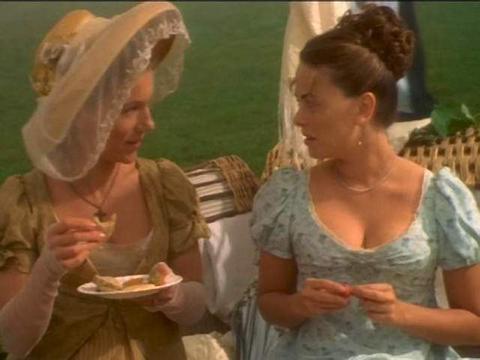
Miss Taylor's hat... sigh.  I mean, Mrs. Weston's hat.

I really liked Miss Taylor---er, Mrs. Weston.  Sorry.  She was so sweet and yet not above giving Mr. Elton the Gladys Gilford Glacial Glare when he refused to dance with Harriet. :) I think maybe some of Emma's penchant for matchmaking came from Miss Taylor's example... she was definitely scheming (albeit quietly) to get Emma and Frank together!


And her romance with Mr. Weston was such a sweet little subplot.  I loved watching the two of them together.

Really, I loved how all the people interact with each other in this beautiful film.  People are fascinating, IMHO, and there isn't a single boring character in Emma.  Everyone is so complex and yet perfectly normal.  Sort of.


Okay, so nobody's going to call Mr. Elton perfectly normal.  Eeeeh, he was so much fun.  I haven't seen Blake Ritson as Edmund Bertram and don't really want to, so I didn't have any problem seeing him as Mr. Elton.  He was hilarious: just the right mix of creepy, wacky and self-satisfied.  How wonderful that he got saddled with a wife who was just like him, only worse.

"Quite so.  And in Bath we would certainly
have announced dinner by now."
Yep, the snotty Mr. Elton deserved everything he got.  "That young man is so conceited, I am surprised he can stay on that horse."  Utter wit, only it didn't come from Mr. Elton.  It came from someone much, much more deserving of praise...

Mr. Knightley and the napkin had me in stitches. :)
I will NOT spend this entire post going on and on about Mr. Knightley.  I could.  But I won't.  I shall spare you the details of how I think he is the ultimate Jane Austen hero and save all that for my series on Period Drama Heroes (which I'll hopefully begin if I ever finish the Heroines series... whatever happened to that??).

Um.  Anyway.  Long sentence there.
"Brother and sister? No, indeed!"

I do want to see the Gwyneth Paltrow version of Emma, but I can't imagine Jeremy Northam holding a candle to Jonny Lee Miller's portrayal of Mr. Knightley.  Where Mr. Elton is pompous, fully aware of his handsome-ness, overbearing and selfish, Mr. Knightley is... well, knightly.  He epitomizes the perfect gentleman, and his rapport with Emma is beautiful to behold.


"Oh! it's beautiful!"
Speaking of which, the entire Crown Inn ball scene had me smiling and laughing and even getting a little misty-eyed the whole time.  I felt the way Emma looked when she came in and saw how beautifully it was decorated.  Mr. Knightley's gallantry in asking Harriet to dance... Mr. Elton's hilarious-yet-awful "I am an old married man" spiel... Frank Churchill's ridiculous bouncing about in "The Ship's Cook"... and Emma and Mr. Knightley's dance. The Last Dance.  

Sigh.

Did I mention I loved this movie?  I think I did.  

So, moving on to some of the other characters.  Frank Churchill, for instance.  Now, I know I'm going to incite some righteous indignation in all of you, but, well, there are times when I can't help liking Frank.  No, no, stop! I didn't mean it!  Put down the tomatoes!


No, but seriously, didn't you feel just a little sorry for him when he was remembering his childhood?  And won't you admit that he's at least a little bit charming?  And, after all, he did use Jane very ill (wow, I sound like Mrs. Bennet) but he did love her.  Of that I have no doubt.  Remember the whole brouhaha at Donwell when Frank came late to the strawberry party and had the big fight with Jane?  The whole reason behind the fight with Jane was that he didn't want her to go be a governess when he could easily provide for her! But... then, of course, Frank didn't have the chutzpah to just tell his aunt he was getting married.  As Melody said to me last week, "Frank Churchill is just one big BUT STILL."  I agree. :)

Emma's relationship with her father was also quite sweet.  Mr. Woodhouse might be a fuddy-duddy hypochondriac, but he genuinely loves Emma and it shows.  I love how this movie portrays the funny characters as humans, not just comic relief.  (Except for Mr. E., the caro sposo, of course.)


Miss Bates, for example.  I am anxious to see Sophie Thompson's funny portrayal of the character ("lovely, lovely lovely!") but I really liked how Tamsin Greig made me feel sorry for Miss Bates.  Though perhaps that wasn't exactly the way Austen wrote the character, still I enjoyed seeing a more sympathetic portrayal of the talkative spinster.


Of course there are a whole slew of other characters (Jane Fairfax, John and Isabella Knightley, all the little Knightleys, Mrs. Bates, Mr. Weston, &. &c.) but I don't have time to talk about them all, much as I would wish to.

No, instead I have to speed my way onward to... the last episode.  The wonderful, glorious, perfectly splenderiferous, rewind-it-three-times end.

The realization...
Emma's shock upon realizing that she loves Mr. Knightley is beautifully sweet.  The proposal (infamous Chapter 49!) is even better, and my happiness is capped by the fact that they left the "If I felt less I might be able to talk about it more" quote intact.  Emma's consternation over having to leave her father is touching, and Mr. Knightley's sacrifice of his beloved home in order to make Mr. Woodhouse happy leaves me sniffling a little.

Awwww...

My reaction to Mr. Knightley's surprise at the very end was much like Isabella's upon receiving Mr. Knightley's letter: "Oh... oh... OH!" *half-hysterical laughing/crying*


The seaside.  The end.

(All pictures except the first one are from this screencap page: http://rawr-caps.net/index.php?cat=71)

Friday, October 14, 2011

Period Drama Heroines #9: Emma Woodhouse

"People--their hopes, their dreams, their aspirations--there I am the expert."
~Emma Woodhouse, Emma (2009)

Emma is fascinating. As we all know, Jane Austen wrote of Emma, "I have created a heroine whom nobody but myself will much like." Far be it from me to dare to differ with Jane Austen, but... how could you help liking Emma?

The best word to describe Emma Woodhouse's personality would be vivacious. Emma is brimming with fun and lightheartedness,
bubbly mirth and optimism. She's sweet, entertaining, and delightfully, humorously meddlesome.

But Emma is not without her faults. In fact, Emma's entire story is about the development of her character. It's the only one of Jane Austen's novels to feature a character's name as its title--and that's not a mistake. Pride and Prejudice, Sense and Sensibility and Persuasion are all about those traits and how they're exemplified in the books' characters. Mansfield Park is about a specific place, a girl who grew up in that place and how it influenced her life. (Northanger Abbey is a little different. Maybe I'll write about Northanger Abbey in a later post. That is, if I can write a sensible post without gushing like a fan-girl over Henry Tilney.)

Romola Garai as Emma (2009)

Emma is, in short, about Emma. The book begins by telling us about Emma Woodhouse, who is handsome, clever and rich, and who has thus far gone through life with very little to distress or vex her. Jane Austen didn't waste any time in getting to the point about her heroine (unlike Leo Tolstoy, who allegedly didn't introduce the heroine into Anna Karenina until the thirtieth chapter). Emma is the focus of the story, and around Emma the first sentence revolves.

Back to what I was saying: Emma isn't perfect. From the very beginning, she shows herself to be thoughtless and even a little condescending in her treatment of her friends. She believes herself to know exactly what is best for everyone. In fact, she believes that she can find the perfect match for each one of her friends. I love the scene in the 2009 movie in which Emma's sister and Mr. Knightley's brother are getting married. (Emma, incidentally, predicted their marriage.) Mr. Knightley leans over the back of the pew and whispers to Emma, "Lucky guess." Emma raises an eyebrow and replies, "Nothing lucky about it. Just talent... and intuition."

Romola Garai as Emma (2009)

Emma definitely has a slight superiority complex, but she is genuinely interested in the well-being of her friends. She truly wants Harriet Smith to find a good match. When she advises Harriet against marrying Robert Martin because he isn't rich, she is displaying snobbishness, but she's also acting in what she thought were Harriet's best interests.


Louise Dylan and Romola Garai as Emma and Harriet Smith (2009)

"Well, look here. 'The wealth and pomp of kings.' Kings. What does that suggest?... Perhaps court. And 'the monarch of the seas.' Seas? Maybe a ship." (Emma, 2009)

Unfortunately, she carries all this a bit too far. "One day," Mr. Knightley reproves, "you will bitterly regret your meddling." But as yet, Emma doesn't regret her meddling. She greatly enjoys planning matches and getting involved in everything. I have to take a moment here to rave about Jane Austen's brilliance. Just listen to this passage from chapter nine. "She was sorry, but could not repent. On the contrary, her plans and proceedings were more and more justified, and endeared to her by the general appearances of the next few days." Does that not hit the nail of human nature on the head?


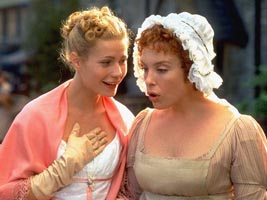
Gwyneth Paltrow and Toni Colette as Emma and Harriet (1996)

Emma's penchant for wit and humor endear her to many (including the reader) but, again, sometimes she carries it too far. At the Box Hill excursion, she thoughtlessly insults Miss Bates through trying to be funny. Cue the Mr. Knightley lecture. (Go, Mr. Knightley!) Emma doesn't stop to think about Miss Bates' feelings because Miss Bates doesn't fit into her little circle of friends. She isn't young or pretty or brilliant enough to meet with Emma's complete approval.

However, lest you think that I'm coming down too hard on Emma (I'm not, really I'm not! I'm just seeing a lot of myself in her), she is not unwilling to admit her faults once she finally realizes them. And it takes Mr. Knightley's rebuke to wake her up. "What have I done?" When she understands the full impact that her unkind words had on Miss Bates, she does everything she can to make amends.


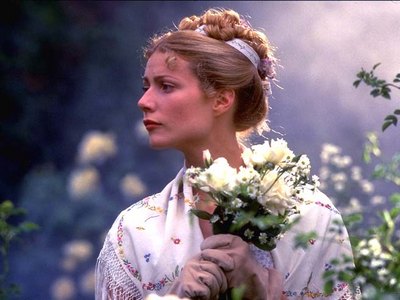
The lovely Gwyneth Paltrow as Emma (1996)

Emma doesn't realize that she's in love with Mr. Knightley until she realizes how much she doesn't deserve his love--as one of my friends pointed out, it's actually a parallel of our relationship with Christ. Once she finally comes to grips with her feelings, the meddlesome part of her personality begins to fade away. Mr. Knightley, the true hero of the novel, is the one who brings about Emma's change. His proposal to Emma, beautifully acted in the 2009 miniseries, is followed by Emma's best line in the whole movie. "I find I... do not know what to think." For once the verbose, witty and always-correct Miss Woodhouse is completely at a loss for thoughts as well as words.
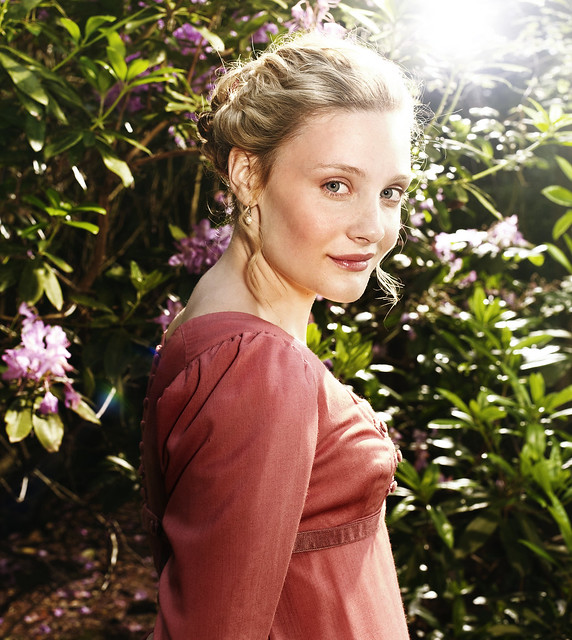
The just-as-lovely Romola Garai as Emma (2009)

But they don't live happily ever after quite yet. There is still the question of what will become of Mr. Woodhouse. Cue my second favorite Emma line in the 2009 movie: "You know I love you, and I always will. But we can never marry. That's all." Here is Emma's selflessness finally brought to light. It was hidden a little too long, but now each one of us can see it and admire her for it. She's willing to give up happiness with Mr. Knightley for the sake of her father--to paraphrase Mr. Knightley: "Well done, Emma."

(See the clip below for Emma's Selfless Scene--don't you just love the little hand-holding thing at the end? Have I mentioned how much I love Mr. Knightley?)


And that's my analysis of Emma Woodhouse. She's vivacious, she's funny, she's hasty, she's conceited, she's sweet, she's meddlesome, she's repentant, she's loving, she's delightful.

She's Emma.